I don’t do downtime…
Here is a thing that happened recently: my editor and I are in the middle of editing The Static, which means I am in that particular phase of the writing life where the manuscript exists but is not yet done and I am not allowed to touch it except in the specific ways I am allowed to touch it, and the rest of my brain is just sitting there, running, with nowhere to go.
The solution to this, obviously, is to start poking at something new.
So I poked. And I poked. And somewhere in the poking I spent an indeterminate number of hours in what I can only describe as a structural fever dream, and emerged on the other side with a twelve-clue mystery, a cozy dark genre identity, and a protagonist who is on her eleventh notebook and has been hearing dead people since she was seven years old.
Let me explain. Or actually, let me not explain and just report what happened, because explanation implies I had a plan and I did not have a plan.

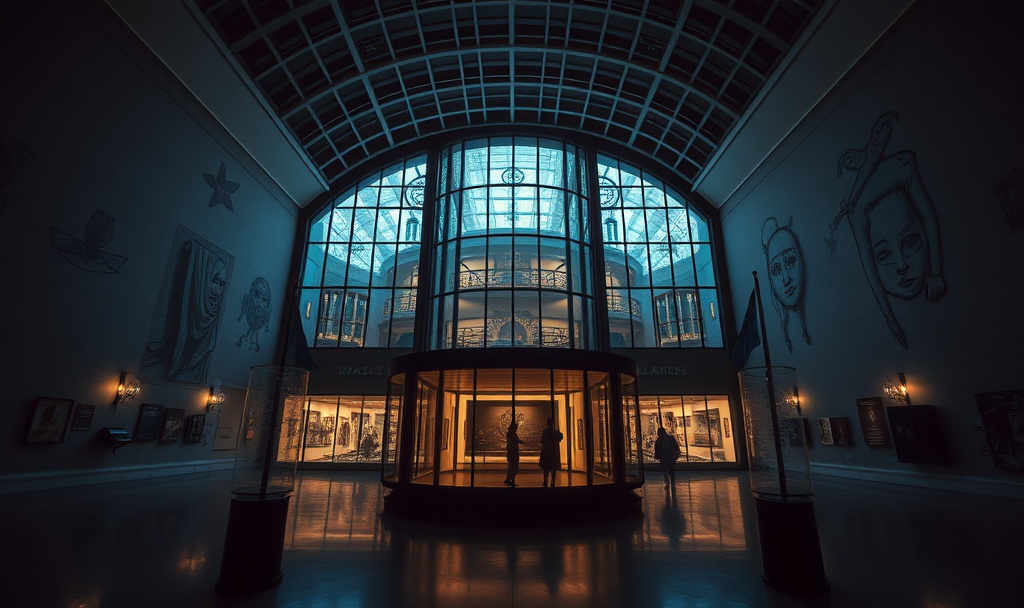
It started, as many things do, with a haunted museum.
The Museum of Ephemeral Arts is a real place in my head that houses things like Victorian Whistling Etiquette and the Evolution of Laughter, and is staffed by a collection of people I would describe as my found family if I weren’t the one who invented them, which I think still counts. The protagonist is Amelia “Mel” Jones, a museum guide who hears ghosts, which is either the best or worst possible job qualification depending on the day.
I had a premise. I had characters. I had, in the loosest possible sense, an outline.
What I did not have was: a coherent mystery structure, a clear understanding of what genre I was writing in, a defined romantic arc, or any explanation for why my protagonist had been hearing voices since childhood that didn’t just sort of trail off with a vague gesture.
So I did what any reasonable person does and started asking questions I didn’t have answers to yet.
Here is a partial list of things that got sorted out:
The ghost community went from three Victorian spirits to hundreds of trapped souls, because apparently I don’t do anything small. Some of them want to leave. Some of them are perfectly content. The 1940s jazz musician in the Forgotten Sounds wing has made his peace with the afterlife and would like everyone to stop making it complicated, and he became, without my fully intending this, the book’s Greek chorus and self-appointed romantic advisor.
The jester became a bard, which is a sentence I did not expect to write but which was absolutely the right call. He has been cursed to repeat a love story in the walls of the building for over a hundred years without ever reaching the ending. This is the central mystery. The mystery now has twelve clues, a wrongdoer with a coherent motive, and a wrong turn in Chapter 5 where Mel accuses the wrong man and has to cross out three pages of her notebook in a single heavy line, which is the most relatable thing I have ever written.
Erasmus Thorne, the museum’s dead founder, lives in the foundation with an ancient artifact called the Casket of Echoes and has been down there long enough to become genuinely malevolent, but in a cozy dark way, which is apparently a genre I am now writing in. He is described in the outline as weather before a storm and a cold intelligence that has been down there a very long time and is deciding how seriously to take her. I find this deeply satisfying.
The romantic lead, Harper, is a tech specialist who shows up with coffee at the exact right moment and listens with her whole body and keeps putting her hand on Mel’s arm slightly longer than necessary. There is a scene in Chapter 8 where Mel is sitting on the floor in the dark and Harper finds her and sits down without asking and their shoulders are touching and neither of them moves for a long time and both of them are entirely aware of that. This is the closest the book gets to saying it out loud. It does not say it out loud. This was a deliberate choice and I am very proud of it.
I also learned, in passing, that my novel is a paranormal cozy mystery with teeth, which is apparently a real genre that is sometimes called cozy dark and sits in a space being carved out by writers whose names I wrote down and then immediately forgot because I was busy adding clues.
The cozy mystery checklist I now have includes items like the protagonist makes at least one significant mistake before reaching the correct solution and dread that is real, not decorative, which is the most accurate description of my aesthetic I have ever encountered.
Mel, it turns out, has been hearing things since she was seven. She has a diagnosis. She has medication she sometimes takes. She is currently on notebook volume eleven. Volume one is in a box under her bed in handwriting that got neater across its pages as she understood that whatever she was doing, she was going to be doing it for a long time and she might as well be organized about it.
She took the job at the museum knowing what it was on day one.
I love her very much. She is not me. She is a little bit me.
The book ends with Mel sitting in the Whispering Wall exhibit after hours, in the silence where the bard’s story used to be, writing in her notebook. Something stirs from below — not distressed, not threatening, more like an acknowledgment. Something old and settled, noting her presence the way a cat watches from a high shelf.
She closes the notebook.
She writes nothing down about this one.
Not yet.
The Museum of Ephemeral Arts is coming. Eventually. When I have stopped building the infrastructure of it and started actually writing the thing, which I am told are different activities.
In the meantime: if you have ever been the only person in the room hearing something you couldn’t explain, and you developed an organizational system for it, and you took the job anyway — this book is for you.
Harlo
P.S. The jazz musician gets the last word in every chapter he appears in. I did not plan this. He simply takes it. I have chosen to respect it.

I so want to read this and can’t wait to follow the journey of its creation!
Thank you, I needed to see that today.