What Do You Want to Read?
I’ve been sitting on fragments lately. Little scenes that won’t leave me alone, that feel too alive to stay locked in my drafts folder but aren’t quite stories yet—not full arcs, not complete narratives, just these moments that grabbed me and wouldn’t let go until I wrote them down.
One of them is a drag king cozy mystery. Which, I know, is a very specific combination of things, but it felt right the moment I started writing it. It’s got the bones of a whodunit (amateur sleuth, locked dressing room, mysterious object) but it’s shot through with that paranormal current that always seems to find its way into my work, and there’s an ex-lover situation with actual chemistry that I couldn’t resist.
I’m curious what you think. Not “is this publishable” or “should I finish this”—I’m asking something different: **Do you want to read unfinished pieces like this? Do these fragments matter to you, or does your interest only kick in when something’s a complete story?**
Because I have more of these. Scene after scene that feel important, even if they’re not going anywhere official yet. And I’m wondering if there’s value in sharing them with you, if you’d like to see my brain working in real time instead of only the finished products.
Here’s what I’ve got. Tell me what you think.
The Lipstick Theory

The thing about working backstage at The Velvet Iris is that you start to understand which disasters are actually disasters and which ones are just theater people experiencing their own private apocalypse, which honestly, I’ve learned, is most of them. Lena came at me with this particular crisis at 8:47 p.m. on a Tuesday, which meant we had forty-five minutes to figure out if the universe was actually ending or if someone had just misplaced a box of makeup, and if you’ve worked with theater people you know that in their minds these are somehow the same thing.
“Sienna’s entire vintage makeup kit is gone,” Lena said, and she said it the way you’d say the building was on fire, which it wasn’t, though the air backstage did smell like a combination of sweat and electrical fire and that weird perfume-and-desperation smell that only exists in spaces where people are about to be looked at by strangers, and I mean *really* looked at.
I was taping down a cable that had been fraying for three weeks because we kept saying we’d fix it later and then later never came, which is basically the story of my entire life if I’m being honest. “Lena,” I said, straightening up and trying to remember what it felt like to care about things in the way Lena cared about things, which is to say: completely. “Will Sienna be able to perform without it?”
“Yes, but it was from the 1960s and it was irreplaceable and—”
“Then we don’t have a disaster. We have a Monday.” Which it wasn’t even, which maybe explains why I said that. I was tired. I’m always tired. It’s the job.
But here’s the thing: Lena said the door was locked. And I’ve been doing this long enough to know that locked doors backstage are like promises—everyone swears they exist until you need them.
Sienna’s dressing room was the kind of organized that makes you nervous about a person, the way a perfectly made bed on a Tuesday makes you wonder what they’re running from. Everything in its place. Wigs on stands like they were waiting for their owners to come back from the dead. The mirror surrounded by those harsh lights that show you everything about yourself that you’ve been trying not to see.
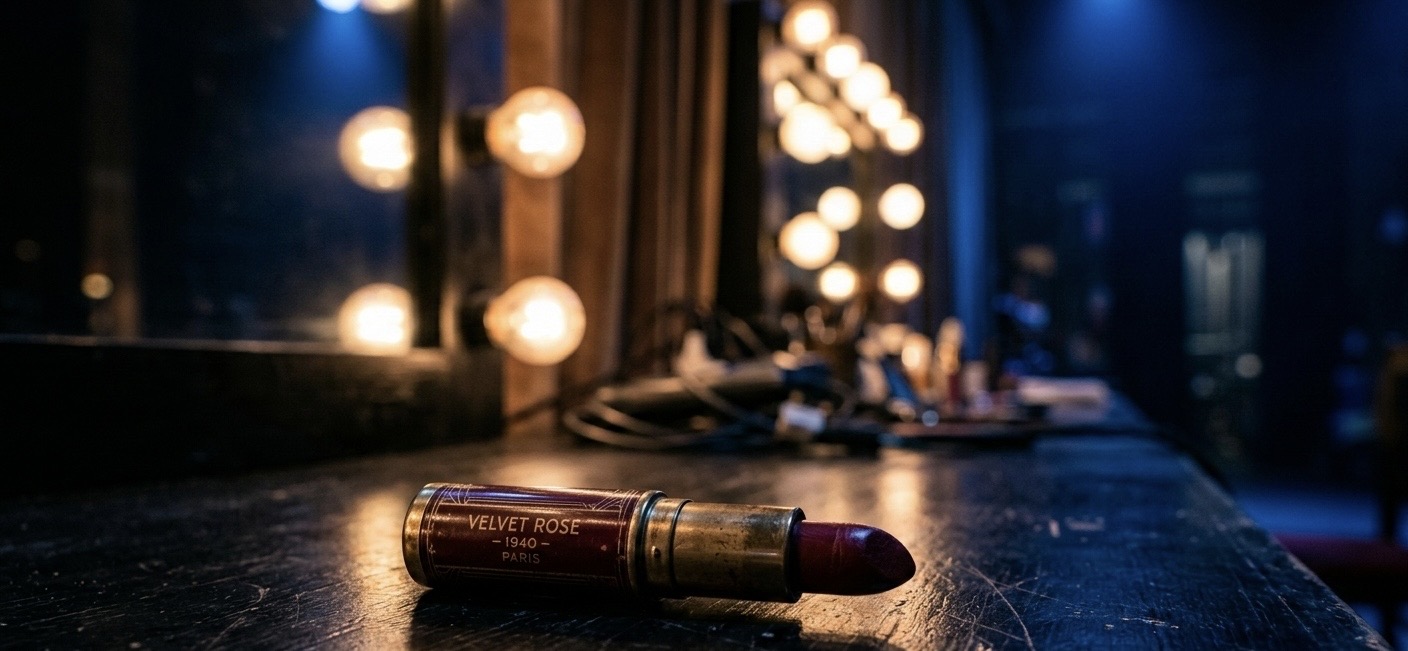
And on the vanity, in the middle of all that careful emptiness, was a single lipstick.
Not new. Old. The kind of old that has weight to it, that has traveled. The tube was cool in my hand—not room temperature, but actually *cool*, the way old things get when they’ve been somewhere dark for a long time. The label read *Moresca Rouge, 1947*, and the city of origin was in letters I couldn’t quite place, and I stood there holding this impossibly cold lipstick and thinking about how some mysteries announce themselves like that, just place themselves in your palm and wait to see what you’ll do about it.
Sienna came in behind me, already halfway into her King—the fitted blazer, the groomed facial hair, that particular kind of presence that only happens when someone has decided to become a more interesting version of themselves on purpose.
“That’s not mine,” she said.
“I figured.”
“Someone broke into my locked dressing room, stole my entire kit, and left a single vintage lipstick as a like, what? A calling card?” She laughed, but it was the kind of laugh people make when they’re standing at the edge of something they don’t understand. “That’s insane.”
“Maybe,” I said, and I was turning the lipstick over and over in my hands, watching the light move across it. “Or maybe they weren’t stealing anything. Maybe they were looking for something specific, didn’t find it, and left this to let you know they’d been here. To let you know they were looking.”
“For what?”
“I have no idea. But I’m going to find out.” I pocketed the lipstick before she could ask for it back, before I had to explain why I wasn’t showing it to anyone else, before I had to admit that I recognized the feeling of it, the weight of it, like a memory that hasn’t happened yet. “You’re going to go out there and you’re going to be magnificent. You’re going to walk on that stage and make people forget that anything in their lives is ordinary. That’s your job, and you’re good at it. My job is to handle the weird stuff that happens in the spaces you’re not looking at.”
She studied me for a second, and I could see her deciding whether to push, whether to ask the questions that sensible people ask when someone pockets evidence of a crime in their dressing room.
“Thank you,” she said finally.
“Don’t thank me yet.”
—
The office was in the basement, which is where all the worst decisions get made in spaces like this—too far from the light, too close to the actual infrastructure of things. I was going through the personnel files looking for anything that made sense when I heard the door open behind me, heard the particular way it moved because some people have a way of moving that your body remembers before your brain catches up, and I didn’t even have to turn around to know it was her.
“Cay.”
Sage. Five years, and she still said my name like it meant something. Like it meant *everything*. She was older—there was gray now at her temples that made her look like a person who’d learned something difficult—and she was wearing a suit that cost more than I made in a month, and she was looking at me the way she used to look at me when we were the kind of people who made sense together, which was briefly, which was intensely, which was in a way that I’ve spent five years trying to forget.
“What are you doing here?” I said, because I’m very good at asking the obvious questions when I’m trying not to ask the real ones, which would be things like: *Why do you still smell the same? Why do I suddenly remember what it felt like to want someone that badly?*
“I own the building now,” she said. Not defensively. Just a fact. “I bought it last month. I was going through the tenant agreements and—” She stopped. “You’re still here.”
“I work here.”
“I know. I—” She moved farther into the room, and it was like watching a change in light, the way everything shifted around her. “I wasn’t sure if you would be.”
“Well, I am. So.” I turned back to the files, because looking at Sage directly was the kind of thing that made you forget why you were angry, made you forget that there were actual reasons you’d spent five years practicing the art of not thinking about her. “There’s a break-in. Sienna’s dressing room. A makeup kit stolen, something left behind. A lipstick from 1947, and it’s—” I stopped. Because saying it out loud to her, of all people, made it sound like the kind of thing Sage would be interested in, and she *was* interested, she was always interested in the inexplicable things, the things that didn’t fit into regular categories.
“Show me,” she said.
“No.”
“Cay—”
“You don’t get to come back here after five years with a suit and gray hair and act like you have standing to ask me for anything.” I said it quietly, which is worse than saying it loud, because quiet is where the truth lives. “You sold the place. You disappeared. You made a choice.”
She was quiet for a moment, and I could feel her choosing her words the way she used to choose them when we were the kind of people who had to be careful about what we said to each other.
“I didn’t know how to stay,” she said finally. “I didn’t know how to be here and not be with you, and you made it clear that—”
“Don’t.” I held up my hand. “Don’t do this. Not now. Not with all of this.” I meant the lipstick in my pocket, the cold of it, the weight of it. I meant the mystery. But what I really meant was: *I can’t want you and investigate this at the same time, and the investigation is the only thing keeping me standing.*
She stepped closer, and the air between us did that thing it used to do, that thing where it became a tangible substance, a thing you could feel against your skin. “Is it the lipstick?” she asked, and her voice had changed, had become the voice she used when she was thinking about something unsolvable. “The one from 1947?”
“How did you—”
“Because I know who came here looking for it.” She was standing close enough now that I could see the line of her jaw, the way her hands moved when she was about to tell you something that was going to change things. “And because they left a message for me, not for Sienna. This is about me coming back. This is about something I thought I’d left behind.”
“Then you need to—”
“I need you to help me figure out what they want.” She said it like a question, like she was asking permission to let me back into whatever part of her life had been consuming her, the part that had made her leave in the first place. “I need—” She stopped herself. “I’m not asking you to forgive me. I’m asking you to help me with this.”
The lipstick in my pocket felt heavier than it should have, colder still. I could feel the exact moment I was about to say yes, the exact moment my body decided that wanting her and being angry at her could somehow coexist, could somehow be the same thing.
“Tell me everything,” I said. “And this time, you don’t get to leave out the parts that matter.”
She nodded, and when she reached for my hand I let her take it, and the contact was like touching a live wire, like touching something that had been waiting five years to recognize the specific shape of your palm.
“Her name is Ezra,” Sage said. “And she’s been dead for seventy-three years. Which is going to be a problem, because according to the message she left, she’s coming back tonight.”
What Happens Next?
I don’t know yet. And that’s the honest answer. Cay and Sage and Sienna and this lipstick from 1947 just showed up in my head and I followed them to this point, and then they went quiet.
But before I decide what to do with this—whether to keep going, shelve it, turn it into something bigger—I want to know: Does this format interest you? Unfinished scenes, real-time creative thoughts, the weird stuff that’s too good to waste but not ready for publication?
Or would you rather I only show up when I have complete, polished stories to share?
I’m genuinely asking. Comment below, hit reply, let me know what you think. And if you have questions about these characters or where I thought this was going, ask those too. I love talking about the almost-stories.
Until next time,
Harlo
