The Knights of Maenara Collective (2 of 10)

The bedroom door at the top of the stairs was locked, the antique brass knob refusing to turn under Nicola’s hand. She knocked once, twice, then harder when there was no response.
“Miss Broadchurch? Grace? I need my jacket. My phone’s in the pocket and I need to call this in.”
Silence. Not the silence of an empty room, but the silence of someone deliberately not answering. The silence of holding your breath and hoping the monster passes by your hiding place.
Nicola knocked again, harder. “Grace, this isn’t…”
A crash from inside. Glass breaking, something heavy hitting the floor. Then a scream that was sharp, genuine, terrified in a way that made Nicola’s cop instincts scream back.
She didn’t think. Stepped back, raised her boot, kicked the door just beside the lock. The frame splintered with a sound like breaking bones. Second kick and it flew open, slamming against the wall hard enough to leave a dent.
Inside the bedroom, moments before:
Grace had locked the door with hands that shook from adrenaline crash and fury and something else she couldn’t name. “Detective Knight, my ass,” she muttered, loud enough to hear her own voice, to confirm she was real and present and not dreaming this fever nightmare. “Storming in here like some self-righteous ghost hunter in discount leather, accusing me of lying about my assistant dying at the bottom of my fucking stairs.”
She yanked Nicola’s jacket off, planning to throw it, to fling it across the room like the accusation it represented, but paused. The leather was soft from years of wear, warm from Nicola’s body heat, heavy in a way that felt… substantial. Real. Anchoring.
Grace sank onto the chaise by the window, the jacket still in her hands. “The audacity,” she said to the empty room. “The sheer theatrical audacity of that woman, standing in my house, my house that I bought with my own money from my own book sales, telling me I don’t know the difference between fiction and reality.”
She flopped back dramatically, one arm flung across her brow like a Victorian lady with the vapors. “I write fantasy for a living and even I wouldn’t have the nerve to write that scene. Too unrealistic. Editor would mark it up with ‘motivations unclear’ and ‘character behavior inconsistent.’”
But those eyes. Honey-colored and haunted and somehow familiar, like she’d seen them before in dreams or photographs or painted on the walls of caves where humans first learned to make permanent marks. Grace hadn’t planned to stay in this house. It had come up during a 1 a.m. Zillow spiral fueled by wine and writer’s block, sandwiched between listings for “authentic plantation experience” and “fixer-upper with character (please ignore the mold).” The photos had shown something grimy and crumbling, thick with Louisiana summer and secrets. The floors slanted like they’d bowed under the weight of too many confessions. The walls were water-stained. The garden was a jungle.
But there had been something in the listing description, “historical home, local family, extensive original features,” that caught her attention and wouldn’t let go. She’d googled “families of New Orleans” at 2 a.m. and fallen down a rabbit hole that lasted until dawn: newspaper archives about disappearances, obituaries that listed cause of death as “unknown” or “natural causes” when the deceased was twenty-three, court transcripts from property disputes and competency hearings.
She’d bought the house during a video walkthrough, never even visited in person. Her agent had called her insane. Her editor had suggested therapy. Her ex-girlfriend had sent a text that just said “this is why we broke up” with no further explanation.
But Grace had known, in that way you know things sometimes, that she needed to be here. That there was a story in these walls, buried in the foundation like bodies in concrete. She’d dug in deep once she arrived: newspaper archives read in bed until her eyes burned, occult clippings folded into church bulletins, a child’s diary in the attic that ended with a drawing of a moon and three words in crayon: ‘don’t look up.’
She’d asked around town, carefully at first, feeling out who would talk and who would clam up. Most people got quiet when she mentioned the Knights, changed the subject, remembered they had somewhere else to be. “Odd family,” one old man had said, looking past her shoulder at something that wasn’t there. “Half of ‘em gone before their time. Other half worse off for staying.”
But one librarian, young, brave, probably too curious for her own good, had handed Grace a folder like it might burst into flames. Inside: yellowed clippings, blurred photos, a teenage girl with Nicola’s exact eyes staring out from decades past. Someone had scrawled across one caption in red ink that looked disturbingly like dried blood: Knight of Maenara.
Grace still didn’t know what it meant. The research had led nowhere solid, just fragments: references in out-of-print folklore collections, a mention in a Catholic diocese record from 1847 about “unholy practices in the Knight household,” a police report from 1952 about a missing woman last seen entering the Knight property and never emerging.
She’d meant to keep digging. Really, she had. But then her publisher called about her vampire novel, Blood Courts, three years of work, finally getting the promotional push it deserved. She’d pivoted to interviews and book tours and pretending to care about questions like “where do you get your ideas?” when the real answer was “from houses like this, from stories people are afraid to tell, from history written in blood and buried under floorboards.”
“No villain in your book,” her editor had noted during their last call. “That’s unusual for the genre. Who’s the antagonist?”
“Longing,” Grace had answered. “Loss. The thing that happens when you love something so much it eats you from the inside and you let it because the alternative is not loving at all.”
Now the ghost was flesh and leather and standing in her house with honey-colored eyes that saw too much. The last Knight. The one who got away, except maybe she hadn’t, not really, not if she’d come back.
Grace sat up, pulling the jacket into her lap. Still warm. Still holding the shape of Nicola’s shoulders, the curve of her spine. She brought it to her face and breathed, vanilla and motor oil and something darker, earthier. Old wood and older earth. Smoke from fires that burned before anyone thought to record their burning.
And underneath it all: blood. Just a trace, but unmistakable. Copper and salt and something that made the back of Grace’s throat itch.
She slipped the jacket on properly this time, sliding her arms into sleeves that hung past her fingertips, drowning in fabric and scent and borrowed warmth. It had been so long since she’d been close enough to someone to know their smell this intimately, to wear their clothes, to feel this particular kind of warmth that was more than temperature.
Her last girlfriend had been three years ago, Professor Katherine Mills, medieval literature, specialty in courtly love and the erotics of denial. She’d left Grace for someone “less obsessed with dead things” and “more present in the actual world.” They’d screamed at each other in a coffee shop, Kate throwing her thesis about Grace being “in love with absence” and “addicted to ghosts” like accusations instead of accurate observations.
Grace wrapped her arms around herself, the jacket creating a cocoon of borrowed presence. She remembered the way Nicola had draped it over her shoulders, the casual intimacy of the gesture, fingers brushing her collarbone, the moment they’d both frozen like they’d touched something electric.
The house creaked around her, old wood settling, temperature shifting, normal sounds that she’d learned to ignore over six months of living here. Except.
The creak wasn’t from the usual places. Not the hallway floorboards that groaned under her weight. Not the stairs that sang different notes depending on where you stepped. This came from inside the room. From the wall beside the bed where the wardrobe stood like a lurking shadow.
Grace went still, every sense suddenly sharp. She’d locked the door. She’d heard the bolt slide home. She was alone in here.
Except she wasn’t.
The air had changed, thicker, charged, pressing in from all sides like the room had inhaled and decided not to exhale. Not just wrong. Intentional. Something was watching her with attention that had weight and texture.
Grace rose slowly from the chaise, every muscle tense, flight instincts screaming at her to run for the door, to scream for help, to do anything except stand here wrapped in a borrowed jacket waiting for something to happen. Her heartbeat thudded in her chest, not fast, but deep and hard, like it was trying to break out, like it knew something her brain hadn’t caught up to yet. The wound on her neck from the attack throbbed in time with her pulse.
She glanced toward the door, locked, solid, between her and escape, then to the mirror over the dresser, half-expecting to see a face behind her shoulder, eyes in the reflection that didn’t belong to any body in the room.
Nothing. Just her own face, pale and wide-eyed, drowning in leather three sizes too big.
But her skin prickled with certainty: the house wasn’t empty. Something was here with her, had been here waiting, maybe had been here all along and she was only now noticing because the house wanted her to notice.
Grace moved toward the door, one careful step at a time, her hand trailing along the wall for balance or grounding or just to touch something solid and real. She was three steps away when she heard it: the whisper of fabric behind her, the soft brush of cloth on wood.
Too close. Right behind her.
She spun… The bed curtains exploded outward like lungs exhaling after holding breath too long. A figure emerged from the shadows behind the heavy fabric, unfolding from darkness like darkness itself had grown limbs and hunger and purpose. Male. Gaunt. Fast. Wrong in ways that made her hindbrain scream predator, made her lizard brain try to shut down higher functions and just run.
Grace had half a second to register movement before she was slammed backward into the door hard enough to rattle her teeth, to knock the air from her lungs in a wheezing gasp. Nicola’s phone slipped from the jacket pocket and clattered to the floor face-down, screen cracking on impact.
He was already pressing something against her lips. It was a bottle, small and green, ornate glass that belonged in a museum or a fever dream. The scent hit first, overwhelming, invasive: blood yes, but altered, spiced and tainted like wine left too long in a crypt until it turned to something else entirely.
Grace twisted, shoved against his chest with both hands, kicked once, twice, her bare heel connecting with shin bone hard enough to hurt. He barely registered the impacts, didn’t even grunt. She fought like someone with something to prove, like every self-defense class and righteous fury could compensate for the fact that he was stronger, faster, other.
He pinned her with one arm, casual, effortless, like she weighed nothing, and forced the bottle between her lips, tilted it, poured.
Blood flooded her mouth. Rich, thick, wrong on every level biology understood. Her stomach lurched. Her body screamed in confusion, every instinct firing at once: poison, wrong, death, spit it out, swallow it, flee, fight, freeze…
She gagged, choked, blood spilling down her chin, soaking into the jacket collar. Tried to spit but he held her jaw, forcing it down her throat like medicine, like sacrament, like something that would save or damn her and she didn’t know which.
Grace clawed at his face. One nail raked across his cheek, drawing a line of blood that looked black in the dim light. He hissed, sounded like steam escaping under pressure, like something boiling over, but didn’t stop.
He shoved her toward the bed. Her limbs flailed, tangled in sheets and the oversized jacket. The bottle slipped from his grip, spilling its contents across the quilt, across her throat, down her chest in sticky rivers.
Nicola’s jacket soaked it in like a sponge, leather darkening, blood spreading through seams and creases and becoming part of the fabric’s history.
Grace screamed. Finally screamed fully terror and rage and denial all compressed into sound.
Outside in the hallway….
Nicola froze mid-step, mid-breath, mid-thought. She smelled it before she heard it: blood, fresh and mixed with something else that made the scar on her collarbone ignite like someone had pressed hot iron to bare skin.
Gun drawn. Door locked. No time for procedure or backup or rational thought.
One kick. The frame shattered like it was made of paper, like the house had been waiting for an excuse to let her in.
Nicola burst through in a blur of motion and training and instinct older than training.
Grace on the bed, blood everywhere, on her face, her throat, her chest, soaking into the jacket that Nicola had worn for fifteen years through a dozen states and a hundred crime scenes. A man straddling her, eyes glowing an unnatural green that didn’t exist in human biology, mouth too wide, too red, teeth too sharp when he turned toward the door.
Nicola didn’t think. Thinking was for later, for reports and justifications and nights when sleep wouldn’t come. Now was for movement.
She tackled him shoulder-first with enough force to lift him off Grace, to drive him backward into the wall hard enough to crack plaster. They hit in a tangle of limbs and momentum, the impact rattling windows in their frames.
He rose like water recoiling from stone, too fast, too fluid, physics operating under different rules for his body than for hers. He spun, kicked her gun. It skittered across hardwood and disappeared under the dresser with a sound like mocking laughter.
Then his fists. One caught her jaw, snapping her head sideways. One across her cheekbone, right over old scar from a bar fight in Georgia that she had barely won. Stars exploded across her vision, white-hot pain flaring through her skull.
The world swam, edges blurring like watercolors left in rain. Nicola staggered but didn’t go down, her grandfather had taught her how to take a hit, how to absorb impact and convert it to momentum, how to stay upright when your body wanted to fold.
He leaned in close, sniffing like an animal scenting prey, like a dog deciding whether something was food or threat. His breath smelled like earth and rot and something older, funeral flowers left too long in standing water.
Then he touched her bleeding cheek with one finger, almost gentle, curious. Brought it to his mouth. Then licked.
His expression changed, confusion rippling across features that were too sharp, too angular, like someone had carved a face from memory instead of looking at an actual human, then something like recognition. Pupils dilating until the green almost disappeared into black. He stared at her, head tilted at an angle that made her neck ache in sympathy, studying her like she was a puzzle he’d been trying to solve for years and had just found the missing piece.
Nicola’s breath hitched, caught somewhere between her lungs and her throat. The scar on her collarbone burned so hot she expected to smell her own flesh cooking.
Footsteps thundered up the stairs, heavy boots, multiple sets, Warren’s voice shouting orders that echoed through the house like prayers in a cathedral. The man heard it, head snapping toward the sound with predator alertness. He turned back to Nicola one last time, something almost apologetic in those impossible green eyes, then pivoted toward the window.
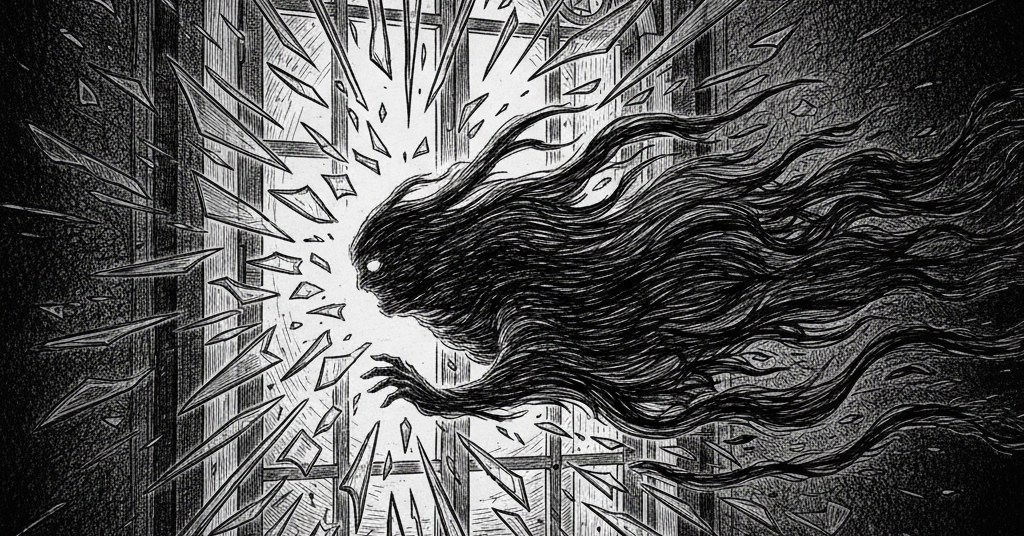
He didn’t run. He flowed, movement too smooth to be running, too purposeful to be fleeing. Hit the window without slowing, glass shattering outward in a spray of moonlight and sharp edges. Disappeared into darkness like smoke dissolving, like he’d never been solid in the first place.
Nicola staggered to the windowsill, her vision swimming, blood dripping from her chin to spatter on worn floorboards. Nothing outside but shingles and moonlight and the garden below, plants moving in wind that didn’t exist. No footprints in the soft earth. No sign anyone had been there at all.
Behind her, the room exploded with noise. Warren and uniforms and voices and flashlights cutting through chaos like knives. Someone was shouting about perimeter breach. Someone else calling for a medic. Radio chatter crackling about subject last seen heading east.
Grace sat up on the bed slowly, moving like her body wasn’t quite connected to her brain anymore, like she was operating on a three-second delay. Blood covered her face, her throat, the bandage torn loose and hanging by one piece of tape. The green bottle lay near her hip, still rolling slightly, catching light and throwing it back in colors that shouldn’t exist in glass.
Nicola slid down the wall to sit on the floor, her back against plaster that was warm, too warm, like the house had fever. Her jaw felt broken. Her ribs burned. Something was wrong with her vision, the left eye refusing to focus properly.
Grace crawled to her across blood-soaked sheets, dropping to the floor with a thud that made Nicola wince in sympathy. “Your face,” she said, voice rough from screaming. “Jesus Christ, your face.” She reached out with trembling fingers to touch Nicola’s temple where blood was matting into her hair.
Nicola tried to smile, felt it come out more like a grimace. “I’m fine.” Her voice sounded wrong, thick and slurred like she’d had too much whiskey. She wasn’t fine. The room was tilting, or she was tilting, one or the other. Couldn’t quite tell.
Grace pushed to her feet, stumbled to the dresser, yanked open a drawer and grabbed a t-shirt, soft cotton, well-worn. She came back, knelt beside Nicola, tried to press it to the worst cuts. Nicola’s hands shook too badly to help, fingers twitching with adrenaline crash and probable concussion. Grace took over, one hand cupping Nicola’s jaw with surprising gentleness, tilting her face up, wiping blood with careful precision.
“Hold still, Detective,” Grace murmured, focused on her task. “Don’t bleed all over my hardwood. It’s original 1920s heart pine. Irreplaceable.”
A drop of Nicola’s blood hit the floor despite Grace’s efforts. Dark red, almost black in the weird light.
The house exhaled.
Not metaphorically. Not imagined. The walls rippled like water disturbed by something moving beneath the surface. The air thickened, pressed in from all sides, pressure building in Nicola’s ears until they popped. A sound, not quite voice, not quite wind, not quite anything that should exist, whispered through the room, through the walls, through the bones of the house itself.
“Maenara.” Then stillness. Absolute. Complete. Like the moment between lightning and thunder, between heartbeats, between breaths when you’re not sure if there will be another one. The word hung in the air like smoke, like something solid enough to touch if you were brave enough or stupid enough to try.
Grace and Nicola both froze, not looking at each other, barely breathing, waiting for whatever came next. Nothing came. The room snapped back to normal, or normal adjacent, normal’s weird cousin who showed up uninvited to family gatherings and made everyone uncomfortable. Blood on the floor, glass on the hardwood, torn curtains moving in breeze from the shattered window.
Warren appeared in the doorway, gun drawn, eyes wide. “What the hell was that?”
Neither woman answered. Couldn’t answer. Didn’t have words for what had just happened because language hadn’t evolved for this, hadn’t developed vocabulary for houses that knew your name before you knew theirs.
The medic arrived thirty seconds later, young guy, paramedic patch on his shoulder, trauma kit in hand, the kind of calm competence that came from years of seeing terrible things and learning not to flinch.
“Who’s hurt worst?” he asked, already pulling on gloves with practiced efficiency.
Warren gestured to Nicola, half-slumped against the wall like a puppet with cut strings, blood running from split lip and a bruise blooming across her cheekbone in shades of purple that would be impressive tomorrow. “Start with her. She tangoed with whatever that was.”
The medic crouched beside Nicola, speaking in that clipped, too-calm tone professionals use when they’re assessing damage and don’t want to cause panic. “Can you look at me? Follow my finger.” He pulled a penlight, flashed it across her pupils. “You take a hit to the head?”
“Some,” Nicola muttered, her voice thick. “Maybe more than some.”
“Left pupil sluggish. Right pupil reactive but delayed. Classic concussion signs, maybe worse. Any nausea? Dizziness? Ringing in your ears?”
“All of the above. It’s a party in here.”
“Yeah, you’re done for tonight. Probably tomorrow too. You need a CT scan, observation, the works.”
“Can’t. Crime scene. Witness.” Nicola tried to stand, made it about six inches before her legs informed her brain that standing was no longer in their job description. She sat back down hard.
The medic put a hand on her shoulder, gentle but firm. “Detective, with all due respect, you can barely sit upright.”
Behind him, Grace stood with arms crossed, still wearing the blood-soaked jacket, her expression half-defiant, half-shaken, all stubborn. She hadn’t moved far from Nicola, Nicola noticed through her swimming vision. Had stayed close like she was guarding something or needed guarding herself.
“What about you?” Warren asked Grace, his tone shifting to something almost gentle, which was unsettling because Warren didn’t do gentle. “You injured?”
“Bloodied. Bruised. Existentially traumatized.” Grace touched her throat where the bandage had torn loose, fingers coming away red. “But functional. More functional than her.” She nodded toward Nicola.
The medic glanced at her, doing a visual assessment. “You sure? That neck wound looks…”
“It’s from earlier. The first attack. This was…” Grace gestured vaguely at the room, at the blood, at the impossibility of explaining what had just happened. “Different blood. Not all mine. Some of it’s Detective Knight’s. Some of it’s from the bottle.” She picked up the green glass carefully, like it might bite. “He forced me to drink this. Some kind of blood.”
Warren took the bottle from her with a handkerchief, holding it up to the light. The liquid inside, what was left, gleamed dark red with undertones of green, like it was reflecting light that wasn’t there. “We’ll get this to the lab. See what the hell it is.”
His phone rang. He answered with one hand, still holding the bottle with the other. “Warren.” Pause. “Yes, sir. She’s here. Concussed. Medic says she needs…” Another pause, longer. Warren’s expression shifted, eyebrows rising. “You sure that’s…? Yes, sir. Understood.”
He ended the call, looked between the two women with something that might have been sympathy or might have been relief that this was someone else’s problem now. “That was Chief Oakley. Hotels in the city are jammed, convention season, weather delays, you name it. He wants Miss Broadchurch to take Detective Knight back to her place.”
Grace blinked. “Excuse me?”
“Knight’s warehouse. Out on Salt Row.” Warren’s voice was matter-of-fact, like he was giving directions to the grocery store instead of ordering a civilian to babysit a concussed detective. “Remote enough to keep you both off the radar until we sort this mess. Press is already circling. Someone leaked the Knight family angle, and now it’s going to be a media feeding frenzy.”
“I’m not…” Grace started.
“…equipped for this, I know. But Oakley doesn’t trust the precinct right now. Word’s leaking too fast, from too high up. Could be press infiltration, could be something else. Either way, safer if you two disappear while we clean house.”
He looked at Nicola, who was trying very hard to focus on his face and not succeeding. “You good with that, Knight?”
Nicola nodded slowly, each movement of her head causing new waves of pain and nausea. “Yeah. Can handle it.” She didn’t specify what ‘it’ was, the concussion, the case, the woman who smelled like gardenia and questions Nicola didn’t want to answer.
The medic finished bandaging her hand, the cut from the broken key had opened completely, would need stitches eventually but could wait for now and wrapped gauze around her split knuckles. “Ice for the face, rest for the brain, hospital if symptoms worsen. You know the drill.”
He stood, packing up his kit. “I’m supposed to recommend immediate ER visit, but something tells me you won’t listen anyway.”
“You tell Oakley you recommended it, and I’ll confirm I ignored you. Story of our professional relationship.” Nicola tried to stand again, more successfully this time. The room spun but stayed relatively stable. Progress.
Warren was already moving toward the door, coordinating with officers via radio. “I’ll have a unit do perimeter checks every hour. But whatever that thing was…” He paused at the threshold, looking back at the shattered window. “…it’s gone. For now.”
Nicola didn’t answer. She knew better. Whatever had come for them wasn’t done. It had tasted her blood and paused, recognized something. That was worse than if it had just tried to kill her. Recognition meant history. History meant it would come back to finish whatever conversation they’d started.
And now she was going back to the warehouse, the place she’d been running from for three years, the place where Ellie’s ghost lived in the walls and plants and every carefully repurposed piece of industrial salvage.
The place where her blood on the threshold had woken something that whispered.
Grace helped Nicola down the stairs, one careful step at a time, Nicola’s arm around Grace’s shoulders, Grace’s arm around Nicola’s waist. Both women were covered in blood: Grace’s, Nicola’s, Derek’s, the thing from the bottle. They moved like soldiers after battle, like survivors of something that shouldn’t have been survivable.
The house watched them go. Silent, patient, knowing. The garden breathed in moonlight, roots drinking deep from soil that remembered everything and forgot nothing.
Somewhere in the dark, out past the garden, past the cypress tree, past the place where Nicola’s grandmother was buried under Spanish moss and promises, something followed. Not close enough to see. The Thief Moon hung overhead, swollen and satisfied, stealing light from stars and time from people who thought they had more of it than they did. It had chosen who to take tonight. All that remained was watching how long they fought before they accepted the theft.
Grace looked up at it once before helping Nicola into the car, an old two-seater that looked like it had stories and wasn’t telling. “That moon’s wrong,” she said quietly.
“Yeah,” Nicola agreed, her voice rough with pain and exhaustion and resignation. “It’s a thief. Grandmother used to say it steals people. Time. Choices.”
“What did it steal tonight?”
Nicola was quiet for a long moment, watching the house recede in the side mirror as Grace pulled onto the road. “Don’t know yet. But it’ll come collect eventually. They always do.”
Grace didn’t ask who ‘they’ were. Didn’t ask why Nicola’s blood had made the house whisper. Didn’t ask about Maenara or bloodlines or any of the thousand questions burning in her writer’s brain. There would be time for that. Later. When they weren’t both covered in blood and shaking with adrenaline crash and heading toward a warehouse that had its own ghosts waiting.
The road unwound before them, dark and winding, lined with trees that leaned in like they were listening. Moss hung from branches like wedding veils or funeral shrouds, depending on how you looked at them. Behind them, the Knight house stood silent under stolen moonlight, waiting. It had waited before. It could wait again. It had all the time in the world, and the Knights always came back eventually.
They always came home.

