The Knights of Maenara Collective (1 of 10)

Her car sat in the side lot where she’d left it years ago, covered in dust and Spanish moss and time: a rebuilt Honda Del Sol she’d named Rougarou after the Cajun werewolf that ran through sugarcane fields and ate children who misbehaved. Compact, quick, painted midnight blue with rust patches she’d never quite buffed out because they gave it character. The kind of car that looked like it had stories and wasn’t telling, that had seen things and kept them close.
She slid behind the wheel and the engine turned over with a growl that said it was offended by the neglect but willing to forgive. The leather seats still smelled faintly of Ellie’s lavender hand lotion, that specific scent she’d ordered from a woman in Oregon who made small batches and infused them with intention. The smell hit Nicola like a punch to the throat, stealing breath and reason.
As she pulled onto the road, gravel crunching under tires, the moon rose above the tree line, hanging low like it had stolen something precious from the sun and meant to keep it, meant to hoard it close and secret. La Lune Voleuse.(The Thief Moon.)
Her grandmother’s voice surfaced from memory like a body from deep water, thick with absolute warning: “Three keys to the blood, my love: the moon that steals, the word that breaks, and the bone that remembers. You see the first, you watch for the others. They never come alone. Maybe that’s the point. The moon doesn’t just steal light, no. It steals people. Time. Choices. And tonight…” Her grandmother would pause here, crossing herself despite not being Catholic, despite whatever faith she actually held being older and stranger. “Tonight, it has chosen who to take. All we can do is watch and remember.”
Nicola’s hands tightened on the wheel until her knuckles went white as the moon overhead, until her cut palm throbbed in time with her heartbeat.
The Thief Moon only rose during certain seasons, certain alignments of planets and tides and things that moved in patterns too large for human comprehension. Her grandmother had said it marked nights when the veil between worlds grew thin as tissue paper, when old debts came due like loans called in, when blood called to blood across distances that couldn’t be measured in miles.
Nicola drove faster, pushing Rougarou hard, the engine whining in protest.
The road bent through cane fields and waterlogged earth black as pitch, the same route she’d taken summers as a girl riding in the bed of her grandfather’s truck, hair whipping in wind that smelled like rain and growing things. Her hands knew when to slow for the blind curve where three people had died over the years, knew how to swerve around the dip near the ditch where water moccasins sunned themselves on logs that looked like crocodiles in certain light.
She’d learned her mother had sold the farmhouse from a lawyer’s letter forwarded three times, following her from precinct to precinct like a curse. No phone call, no warning, no “I thought you should know.” Just paperwork and a check for half the sale price that Nicola never cashed, that still sat in a drawer somewhere.
“After the war, we needed a place that wouldn’t bite back,” her grandfather used to say, sitting under the cypress tree every evening without fail, pipe in hand, smoke curling around his weathered face. He’d watch the sky like it was scripture written fresh each sunset, reading meanings in cloud formations and bird flight.
In the silence he said, “Your grandmother stepped barefoot onto this field the first day we saw it, before we’d even talked to the realtor, and pricked her thumb on a fence post. Didn’t even flinch. Said it was a gift for the land, an introduction. Said politeness matters when you’re asking permission to stay.”
The birds had hushed that day, her grandfather told the story. The wind had stilled. Everything waiting to see what would happen next.
“You don’t argue with a woman who hears trees talking,” he’d add with a crooked smile, eyes crinkling at the corners. “That’s how you stay married sixty years. That’s how you stay alive.”
And years later, decades after her grandmother had died and been buried under that same cypress tree, Ellie had knelt in that same dirt wearing cutoff shorts and Nicola’s old t-shirt, murmuring to understory plants like they were lovers she was trying to seduce. Different magic than her grandmother’s, softer but no less potent. Ellie didn’t charm or cast spells or draw sigils in salt. She noticed. She paid attention. She listened. That was her gift, and it was rarer than any other magic Nicola had ever seen.
Nicola pushed the memories down hard, swallowed them like pills that wouldn’t dissolve, and focused on the road unreeling before her like ribbon cut from darkness itself.
She passed the front entrance without slowing, without even glancing at the new mailbox. A news van was parked at the gate, satellite dish extended like an antenna searching for signals from dying stars. Uniformed officers were keeping them at the road, a good fifty yards from the house. Flashbulbs still popped in the distance, creating brief moments of artificial day. A reporter barked into a mic, silhouetted against patrol vehicles whose lights painted everything in rotating red and blue, the colors of emergency and endings. Nicola kept driving, turning instead onto the old maintenance path now half-swallowed by overgrowth and blackberry brambles reaching for her car like hands.
The land opened suddenly, like curtains pulled back on a stage. And there, where the field dipped near what had once been a pond and was now just a depression filled with cattails and secrets, stood the cypress tree. Older than the house by centuries. Older than any structure in the parish. Maybe older than the dirt itself, her grandfather used to say, planted when the world was still deciding what shape to take.
She killed the engine and stepped out into air that felt wrong, too thick, too warm, charged with something that made the hair on her arms stand straight. She moved toward the tree slowly, boots sinking slightly in damp grass, making soft sounds like whispered warnings. Her hand reached out, hesitated, then touched bark rough as shark skin. She paused, fingers exploring grooves deep as old grief, channels worn by decades of rain, sun, and time. The tree smelled like rain that hadn’t arrived yet, like ozone and memory and things that refuse to die properly.
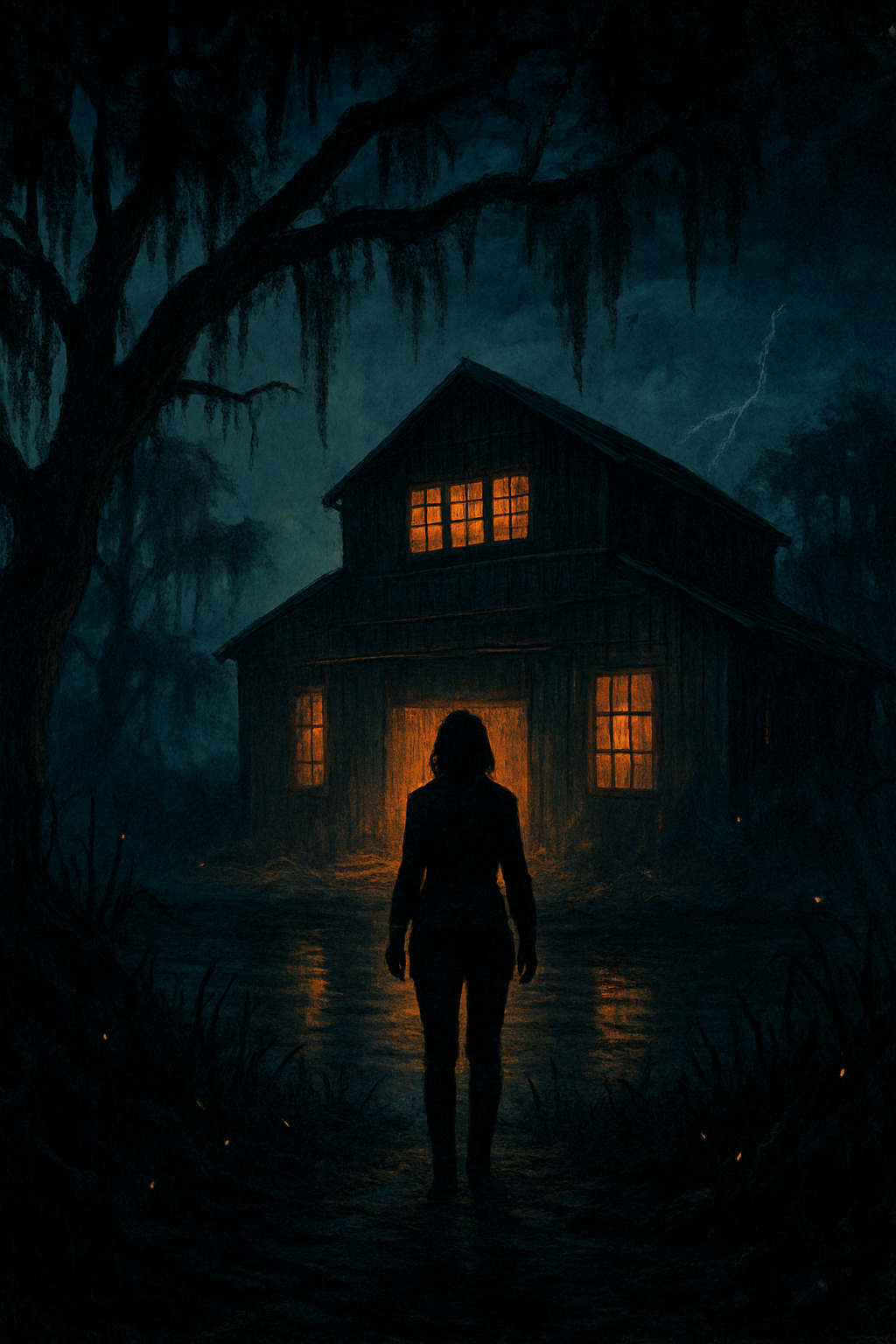
Behind the barn, leaning now, its red paint peeling in long strips like sunburned skin, the garden came into view. And it was wrong. Fundamentally, impossibly wrong.
She hadn’t set foot here since the funeral, since they’d scattered some of Ellie’s ashes in the soil she’d loved. It had been wild then, grief-struck and overgrown, plants going to seed and spreading chaos. Now it was immaculate. The paths were clear, swept clean as temple floors. The beds were lush beyond reason. Basil in full bloom though it was November. Angelica arching six feet tall without any heat stress, its white flowers perfect as carved ivory. A rosemary bush six feet tall, fat with purple-blue blossoms that should have withered weeks ago.
It smelled like sugar crystallizing in humid air, like rot sweetened with honey, like lavender crushed between fingers until it released all its oil at once. No one should have been tending this. The property had been sold six months ago according to Del, sat empty during renovations while lawyers argued over permits. Yet someone had been here. Recently. The soil was freshly turned, still dark with moisture that gleamed like blood in the moonlight, still holding the shape of careful hands.
She stepped carefully between rows, trying not to disturb anything, though everything felt already disturbed in ways she couldn’t name. Something skittered under leaves, quick movement, too fast to identify. Rat or snake or something else that preferred darkness.
Then she saw it, half-hidden beneath a sprawl of white-flowered mugwort: a small marker, no bigger than a matchbook. Clay or bone, she couldn’t tell in this light, but carved with symbols that made her scar pulse hot. Her blood went cold despite the humid air that clung to her skin like wet cloth. The scar at her collarbone began to itch, then burn, then scream. This wasn’t neglect growing wild. This was cultivation. Intention. Purpose.
Someone had been keeping the garden alive, feeding it and tending it and speaking to it in whatever language plants understood.
Before she could reach for the marker, before she could crouch and examine it properly, a voice shattered the stillness like a brick through glass.
“Goddamn mud trying to eat my boots.”
Nicola spun upright, heart slamming against her ribs like something caged and desperate, hand going automatically to her weapon.
An officer stood at the garden’s edge, mid-thirties and miserable, face shining with sweat despite the evening hour. His flashlight beam scanned the rows mechanically, missing everything important. His boots were caked with black soil that looked like it had texture, like it might move if you watched it long enough.
He froze when he saw her, flashlight jerking up to pin her in its beam. “Jesus Christ, you scared ten years off me Detective Knight?”
She stepped toward him, moving between him and the marker, blocking his view with her body. “Why are you out here trampling through a potential crime scene?”
“Warren sent me to check the perimeter. Victim’s phone pinged out this direction earlier today, around three o’clock, then went dark.” He shifted his weight from foot to foot, clearly uncomfortable, looked anywhere but her eyes.
“We’re trying to establish movement patterns, figure out where he went, what he was doing. But this whole place feels wrong. Plants shouldn’t look like this in November, shouldn’t smell like this. Place gives me the creeps, like it’s watching. Like it wants you to leave or it wants you to stay forever, can’t decide which.”
Nicola stepped closer, using her height advantage, her presence. “And the victims? Plural?”
“Inside. Two of them. You’ll want to talk to Warren, he was in the hall with one of them when I left.” He paused, swallowing hard enough that his Adam’s apple bobbed visibly. “The rest of the team’s around front, trying to keep the press back. They’re like vultures when they smell blood.”
He moved past her quickly, flashlight beam jittering across plants and shadows, clearly eager to be anywhere else, back with other officers and floodlights and things that made sense.
Two victims. That stopped her cold, froze her in place like someone had poured ice water down her spine. She hadn’t expected a body, let alone two. Had expected vandalism maybe, kids breaking in, copper thieves. Not bodies. Not here. Not under this moon.
The wind shifted direction, coming now from the garden instead of toward it. Beneath the lavender and lemon balm and too green tomato vines growing things they shouldn’t in November, Nicola caught it, faint but unmistakable, settling into the earth like morning dew. Blood. Fresh enough to still smell like copper, like pennies held too long in a sweaty palm, like the moment before you realize you’ve cut yourself.
She turned toward the house, and it waited for her. Bent but breathing, watching with windows dark as closed eyes. The porch steps creaked under her weight, each board singing a different note of protest. The kitchen door was painted pale creamy blue now, not the weathered green her grandmother had favored, not the color that meant protection and peace. Fresh paint, like someone had tried to coax charm from rot, to make the house forget what it was.
Nicola reached for the handle and hissed through clenched teeth. Her palm, still healing from the broken key earlier, had split open again along the same line. Blood welled fresh across her fingers, hot and dark and too red. She wiped it on her jeans, leaving a smear like rust, but a streak remained on the brass door handle. The handkerchief had failed completely, soaked through and useless. The cut was deeper than she’d thought, or it was refusing to clot.
The second her fingers touched metal, slick with her own blood, the house shifted.
Not physically. The walls didn’t move, the foundation didn’t shake. But the light dimmed a shade too fast, shadows deepening like pupils dilating. The air thickened, becoming viscous as honey, like the room had inhaled and was holding its breath to see what she’d do next. The scent of garden mint and old floor polish bloomed sharp and sudden, so strong it made her eyes water.
It felt like something sleeping had just opened one eye and recognized her face. Like something had been waiting a very long time and was patient enough to wait a little longer. She’d felt that once before, the night Ellie died, the air folding itself around grief, making space for loss, accommodating death the way houses accommodate new furniture.
Maybe houses did what people couldn’t: remember everything perfectly, hold grudges forever, forgive nothing.
The sensation passed like a wave breaking, leaving her breathless and uncertain. Nicola swallowed hard, tasting copper, and stepped over the threshold into air that felt different on the inside…cooler, watching, alive in ways air shouldn’t be.
The kitchen was familiar but changed, caught between memory and present. Same bead board paneling her grandmother had installed, same worn floor tiles with chips she remembered from childhood, but everything else updated with money and taste that felt wrong here. Sleek black appliances gleamed beneath vintage sconces that threw amber light across stainless steel. A six-burner gas range that looked like it could summon hell if you knew the right prayers. A massive matte-black refrigerator, probably expensive enough to feed a family for months.
She could almost hear her grandmother laugh, that deep rumbling sound: “No machine’s gonna make food taste better, but I suppose you need something to lean on when you get tired of cooking.”
Nicola moved through the kitchen into the hallway on feet that felt too heavy, each step an effort. Voices murmured from deeper in the house, low, official, careful in the way cops talk at crime scenes, aware that walls have ears and dead people deserve respect. The floorboards groaned under her boots, announcing her presence to whatever waited ahead. Each step felt watched, measured, judged against some standard she didn’t understand.
Nicola touched the scar at her collarbone through her shirt, felt it pulse in perfect time with her heartbeat, one-two, one-two, like a second heart beating just under her skin. Blood and bone and something older than both.
Whatever waited in the next room, whatever had brought her back to this house on this night under this moon that stole light and people and time itself, it had been waiting a long time. Waiting with the patience of plants and blood and things that grow in darkness.
She took a breath that tasted like lavender and old grief, steadied herself with a hand against the wall that felt warm under her palm, and walked forward into the dark where flashlight beams danced like fireflies and voices spoke in hushed tones about things that shouldn’t happen but always did.
The house breathed around her, and somewhere deep in its bones, something that might have been her grandmother or might have been Ellie or might have been the house itself whispered:
Welcome home…

To everyone reading,
