11 of 13 Short Stories Before Halloween

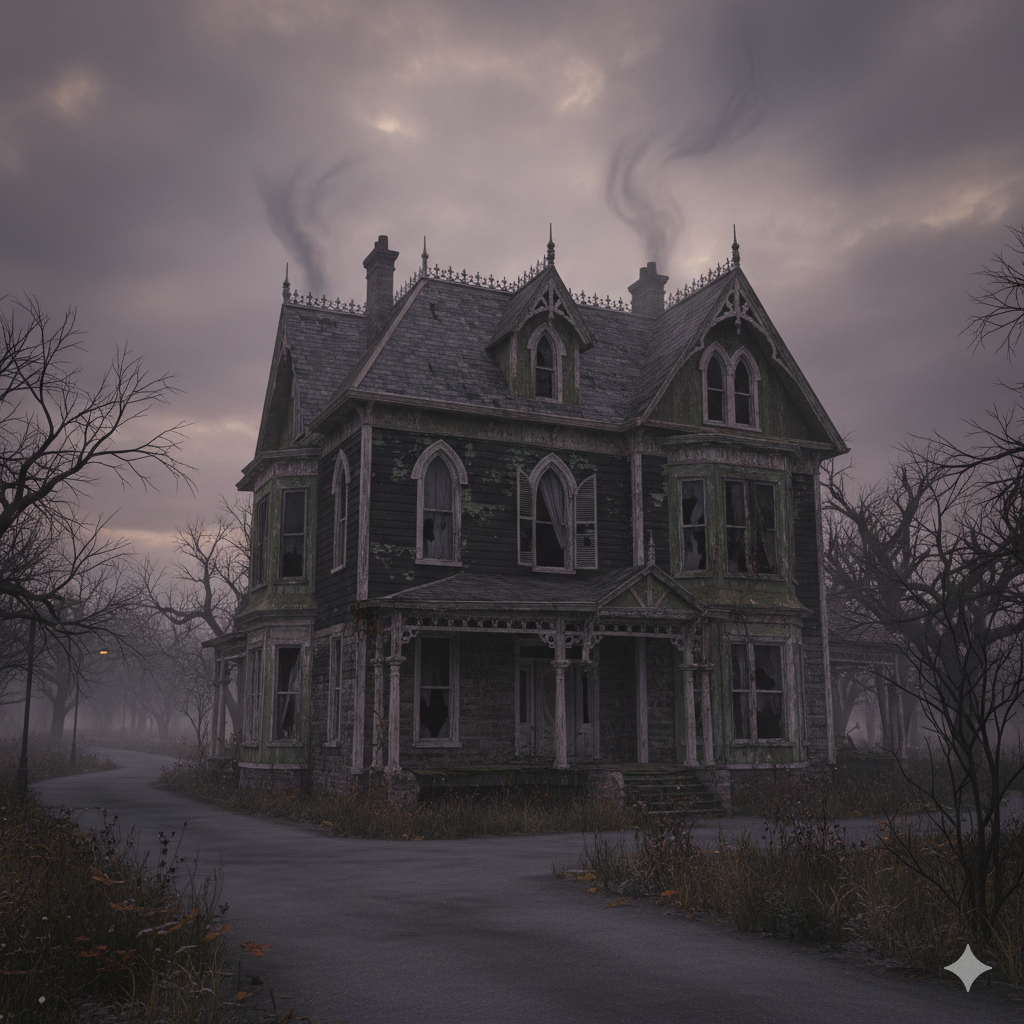
The house squatted at the end of the cul-de-sac like a sulking child, all Gothic Revival gingerbread and peeling paint. Eleanor Crane, Nell to anyone who’d survived more than one conversation with her, pulled her car into the weed-choked driveway and killed the engine. Through the windshield, she counted the architectural red flags: sagging porch, shutters hanging at drunken angles, windows that seemed to watch her with the suspicious glare of a clerk convinced you’re shoplifting.
“Charming,” she muttered, grabbing her briefcase. “Really commits to the aesthetic.”
Nell specialized in what the agency delicately termed “challenging properties.” In practice, this meant houses where people had died badly, or houses people *claimed* had ghosts, or, in one memorable case, a split-level ranch with a sewage problem so catastrophic it had achieved near-sentience. The Gable Street property fell into category two, though the price suggested the seller suspected it might actually be category one.
She’d sold worse.
The front door opened before she could knock, which was either helpful or ominous depending on your worldview. Nell chose helpful and stepped inside.
The interior had that faded elegance particular to houses built when craftsmanship mattered and safety codes didn’t. Crown molding traced the ceiling in elaborate curlicues. A chandelier hung in the foyer, crystals dulled by decades of dust. The floorboards were wide-plank oak, warped just enough to make her footing uncertain. Everything smelled of age and absence, dry rot, old wallpaper paste, something faintly sweet and unpleasant underneath.
“Classic haunted vibe,” Nell said to the empty hallway. “Ten out of ten, would be menaced again.”
A cold draft wrapped around her ankles.
She ignored it. Draft was just physics. Old houses were drafty. That’s why people invented weatherstripping and eventually decided to build houses that didn’t actively try to kill you via hypothermia.
The parlor sprawled to her left, crowded with furniture draped in dust covers like a room full of ghosts playing at being furniture. She pulled out her phone and started taking photos for the listing. The camera flash lit up the space in stark bursts, and in one of them she could’ve sworn the shadows moved wrong, pulling away from the light instead of being dispelled by it.
“Cute,” she said. “Very atmospheric.”
Something in the walls whispered.
Nell paused. The whisper came again, too low to make out words but clearly linguistic. Sibilant. Vaguely annoyed.
“Yeah, well, same to you,” she told the walls.
She’d learned early in this job that the worst thing you could do was show fear. Houses, haunted or otherwise, responded to hesitation the way sharks responded to blood in the water. Project confidence, even if that confidence was ninety percent sarcasm and ten percent spite, and you’d get through it.
Probably.
She finished photographing the first floor and headed upstairs.
The next morning, the house had redecorated.

Nell stood in the parlor, coffee cooling in her hand, and stared at the room that had definitely not looked like this yesterday. The dust covers were gone. The furniture had rearranged itself into a Victorian salon: settees positioned for conversation, a tea service laid out on the side table (complete with actual tea, steaming gently), antimacassars on every horizontal surface.
“Oh, it’s precious,” she said flatly. “Did you spend all night on Pinterest?”
The wallpaper had changed too. Yesterday it had been a faded floral pattern, barely visible under decades of grime. Now it depicted a pastoral scene: shepherdess, frolicking lambs, the works. Except the shepherdess’s face looked distinctly judgmental. Disapproving, even. Like she’d just watched Nell eat an entire sleeve of Oreos for dinner and had opinions.
“Okay, that’s just rude,” Nell told the wallpaper.
She walked through the rest of the first floor. Every room had undergone similar overnight transformations. The dining room now featured a table set for twelve, complete with china that probably cost more than her car. The library, which yesterday had been empty except for built-in shelves, now overflowed with leather-bound books, all of them opened to pages that seemed to be highlighting particularly cutting observations about human nature.
In the kitchen, the cabinet doors hung open. Someone, something, had arranged her packet of instant coffee, energy bars, and bottle of Tums into a sad little still life that felt like commentary.
“Oh, it’s a little passive-aggressive today,” Nell muttered. “How quaint.”
Her phone buzzed. The first showing was in an hour.
The Hendersons were a young couple, eager and optimistic in that way that suggested they’d never encountered a problem money couldn’t solve. Nell met them at the door with her professional smile, the one that said I’m helpful without promising I’m honest.
“It’s got great bones,” she began, which was what you said about houses that had nothing else going for them.
Mrs. Henderson’s eyes went wide as they stepped into the Victorian parlor. “Oh my god, it’s like stepping back in time!”
“Isn’t it just,” Nell agreed.
They made it as far as the library before Mr. Henderson stopped dead. “Did that book just move?”
“Old houses settle,” Nell said smoothly. “Shifting foundations can create the illusion of, “
The book flew off the shelf and hit him in the face.
The Hendersons fled.
“Subtle,” Nell told the house. “Real professional.”
The wallpaper shepherdess’s expression had shifted to something that might have been smugness.
The showings continued through the week, each one a fresh disaster.
A retired professor got trapped in the upstairs bathroom when the door refused to open. It took Nell twenty minutes and a screwdriver to get him out, and by then he’d decided he preferred condos.
A pair of newlyweds made it through the tour just fine until the wife pointed out that all the portraits in the hallway now looked exactly like Nell, rendered in increasingly unflattering styles. Gothic Nell glowered from an ornate frame. Renaissance Nell had three chins. Cubist Nell was just disturbing.

“Family resemblance,” Nell tried.
“You said the house was unoccupied,” the husband said slowly.
“It is.”
“Then who painted…”
A chandelier crashed down from the ceiling between them.
They left without finishing the sentence.
That night, Nell stood in the hallway and glared up at the portraits. “You know what your problem is? You’re needy. You want attention so badly you’re sabotaging your own sale. That’s not haunting, that’s just sad.”
Every portrait’s eyes tracked her as she walked to the stairs.
“Yeah, yeah. Very spooky. I’m trembling.”
She wasn’t, quite. But it was closer than she liked to admit.
The house escalated.
Hallways stretched when she tried to walk down them, doors appearing three feet ahead every time she got close. Nell would reach for a doorknob only to have the door slide away, the hallway extending into impossible distances. She’d turn around and find herself back where she started, the house folding space like origami.
“This is a fire code violation!” she shouted at the ceiling.
The ceiling didn’t care.
Furniture developed opinions. Chairs moved to trip her. Tables shifted to block her path. She’d set her coffee down and turn away for a moment, only to find it relocated to the other side of the room, sitting innocently on a shelf, as if to say what? I’ve always been here.
The voices grew louder. They whispered her name now, drew it out into something mocking. Nellllll. Nellllll. Like they were calling her to dinner and also threatening to make her into dinner.
“You know what?” she said to the empty parlor. “This is still better than selling McMansions to crypto bros. At least you’re interesting.”
A vase exploded.
“Okay, rude.”
Her humor had become armor, she realized. A thin shell between her and the growing certainty that this house didn’t just want her gone. It wanted to punish her first. For her flippancy. For her sarcasm. For refusing to give it the fear it craved.
Too bad. She’d been doing this job for eight years. She wasn’t about to let some temperamental architecture get the better of her.
Probably.
The buyer arrived on a Thursday.

Nell was in the kitchen, trying to convince the refrigerator to stop humming the Jeopardy theme, when she heard the front door open. She hadn’t unlocked it. The house had been doing that lately, picking and choosing who it let inside based on criteria she couldn’t fathom.
She found him in the parlor, studying the wallpaper with the detached interest of a surgeon examining an X-ray.
He was rough-edged in a way that suggested actual labor rather than a gym membership: calloused hands, canvas jacket, boots that had seen mud and worse. Probably mid-forties, with the kind of weathered face that came from spending more time outdoors than in. Dark eyes that didn’t blink as much as they should.
“You the agent?” he asked.
“Nell Crane. And you are?”
“Marcus Webb.” He didn’t offer a handshake. “I’m here about the house.”
“Great. Let me get my…”
“I’m not buying it.” He turned to look at her, expression perfectly calm. “I’m going to burn it down.”
Nell blinked. “I’m sorry, what?”
“Burn it,” he repeated. “Salt the earth. Proper cleansing. Should’ve been done decades ago.”
“You can’t just, that’s arson. That’s several crimes.”
“Property’s got an old claim on it. Older than the deed.” He gestured toward the corner of the room, where Nell could now see something carved into the baseboard. Symbols, worn smooth with age. “Someone tried to bind something here. Did a piss-poor job of it. Now it’s soaked into the foundation.”
“Bind something,” Nell echoed. “Like, what, a demon?”
“Something like that.” Marcus moved through the room with the confidence of someone who knew exactly what they were dealing with. He paused at the fireplace, ran his hand along the mantel. “You’ve noticed it getting worse. More active. That’s because it’s feeding on attention. Every person who walks through here gives it a little more strength. Every show of fear makes it hungrier.”
Nell thought about the stretched hallways, the rearranging furniture, the portraits that now looked like her worst yearbook photos given physical form.
“So you’re what, an exorcist?”
“Something like that.”
“And you think I’m just going to let you commit felony arson on a property I’m contracted to sell?”
Marcus smiled. It wasn’t a comforting expression. “I think you’re smart enough to know this place isn’t going to sell. Not to anyone who doesn’t already know what it is. And the people who know what it is…” He trailed off meaningfully. “Well. They’re not buying it to live in it.”
The house shuddered. Nell felt it through the floorboards, a tremor of recognition or maybe rage. When she looked at the wallpaper, the shepherdess’s face had shifted into something ancient and furious.
“It knows you,” she said slowly.
“We’ve met before. Different house, same problem. It’s a pattern.” Marcus pulled something from his jacket pocket: a leather pouch that smelled of sage and salt and something sharper. “I can handle this alone if you want to leave. But it’ll go easier with two. You’re a necessary element, attention matters, and legally, I can’t touch this property without an observer.”
Nell looked at the wallpaper, at the tea service that had appeared on the table while she wasn’t watching, at the portraits in the hallway that definitely hadn’t been there this morning.
She thought about her job. About years of explaining away water damage and foundation cracks and the persistent smell of death. About smiling through showings while pretending not to notice the cold spots and phantom footsteps. About the careful dance of acknowledging just enough to seem honest without acknowledging so much that people fled.
This house had gotten personal.
“Fine,” she said.
Marcus raised an eyebrow. “You understand what I’m proposing?”
“I understand that this house has been trying to kill me for a week and I’m running out of clever things to say to it.” Nell crossed her arms. “But I also understand that I work on commission, and if this property doesn’t sell, I don’t get paid. So unless you’ve got a solution to that problem, you can handle your cleansing ritual solo.”
Marcus studied her for a moment, then reached into his jacket, the other side, not where he’d pulled the leather pouch. He withdrew a thick envelope, rubber-banded and worn at the edges.
“What’s the asking price?” he asked.
“Two hundred thousand.”
“And your commission?”
“Six percent. Twelve thousand.”
He pulled bills from the envelope, counted them with the quick efficiency of someone used to dealing in cash. “Two hundred thousand for the seller. Fifteen for you, twelve percent plus hazard pay. Deal?”
Nell stared at the money. It was real. She could see the security strips, the watermarks, the particular texture of actual currency rather than the too-smooth feel of counterfeits.
“You just carry this around?”
“I’m prepared for most contingencies.”
“Who are you?”
“Someone who’s been doing this longer than you’ve been alive.” He held out the stack of bills. “The seller gets a cashier’s check tomorrow morning for the full amount. You witnessed the transaction. Everyone walks away whole. The house gets what it deserves.”
It was a lot of money. More than Nell had made in the last three months combined. And the house had been trying to kill her, or at least make her life sufficiently miserable that death started looking appealing by comparison.
She thought about the stretched hallways. The portraits. The Henderson couple, who probably still had nightmares about flying books.
“Make it seventeen,” she said. “Emotional damages.”
Marcus smiled, the first expression that looked genuinely amused rather than unsettling, “Deal.”
Nell took the money. It was heavy in her hands, substantial. Real.
“Okay,” she said. “Let’s commit some felonies.”
Marcus worked with the methodical efficiency of someone who’d done this before, many times before.
He drew symbols on the floor in salt, muttering words in a language Nell didn’t recognize. He burned bundles of herbs that made her eyes water and her throat close. Candles appeared at precise points throughout the house, and when he lit them, the flames burned blue-white and cold.
The house fought back.

Doors slammed with concussive force. Windows shattered inward, spraying glass. The temperature plummeted until Nell could see her breath, feel ice forming in her lungs. The whispers became screams, wordless, agonized, furious. They echoed through rooms that suddenly had too many walls, too many corners, geometry folding in on itself like a collapsing star.
“Keep moving!” Marcus shouted over the cacophony. “It can’t hold the space if we keep moving!”
They ran through hallways that stretched and bent, stairs that led nowhere, rooms that hadn’t existed yesterday and wouldn’t exist tomorrow. Nell’s briefcase became a weapon. She swung it at furniture that lunged, at portraits that grabbed, at shadows moving with predatory intent.
“This is not in my job description!” she yelled.
“Add a hazard bonus!”
Figures manifested in the doorways, past tenants, Nell realized. Faces hollow with rage or terror or both, mouths opening on silent screams. They reached for her with translucent hands, and where they touched, her skin went numb and gray.
Marcus grabbed her arm, pulling her through a doorway that led back to the parlor. He was chanting now, words that made the air vibrate and her teeth ache. The candles began burning brighter, blue flames rising like pillars.
The house screamed.
It was the sound of wood splintering, glass shattering, something ancient and malevolent realizing it had lost. The furniture collapsed into splinters, the tea service shattered, portraits melted into dark streaks. The wallpaper peeled away in strips.
And then… silence.
Marcus stood in the center of the parlor, breathing hard, the leather pouch empty in his hand. Around them, the house looked like it had aged a century in minutes. The elegant Victorian facade was gone, replaced by naked studs and broken plaster. Even the foundation looked cracked and compromised.
“It’s done,” he said.

Nell looked around at the ruins. She felt… lighter. Like a weight she hadn’t consciously noticed was suddenly gone.
“Just like that?”
“Just like that.”
She studied him in the dim light filtering through the broken windows. Symbols drawn on his skin in ash glimmered faintly. Marks that hadn’t been visible before. His eyes caught the light wrong, reflected it back like an animal’s.
“What are you?” she asked quietly.
Marcus smiled that unsettling smile again. “Someone who cleans up messes. Same as you, just different kind of messes.”
He walked to the door, paused at the threshold. “You should leave town for a few days. Let things settle. And maybe consider a career change.”
“Not a chance,” Nell said. “I’ve got student loans.”
He laughed, actually laughed, which somehow made him more unsettling, not less. Then he was gone, walking down the overgrown path to the street, leaving footprints in the morning frost that didn’t look quite right. Too many toes, maybe. Or not enough.
Nell stood in the ruined parlor and realized she was shaking.
“Well,” she said to the empty air. “That was unprofessional.”
The walls didn’t answer.
She returned the next morning to find a construction crew surveying the property.
The foreman explained that the land had been purchased by a development company. They were planning something modern, condos, perhaps, or townhouses. Clean lines, sensible floor plans, no character whatsoever. The kind of housing that denied the possibility of mystery.
Nell watched them measure and mark, watched them drill into the earth where the house had stood. In the churned dirt, she could see the remains of Marcus’s ritual: salt lines gone to nothing, charred symbols that meant something to someone.
But also other marks. Older ones. Marks that predated Marcus, suggesting his cleansing had been just the latest in a long line of attempts to make this land safe.
“You want to walk the property?” the foreman called to her.
“No thanks,” Nell said. “I’ve seen enough.”
She got in her car and pulled up her email. Three new listings had come through overnight. One was an estate sale with “unexplained noises.” One was a Victorian in the historic district with “a complicated past.” One was a farmhouse where the previous owner had died in unclear circumstances.
Nell stared at the listings for a long moment. Then she opened the farmhouse file and started drafting the listing description.
*Charming rural property with original hardwood floors and period details. Excellent bones. Some TLC needed. Perfect for buyers looking for a project with character.*
She finished the listing description and hit send.
Then she muttered to herself, in the privacy of her car where no one could hear her and no houses could judge:
“Alright… next haunted house. Bring it on.”
She started the engine, already running through her mental checklist: photos, floor plans, disclaimers about creaky floors and “minor paranormal activity.”
Her phone buzzed on the passenger seat. A text.

She glanced down. New contact.
Disposal Service
No number saved. No context. Just that.
Curiosity flicked through her. She tried to delete it. Impossible. The option was grayed out, as if the phone itself recognized the danger in erasing it.
Tapping the contact opened a link.
Marcus Webb.
A chill ran up her spine.
She locked the phone and shoved it back in the console. Couldn’t ignore it. Couldn’t erase it. Couldn’t really call it, either.
Nell sighed, adjusted her rear view mirror, and forced herself to focus. Another listing awaited. Another haunted mess with commission attached. Human problems, not arcane ones. At least, that’s what she told herself.
The road ahead curved into autumn sunlight. She smiled wryly.
“Let’s see what horrors this one has,” she muttered.
Her car rolled forward. The phone sat silent beside her, but the contact pulsed faintly, as if it had a heartbeat of its own.
Some things, Nell realized, weren’t in her control. And some things, people who cleaned up what shouldn’t exist, had a way of showing up when you least expected them.
She glanced at the link one last time. Marcus Webb. Disposal Service. Always watching. Always ready.
Then, just as she hit the accelerator, a message appeared on her screen:
“You found the wrong house first.”
The car shivered under her hands. Outside, the shadows seemed to stretch toward her, long and hungry.
Nell’s stomach dropped. She knew, in a way she didn’t want to admit, that Marcus Webb wasn’t finished. And neither, perhaps, was the world he cleaned up.
Somewhere in the distance, something ancient and patient stirred, waiting for her next listing.
