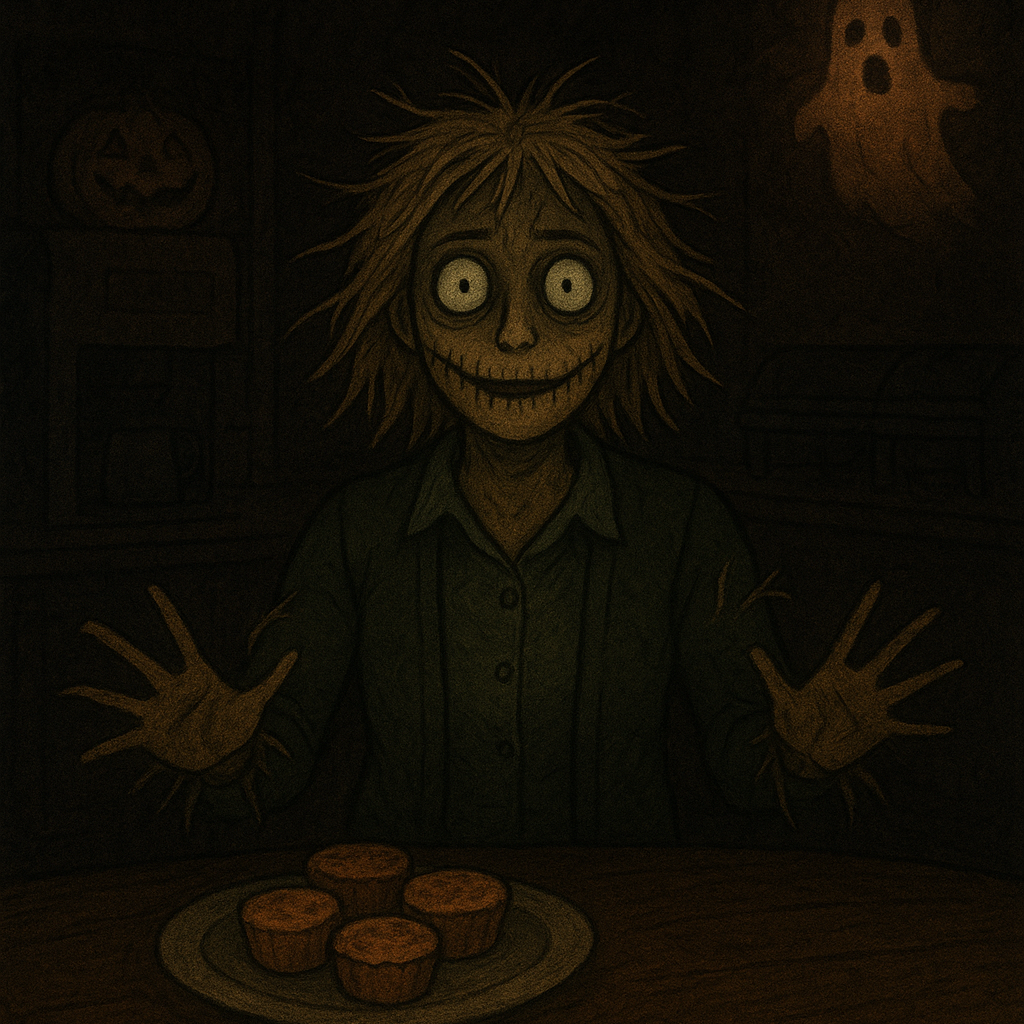
10 of 13 Short Stories Before Halloween
Hey friends,
I’ve been going through some health stuff lately, both the physical kind and the mental kind, and it’s been a little rough. The writing helps, though. Even when I don’t feel great, putting words down is a way to keep moving, to make sense of things. So I’m trying to write through the feelings instead of waiting to feel better first.
I also noticed I’ve lost a couple followers recently, and I’ll admit, it’s a little disappointing. But hey, I get it, people’s attention shifts, inboxes get crowded. I’m grateful for everyone who’s still here, still reading. It honestly means a lot.
After Halloween, I might need to change up my strategy a bit, maybe slow down or try something new. I’m figuring it out as I go. For now, I’m just trying to show up, even when it’s messy.
Thanks for sticking with me.

Marjorie Blount had not come to Salem to become a monster. She had come for the annual Readers of the Realm Librarian Conference, a gathering of several hundred bookish professionals who believed deeply in the twin powers of information access and tote bags.
They were a proud, cardigan wearing army of organizers, and for three days straight they had discussed metadata, fine forgiveness policies, and the moral failings of patrons who returned coffee-stained hardcovers.
Marjorie had been looking forward to the trip for months. The hotel was modest but boasted a “complimentary hot breakfast,” and she figured she would finally get a chance to eat something that wasn’t microwaved. That assumption would prove fatal to her dignity.
The Breakfast of Slightly Damned Champions
The Hearthstone Inn & Suites looked like the inside of a craft store that had suffered a nervous breakdown. The lobby was decorated with plastic pumpkins, flickering orange lights, and cinnamon-scented candles that were definitely a fire hazard. A motion-activated ghost near the juice machine shrieked “BOO!” every thirty seconds, regardless of whether anyone was nearby.
Marjorie had spent the previous night editing her PowerPoint on “Cataloging the Macabre: Horror Collections and the Modern Reader.” Her slides included tasteful images of skeletons and a brief but impassioned rant about people who filed Stephen King under “General Fiction.” She was proud of it. But by morning, she was exhausted.
At the breakfast buffet, she surveyed her choices. The scrambled eggs were the color of faded wallpaper. The sausage links glistened with a kind of moral uncertainty. The waffle iron had a hand-lettered sign taped to it that said, Do Not Close All the Way or It Screams.
She opted for the quiche bites. They were bright orange with a greenish tint and smelled like pumpkin pie and static electricity. A small sign next to them read “Seasonal Special: Pumpkin Spice Quiche, made with love by Mrs. Dorrance.”
“Careful with those, dear,” came a voice behind her.
Marjorie turned. The cook was a tiny old woman with eyes like sharpened marbles. Her name tag read MRS. DORRANCE, KITCHEN STAFF.
“They’re a little… strong,” Mrs. Dorrance said. “Best not to overindulge.”
Marjorie smiled politely. “I like a little spice.”
Mrs. Dorrance gave her a look usually reserved for people about to regret something.
The first quiche bite was oddly warm, almost pulsing. The second had a zing that made her teeth buzz. The third was somehow spicy and cold at the same time. She felt a pleasant hum through her body, as if she’d swallowed a secret.
“Delicious,” she said.
Mrs. Dorrance muttered something that sounded like “goddess help us all” and shuffled back toward the kitchen.
The Itch of Doom
Two hours later, Marjorie was in the conference’s largest meeting room, giving her presentation to a crowd of fellow librarians. She had just clicked to her slide on “The Semiotics of Fear in Dewey Classification” when her wrists started itching.
She scratched absentmindedly, but the itch deepened into something grainy. She looked down and saw something pale sticking from under her sleeve. She tugged at it, thinking it was a thread. It wasn’t a thread.
It was straw.
She stared at it in horror. The audience stared back, assuming she was demonstrating something.
Sasha Patel, her roommate and best friend, whispered from the front row, “You okay, Marj?”
Marjorie tried to smile. “Fine. Just…”
Her voice cracked like parchment. She hurried through the rest of her slides, hoping no one noticed that her fingertips were stiff and oddly yellow. When someone complimented her “great scarecrow costume,” she laughed too loudly and said, “Thanks, it’s… an immersive experience.”
The Investigation
Back in their hotel room, Sasha stared as Marjorie pulled more straw out of her hair.
“This is not normal,” Sasha said. “You look like the aftermath of a hayride.”
Marjorie groaned. “Do you think it’s an allergy? Maybe the eggs were contaminated.”
“Contaminated with what? Autumn?”
They went to the front desk. Gus, the night manager, looked up from his computer with the defeated eyes of a man who had seen too much at minimum wage.
“Let me guess,” he said. “Breakfast-related issues?”
“Yes,” Marjorie said. “Your pumpkin quiche bites are doing something… biological to me.”
He sighed. “I told her to stop serving those. Ever since Mrs. Dorrance started running the kitchen, people have been… changing.”
“Changing how?” Sasha asked.
“Well, last week a guy grew feathers after eating the muffins. One lady’s voice started echoing like she was in a cave. Another guest’s hands turned to stone for three days. We comped their rooms.”
“That’s not a comp situation,” Sasha said. “That’s a containment situation.”
Gus rubbed his temples. “Look, I don’t know what she’s doing back there. She came with the building when the new owners bought it. Literally. She was in the deed paperwork as ‘permanent kitchen staff.’ Can’t fire her, can’t question her. The one time the old manager tried, he woke up covered in moss.”
“Where is she now?” Marjorie demanded, feeling another tuft of straw push through her collar.
“Probably in the kitchen. But she won’t talk. Believe me, we’ve tried.”
Sasha crossed her arms. “Then we try harder.”
The Confession
They found Mrs. Dorrance in the industrial kitchen at midnight, stirring a massive pot of what looked like liquid amber. The air smelled of burnt sugar and old earth. Dried herbs hung from the ceiling in bundles, and the walls were lined with jars labeled in a language neither of them recognized.
“We know you’re doing this,” Marjorie said, her voice crackling like dry leaves. “And you’re going to tell us how to stop it.”
Mrs. Dorrance didn’t turn around. “Go back to your room, librarian. This doesn’t concern you anymore.”
“Doesn’t concern me?” Marjorie stepped forward, straw falling from her sleeves. “I’m turning into a scarecrow!”
“Better than what you were becoming.”
Sasha moved to block the door. “We’re not leaving until you explain. And if you don’t, I’m calling the health department, the police, and the Massachusetts Board of Tourism. In that order.”
Mrs. Dorrance finally turned. Her eyes were darker now, older, as if they’d been watching things for far longer than one lifetime. She set down her spoon with a heavy sigh.
“You want the truth? Fine. Sit down. This will take a while.”
They sat at a prep table covered in flour. Mrs. Dorrance poured three cups of tea that steamed despite the kettle being cold. She settled into a chair that creaked under her small frame.
“This land,” she began, “was never meant for hotels. Before the English came, before Salem was Salem, this was Naumkeag territory. The indigenous people here had an understanding with the land, with the cycles of growth and rest. But when the colonists arrived, they broke that understanding. They took and took—harvested without gratitude, cleared without respect, built without permission.”
She sipped her tea, eyes distant.
“My family descends from those first colonists. The Dorrances were farmers, proud and greedy. In 1697, during a harsh winter, my ancestor Absalom Dorrance tried to force a crop from frozen ground. He used the labor of enslaved people and indentured servants, worked them until they collapsed. Three died in his fields that winter. Their names were Mercy, Thomas, and a boy called only James.”
Marjorie felt the straw in her hair shift, as if listening.
“On the last day of harvest, the survivors gathered what little they’d grown and cursed the soil in three languages—Algonquian, English, and one that had no name. They called upon the earth itself to claim those who took comfort without question, who accepted gifts without asking their cost, who consumed the fruits of others’ suffering without seeing the hands that planted them. They asked that the land transform the unseeing into guardians, into watchers who could never rest, who would stand in the fields forever and remember what was lost.”
“The scarecrows,” Sasha whispered.
Mrs. Dorrance nodded. “The curse lay dormant for centuries, waking only when the ground was disturbed. This hotel was built directly over Absalom’s fields in 1923. The basement foundations broke through into the old root cellars, where the enslaved workers had lived and died. The curse woke up. And it’s been hungry ever since.”
“But why help it?” Marjorie asked. “Why serve cursed food?”
Mrs. Dorrance’s face twisted with something between shame and defiance. “Because I am a Dorrance. The curse knows my blood. It won’t let me leave. Every morning, I wake up knowing what the food will do, and every morning, I have no choice but to prepare it. The curse needs agents—people to feed the transformation, to identify those it can claim.”
“Claim how?” Sasha demanded. “Marjorie’s not some greedy corporate monster. She’s a librarian. She helps people find books.”
“That’s not what the curse sees,” Mrs. Dorrance said quietly. “It doesn’t see malice or virtue. It sees those who partake without witnessing. She came here for a complimentary breakfast—free food, no questions asked. She ate what was offered without wondering about the hands that made it, the cost that was paid. That’s what the curse hunts: not the deliberately cruel, but the comfortably blind. Those who benefit from systems they never examine.”
Marjorie felt her throat tighten. “But I didn’t know—”
“That’s the point,” Mrs. Dorrance interrupted. “The curse transforms the unseeing into watchers, the comfortable into guardians who can never stop looking, never stop remembering. It forces you to stand witness for eternity to what you once overlooked. The more decent you are otherwise, the more powerful the irony—the kinder you are in your visible life, the more devastating to trap you in eternal observation of what you failed to see.”
Marjorie felt ice in her chest. “You’re using good people as… as batteries?”
“I’m not using anyone,” Mrs. Dorrance snapped. “The curse is. I’m just its prisoner. Every scarecrow that rises from this ground is another soul standing watch, another guardian the earth claims to protect itself from people like my ancestors. And I…” Her voice cracked. “I have to help it. The curse won’t release me until I’ve transformed enough souls to equal the three who died. I’ve managed two so far. You would have been the third.”
The kitchen went silent except for the drip of the faucet.
“After you,” Mrs. Dorrance continued, “I could finally die. The curse would release me. I could rest.”
Sasha stood up so fast her chair fell over. “You were going to sacrifice her so you could take a nap?”
“So I could stop!” Mrs. Dorrance’s voice rose to a shriek. “Do you know what it’s like to poison good people for three hundred years? To watch them change, to hear them cry out, knowing you’re the instrument of their suffering? I am so tired, child. So endlessly, impossibly tired.”
Tears ran down the old woman’s face, cutting tracks through flour dust.
Marjorie felt something shift inside her—not the curse, but something else. Compassion, maybe. Or recognition of another kind of prison.
“Then help us break it,” Marjorie said. “Not just for me. For all of us.”
Mrs. Dorrance looked up, something like hope flickering in her ancient eyes. “There might be a way. But it will require a sacrifice of a different kind.”
The Ritual of Waffles
Mrs. Dorrance led them to the basement, past storage rooms and boilers, down into a sub-level that didn’t appear on any floor plan. The walls were old stone, Colonial-era construction, and in the center of the room was a circle of symbols carved into the floor—three sets of marks in three different scripts.
“The curse demands completion,” Mrs. Dorrance explained, her voice echoing. “Three souls to balance three deaths. But there’s another way to satisfy it: three acts of willing sacrifice, offered in place of transformation. Something precious given freely, not taken by force.”
They found the half-burned spellbook in a locked cabinet, its pages brittle with age. Inside was a reversal ritual involving a “symbol of excess,” a “vessel of sweetness,” and “a voice of truth.”
“The waffle iron,” Sasha said, reading over Marjorie’s shoulder. “That’s the symbol of excess—the complimentary breakfast itself, the modern expression of taking without cost.”
“The syrup,” Marjorie added. “The vessel of sweetness.”
“And the voice of truth has to be someone affected by the curse,” Mrs. Dorrance said, looking at Marjorie. “Someone mid-transformation who can speak for both the living and the guardians.”
They hauled everything back to the breakfast area. The moon was enormous through the windows, fat and orange and setting fast. Mrs. Dorrance drew symbols on the floor with cinnamon and salt while Sasha set up the waffle iron and syrup.
“What do we sacrifice?” Sasha asked.
Mrs. Dorrance handed them each a slip of paper and a pen. “Write what you’d give up to break this. What you’d surrender willingly to free the trapped souls, mine included.”
Marjorie’s hands were almost entirely straw now, but she managed to write: My safety. My certainty. My right to take without consequence.
Sasha wrote: My silence. My comfort. My tendency to ignore injustice.
Mrs. Dorrance’s hand trembled as she wrote: My life. My rest. My claim to escape the sins of my ancestors.
They placed the papers in the waffle iron and poured the syrup over them. Mrs. Dorrance began chanting words in three languages, ancient and creaking. The air thickened. The lights flickered. Wind howled through the cereal dispensers, rattling tiny Froot Loops like bones.
Marjorie felt her legs stiffen. Straw pushed through her sleeves. Her thoughts came in bursts of static and wind. Somewhere deep inside her, something ancient whispered, Protect the harvest. Stand eternal. Remember the dead.
“No,” she said. Her voice sounded hollow, like the inside of a pumpkin. “I remember them. Mercy, Thomas, and James. I remember. But I won’t become a monument to guilt. The debt is paid.”
She slammed the waffle iron closed.
It screamed.
Light burst through the room like sunrise through molasses, like justice delayed but finally arriving. The symbols on the floor ignited in three colors—white, gold, and green. The walls shook. Somewhere far below, something old and angry and deeply, deeply tired finally let go.
The wind stopped. The lights came back on. The ghost by the juice machine screamed “BOO!” one last time and died permanently.
Aftermath and Checkout
When it was over, the breakfast room was wrecked. There was syrup on the ceiling, straw in the orange juice, and the distinct smell of ozone mixed with freed earth.
Mrs. Dorrance lay on the floor, not unconscious but weeping. Her body was solid, real, no longer translucent with the weight of curses. She looked older somehow, but also more human.
Sasha was filming everything “for future liability purposes and also because nobody will believe this.”
Marjorie looked at her reflection in the chrome coffee urn. She was human again, more or less. Her hair had turned permanently straw-blonde and her fingertips had a faint golden tinge. A small crow perched outside the window, watching her with suspicious affection.
In the basement, later, they found three scarecrows that had been standing in the shadows. They crumbled to dust when touched, releasing three small lights that drifted up through the ceiling and disappeared into the dawn.
At the closing banquet that evening, Marjorie won Best Costume despite her protests that she hadn’t been wearing one. She gave a short speech about the dangers of continental breakfasts and the importance of remembering whose labor built our comforts, which received a standing ovation and confused several people.
Sasha leaned over and said, “Next year, we’re staying at the Marriott.”
Marjorie nodded solemnly. “Agreed. I’m bringing my own bagels.”
Mrs. Dorrance retired the next week. Gus found her note on the industrial mixer: Gone to make amends. The breakfast bar is safe now. Recommend discontinuing the pumpkin items just in case.
Two weeks later…
A small package arrived at Marjorie’s library. There was no return address, only a label that read Hearthstone Inn & Suites Autumn Sampler.
Inside were three perfectly wrapped pumpkin spice quiche bites.
They were still warm.
Beneath them was a note in shaky handwriting: For the next person who needs saving. May they have a friend like yours. —E.D.
Marjorie closed the box and whispered, “Not today, Satan.” Then she marched it straight to the staff room fridge, because librarians are constitutionally incapable of throwing away free food.
But she also printed out three names on cardstock and taped them above her desk: Mercy, Thomas, and James. Remembered.
The crow that had been following her landed on the windowsill and cawed once, approvingly.
Some debts, Marjorie thought, can only be paid with witness.

