7 of 13 Short Stories Before Halloween

The scratching started at 2:47 AM.
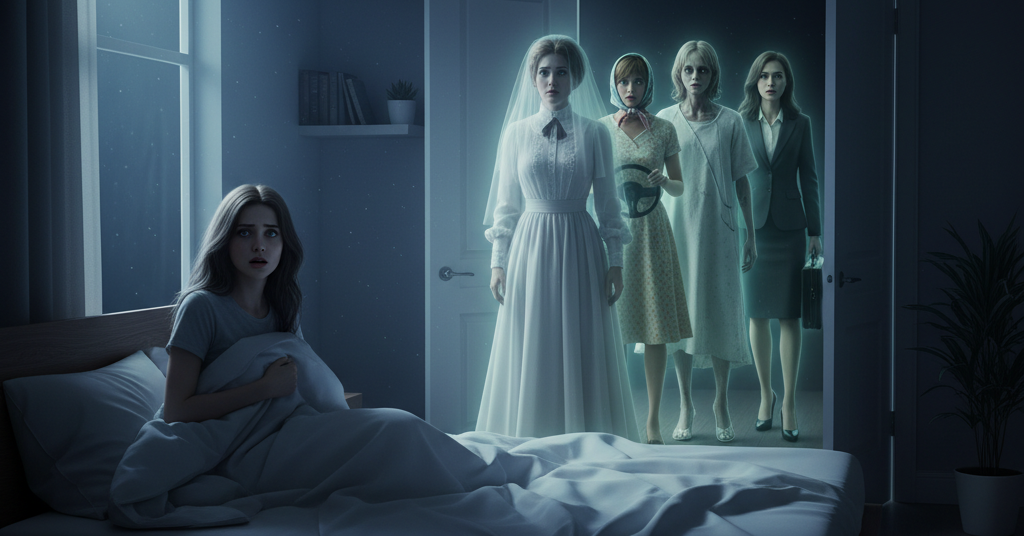
Cassandra had heard it before, soft, insistent, like fingernails on wood, but tonight it was louder, more urgent. She pulled her blanket tighter and stared at her closet door, the only shadow in her moonlit bedroom that seemed to breathe.
“Not tonight,” she whispered. “Please, not tonight.”
The door swung open.
They emerged in order of death, as they always did. Great-great-grandmother Josephine came first, her Victorian dress rustling despite having no body to fill it. Then Great-aunt Dorothy, still clutching the steering wheel she’d been holding when her car careened off the bridge at thirty two. Grandmother Ruth followed, her hospital gown pale as milk, the cancer having taken her at forty one. And finally, her mother Elena, looking exactly as she had five years ago when she’d simply closed her eyes at her desk and never opened them again. She’d been thirty-eight.
Cassandra was twenty four. By her family’s standards, she had maybe a decade left.
“You can’t keep ignoring us, child.” Josephine’s voice sounded like wind through dead leaves.
“I’m not ignoring you. I’m surviving you.” Cassandra sat up, her heart hammering. “Every woman in our family dies young. Every one of us fails at everything we try. I’ve lost three jobs in two years. My scholarship evaporated. My car’s in the shop for the fourth time this month, and I can’t even afford to…”
“Because you won’t listen!” Dorothy slammed her phantom steering wheel down, and Cassandra’s desk lamp flickered. “The curse won’t break itself, girl. We tried everything: denial, distance, prayer. Your mother tried to burn the house down.”
“The house survives,” Ruth said quietly. “It always survives. While we wither.”
Cassandra had driven past the house once, after her mother’s funeral. The Blackwood place, sitting on five acres of overgrown land outside Fairfield, Connecticut, like something time had forgotten. A small, white single-story house with two bedrooms and a sagging front porch that wrapped around the east side. Three hundred years old, built by her ancestor Mercy Blackwood in the shadow of Connecticut’s witch trials, and it had been killing them ever since. The property was littered with decay: a leaning barn with half its roof gone, a chicken coop claimed by wild vines, a rusted trailer from the 1970s that listed to one side like a sinking ship. Every generation had tried to sell it, demolish it, abandon it. The paperwork always vanished. The buyers always backed out. The structure stood impervious to flame, storm, and time.
“Why now?” Cassandra’s voice cracked. “Why me?”
Elena drifted closer, her face soft with the sadness Cassandra remembered. “Because you’re the last of us. The line ends with you, one way or another.”
“What did we do?” Cassandra asked. “What did Mercy do that was so terrible?”
The ghosts exchanged glances, a hierarchy of grief passing between them.
“We don’t know,” Josephine said, her voice cracking with frustration. “That’s the worst of it. Mercy never wrote it down. Never told a soul. She took the secret to her grave, and we’ve spent generations dying without knowing why.”
“But there has to be something,” Cassandra pressed. “Records, letters, something…”
“Mercy burned everything,” Ruth said bitterly. “Before she died, she destroyed every document, every diary. All we know is what’s been passed down, whispers that she wronged a woman named Constance Thorne. That Constance cursed us. That the house… the house holds the answer.”
Elena moved to the window, gazing toward where the house waited in the darkness beyond town. “We’ve all felt it. When we go there, the house knows things. It shows us glimpses, fragments of the past. But none of us could piece it together. We were too afraid, or too proud, or we died before we could figure it out.”
“Your mother got the closest,” Dorothy said quietly. “She spent three months in that house, searching. She found old documents stuffed in the walls, court records, letters. She found a name: Constance Thorne. But then…”
“Then I got sick,” Elena finished. “So sick I couldn’t think straight. The house didn’t want me to know. Or maybe it did, and I just wasn’t strong enough to face it.” She looked at Cassandra with desperate eyes. “You’re the last of us. The last chance. If the curse is going to break, it has to be you.”
“But what am I supposed to do?” Cassandra’s voice rose. “If you don’t know what Mercy did, how am I supposed to fix it?”
“Go to the house,” Josephine said. “Search it. Let it speak to you. The truth is there, in the walls, in the bones of the place. Constance is there. She’s been waiting three hundred years for one of us to be brave enough to find out what really happened and face her with it.”
“What if I can’t figure it out? What if I fail like all of you?”
“Then you die having tried,” Josephine said simply. “Or you die in six years, maybe ten, having spent every moment running from a fate you cannot escape. Those are your choices, child. There are no others.”
The ghosts began to fade, pulled back into whatever darkness held them between visits.
“We’ll be there,” Elena said, her voice already distant. “In the house. All of us, every woman who’s died under this curse. You won’t be alone.”
“Wait…” But they were gone, and Cassandra was staring at an empty closet full of clothes she’d never get to wear to a career she’d never get to have, for a future that was already slipping through her fingers like smoke.
—
She drove to the house the next evening, as the sun bled red into the horizon. The Blackwood place materialized through the overgrown trees, small, white, innocent-looking except for the darkness that seemed to cling to it like a second skin. The porch steps groaned under her weight. The door was unlocked, it was always unlocked for family.
Inside, the air was thick with the weight of centuries. Dust motes swirled in the dying light filtering through yellowed curtains. The front room was sparse: a worn sofa, a coffee table with water rings older than Cassandra. Through the doorway she could see the tiny kitchen, and beyond that, the two small bedrooms where generations of Blackwood women had been born and, too often, had died. And everywhere, in every shadow, she felt them: the watching dead, the accumulated sorrow of ten generations.
She could hear the coal furnace in the basement rumbling to life, though no one had been here to light it. The sound was like breathing, like the house itself was waking up.
Cassandra started in her mother’s old bedroom. She pulled up floorboards, finding nothing but dirt and beetles. She tore through the kitchen cabinets: ancient canned goods, rusted utensils, mouse droppings. In the other bedroom, she found a loose brick in the wall behind the closet. Behind it: old documents, so brittle they nearly crumbled at her touch.

A letter in faded ink, dated 1692. A petition to the colonial court in Fairfield. Court records bound with rotting string.
Her hands shook as she read by the light of her phone. The documents told the story: Constance Thorne, midwife and healer, accused of witchcraft after saving the minister’s son from a deadly fever. The trial records showed witness after witness speaking against her. And there, on yellowed parchment, the testimony that had sealed Constance’s fate:
“I, Mercy Blackwood, do swear before God and this Court that I witnessed Constance Thorne invoke dark spirits to cure the child. She spoke words in a tongue I knew not, and made signs with her hands that were not of God. I saw with mine own eyes the Devil’s work.”
But there was another document, a letter, hidden beneath the others, in the same handwriting:
“Lord forgive me. I have condemned an innocent woman. Constance used only herbs and prayer, as I have done myself a hundred times. But they asked me, and I was afraid. If I said she was innocent, they would ask why I knew the cure she used. They would ask about my own healing. Connecticut has hanged seven already for less. So I lied. God forgive me, I lied, and tomorrow she hangs. I am damned.”
“I found it,” Cassandra whispered to the empty room that wasn’t empty at all. “She knew. Mercy knew Constance was innocent.”
The house groaned. The basement door swung open on its own, revealing darkness and the glow of the coal furnace that burned without coal.
Cassandra descended the narrow stairs. The basement was small, cramped, with a ceiling so low she had to duck. The furnace blazed in the corner, its heat oppressive. And there, in the dancing light of the flames, scratched into the stone foundation in letters that looked burned rather than carved, were words:
“SPEAK THE TRUTH MERCY WOULD NOT. NAME THE SIN. BEG FOR MERCY YOU SHOWED NONE.”
“Constance Thorne!” Cassandra’s voice rang out. “I know what Mercy did. I know the truth!”
The house groaned around her. Shadows deepened and stretched. Through the narrow basement window, she saw the barn door swing open on its own, the trailer’s door bang against its frame.
“Mercy Blackwood bore false witness!” The words felt like glass in Cassandra’s throat. “When the witch trials came, she was afraid. Constance Thorne had healed the minister’s son with herbs and skill, but the town wanted someone to blame, someone to fear. They asked Mercy if it was witchcraft. She knew it wasn’t. She knew Constance was innocent. But she was afraid they’d accuse her next, so she lied. She said yes. She condemned an innocent woman to death to save herself.”
Silence. Then, a voice like wind through bones, rising from the basement, from the walls, from the very foundation: “Why should I forgive?”
Cassandra looked toward the narrow basement door. The shadows there had coalesced into a form, a woman, neither young nor old, with eyes that held three centuries of rage, rising up from where the coal furnace burned with impossible heat.
“Because we’ve suffered,” Cassandra said. “Because we’re sorry. Because…“
“Because you want to live?” Constance emerged fully now, her form flickering between solid and smoke. “Your ancestor wanted to live too. She sacrificed me for her safety.”
“I know.” Cassandra stood her ground, though everything in her screamed to run. “And it was wrong. Evil. Unforgivable. I can’t undo it. I can only acknowledge it, carry the weight of it, and ask not for forgiveness, because I don’t deserve it, but for release. For all of us.”

She gestured around the room, and now Cassandra could see them: Josephine, Dorothy, Ruth, Elena, and dozens of others, generations of Blackwood women, crowding the small house, filling the bedroom doorways, standing on the porch visible through the windows. All watching, all waiting.
Constance looked at them, really looked, and something shifted in her ancient face. “You’re all here. Every daughter, every victim of my rage.”
“We didn’t know,” Josephine said. “Most of us didn’t even know what Mercy had done. We just suffered and died and never understood why.”
The witch was quiet for a long moment. When she spoke again, her voice was softer, tired. “Three hundred years. I’ve been anger for three hundred years. I’ve forgotten how to be anything else.”
Cassandra took a step forward. “Then rest. Please. Let go. Let us all let go.”
“You would have spoken for me.” Constance studied Cassandra with those ancient eyes. “That day, at the trial, knowing it might mean your own death, you would have told the truth, wouldn’t you?”
Cassandra thought of her mother, who’d tried to burn this house. Her grandmother, who’d fought the curse with every breath. All the women who’d struggled and failed and died trying.
“Yes,” she said. “I would have.”
Constance Thorne closed her eyes. When she opened them again, they were wet with what might have been tears or might have been rain from a storm three centuries past.
“Then I am satisfied.”
The house shuddered. Wood groaned. Something fundamental in its structure began to crack and splinter. The coal furnace in the basement gave one final, rattling breath and went silent. The ghosts around them started to shimmer, their forms growing lighter, more transparent.
“Thank you,” Elena whispered, her hand passing through Cassandra’s shoulder like a blessing. “Live, baby. Live for all of us.”
One by one, they faded, released, finally, into whatever waited beyond. Constance went last, her form dissipating like morning fog, a faint smile on her lips that might have been peace.
Cassandra stood alone in the collapsing house. She walked calmly to the door as the ceiling began to cave, as three hundred years of cursed architecture finally surrendered to time. She made it to the porch just as the small white house folded in on itself with a sound like a sigh, like relief, like the end of a very long story. The barn collapsed next, then the chicken coop. The trailer crumpled like tin foil. The very land seemed to exhale, releasing something it had held too long.

Six months later, Cassandra got promoted at her new job, the first Blackwood woman to advance in a career in living memory. She bought a small apartment in Bridgeport, far from the five acres outside Fairfield that now held only foundation stones and wildflowers. Sometimes, late at night, she thought she heard her mother’s voice on the wind, or caught the scent of her grandmother’s perfume.
But when she opened her closet now, she found only clothes. Only the future, hanging there waiting to be worn.
She was twenty-five years old.
By her family’s old standards, she was living on borrowed time.
By her own, she was just getting started.


