5 of 13 for Halloween

Maya had learned long ago not to mention the voices to anyone who mattered. People were charmed when she seemed to know exactly what they needed, attributing it to intuition rather than the whispered suggestions from Mrs. Chen, who’d run the laundromat for forty years before her heart gave out. She still liked to help.
The thrift store on Halloween was a chaos of costume hunters picking through racks, children hopped up on pre-trick-or-treating sugar. Maya wandered to the back corner where forgotten housewares gathered dust. That’s when she saw it: a clay pot, small enough to cradle in two hands, with an uneven glaze the color of river stones.
“Finally,” a voice said, clear as bells.
Maya’s hand froze above the pot. She glanced around, but everyone else was absorbed in their hunting. Carefully, she picked up the pot. It was warm.
“You can hear me.” The voice trembled with something Maya recognized, hope after a long drought of it.
“Yes,” Maya whispered, turning the pot over. No maker’s mark, but the clay had been shaped by hands that knew what they were doing. “How long have you been waiting?”
“Fifty-three years, two months, and…” The voice paused. “I’ve lost track of the days.”
Maya bought the pot for three dollars.
At home,
Maya set the pot on her kitchen table and made tea. The ghost materialized gradually, not in the horror movie sense, but the way a photograph develops, details emerging from mist. She was perhaps seventy when she’d died, with silver hair pinned back and laugh lines framing her mouth.
“I’m Rosemary,” the ghost said. “Rosemary Wooledge. Well, I was Rosemary Navarro first, then Rosemary Baptiste for a while, then back to just Rosemary for the last bit.”
“I’m Maya. Can I ask about the pot?”
Rosemary smiled, sad and fond. “I made it for my friend Joan. We were going to open a pottery studio together in Santa Fe. I threw this pot the week before I died. Aneurysm. Dropped dead loading the kiln.” She laughed, a sound like wind chimes. “Joan never knew I’d made it for her. My things got scattered. Estate sale. I’ve been following this damned pot ever since, watching it sit on shelves, hold spare change, collect dust.”
Maya wrapped her hands around her tea. “Fifty-three years is a long time.”
“I kept thinking it would make its way to her somehow. The universe has a sense of irony. Surely it could manage one coincidence? But Joan died in ‘02. After that, I didn’t know what I was waiting for.” Rosemary looked at Maya with eyes that had seen decades pass like pages turning. “Then you picked it up, and you heard me. So I thought maybe this is it. Maybe I can finally tell someone the story before I… well, before whatever comes next.”
“I’m listening,” Maya said.
Rosemary’s story spilled out like water from a broken dam. She’d been born in 1908, the youngest of five children. By 1968, she was the last one left.
“Mama died when I was seven. Influenza. Papa remarried a woman who didn’t much like children that weren’t hers. My brothers scattered as soon as they could. Michael made it to 1944 in Anzio, Rome. Robert to 1951 with his factory worn lungs. Thomas just vanished in ‘29. We think he rode the rails and never came back.” She smiled faintly. “My sister Eleanor made it the longest. She died in ‘67, cancer. That was the hardest. We’d been writing letters every week for forty years.”
“I’m sorry,” Maya said quietly.
“Don’t be. Not entirely, anyway.” Rosemary straightened. “I married twice. Frank Baptiste was a jazz musician and we had eight wild years before his heart gave out. No children, by choice. We wanted to see the world, and we did. Paris, Morocco, Brazil. Then I married Jonathan Wooledge, a poet who made me laugh until I couldn’t breathe. Fifteen years with him before emphysema took him.”
She listed adventures like other people listed groceries: studying pottery in Japan, smuggling banned books across the Spanish border during Franco’s regime, learning to sail at sixty, falling in love with a woman named Carmen in Mexico City (”It didn’t work out, but my God, what a year”), teaching English to refugees in New York, and finally settling in New Mexico to make pottery and chase sunsets.
“People always asked if I regretted not having children. If I felt incomplete.” Rosemary’s form shimmered with something that might have been indignation. “I was never incomplete. I was full to bursting. The Wooledge name died with Jonathan, the Navarro name ended with me, and I don’t mourn it. We were more than our surnames. We were people who lived.”
Maya found her eyes were wet. “That’s one hell of a life.”
“It was,” Rosemary said simply. “It really was.”
They sat in comfortable silence, the pot between them like a bridge between worlds. Finally, Maya said, “Would you like to stay? Here, I mean. With me.”
Rosemary looked startled. “Stay?”
“I have other friends who might like to meet you. Mrs. Chen from the laundromat. She’s got stories about immigrating from Taiwan in the fifties. And Harold, he haunts the coffee shop on Fifth. Died in the AIDS crisis, has very strong opinions about espresso. There’s a whole neighborhood of us, really. The living and the… less living.”
“A community,” Rosemary said slowly, as if testing the word’s weight.
“More or less. We look after each other. And I’ve always got questions about books from the fifties and sixties…you could help customers. If you wanted.”
Rosemary laughed, and this time it was pure and clear, free of sorrow. “I spent fifty-three years following this pot, waiting for Joan or closure or some cosmic purpose. And the answer was just… companionship? Conversation? People to talk to?”
“Sometimes the answer is just not being alone,” Maya said. “Is that enough?”
Rosemary looked at the pot. The thing that had anchored her to this world for half a century. Then she looked at Maya, really looked at her, and smiled.
“Yes,” she said. “Yes, I think it is.”
The next day,
Maya brought the pot to Turning Pages and set it on the shelf behind the register, between a biography of Eleanor Roosevelt and a collection of Pablo Neruda’s poetry. Rosemary settled into the bookshop like she’d always been there, recommending books to customers who felt a sudden, inexplicable certainty about what they needed to read.
That evening, as trick-or-treaters filled the streets in their costumes, Maya closed the bookshop early and walked through the neighborhood with Rosemary trailing beside her, visible only to Maya, but solid enough in presence to make the air shimmer slightly.
“I’m hosting a Halloween gathering,” Maya explained. “It’s the one night of the year when the living throw parties for the dead without realizing how literally true that is. Seemed appropriate for introductions.”
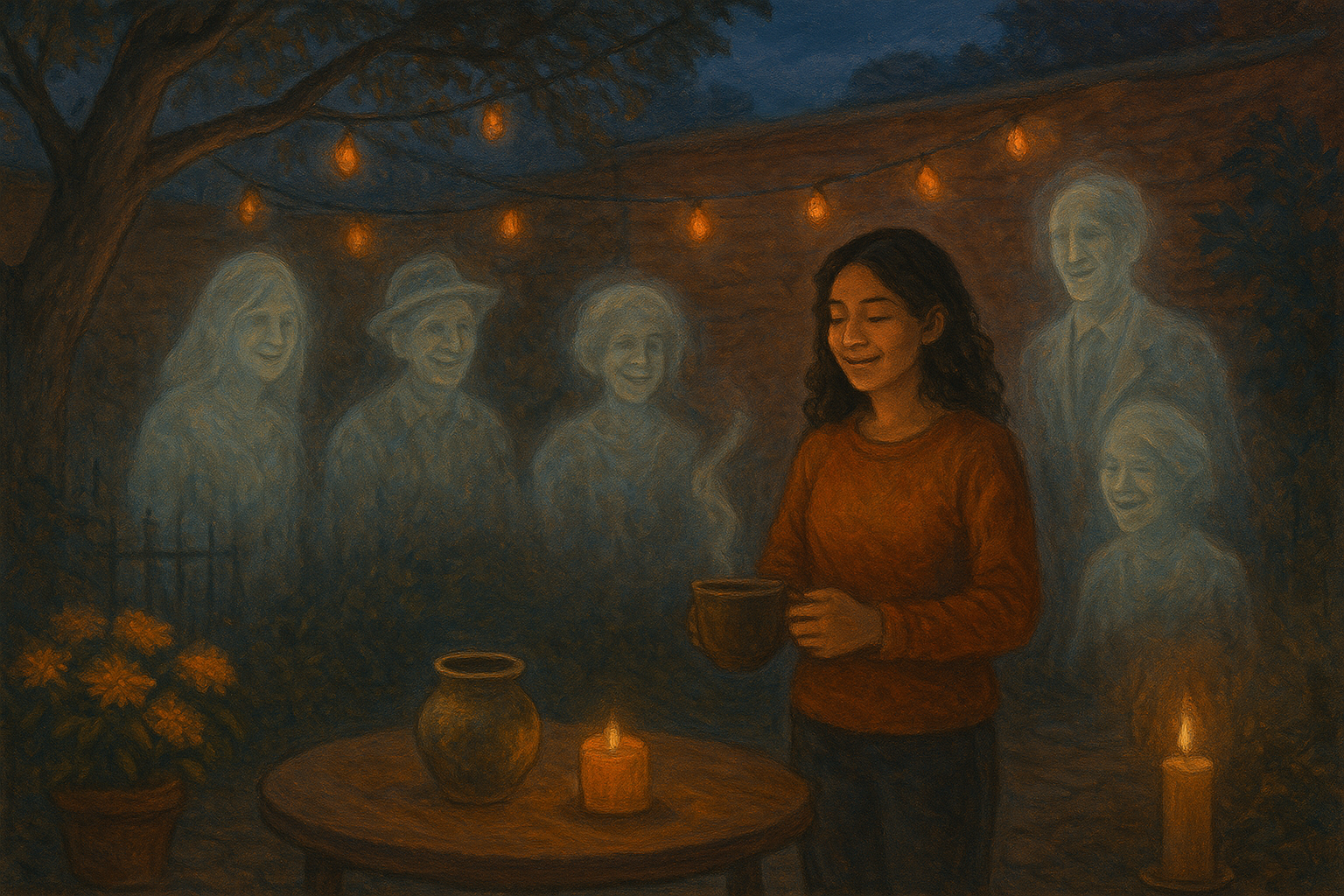
She’d set up in the small courtyard behind Turning Pages, stringing orange lights between the fire escape and the oak tree. A card table held cider and cookies for Maya, and candles for atmosphere. As the sun set and the veil between worlds grew thin, as it always did on Halloween, the ghosts arrived.
Mrs. Chen came first, manifesting near the potted chrysanthemums she’d always loved. Then Harold from the coffee shop, wearing the same flannel shirt he’d died in. A young woman named Lupita, who’d haunted the community garden since the 1990s. Mr. Kowalski, who’d run the corner deli and still liked to check that the new owners were slicing the pastrami correctly. Even Thomas appeared, a quiet presence who usually kept to the library, dead since the 1800s and still adjusting to the modern world.
“Everyone,” Maya said, gesturing to Rosemary, who stood uncertainly by the clay pot Maya had brought down, “this is Rosemary Wooledge. She’s new to the neighborhood.”
Mrs. Chen was delighted to discuss the McCarthy era with someone who’d lived through it. Harold insisted on telling Rosemary about pre-Stonewall San Francisco, and she countered with stories about the jazz clubs in Harlem. Lupita asked about Morocco, her eyes bright with vicarious adventure. By the time the moon rose and the last trick-or-treaters headed home, Rosemary was laughing with the entire group, swapping stories about lives fully lived and deaths that couldn’t diminish them.
“Happy Halloween,” Maya said softly, raising her cider to the gathered ghosts.
They raised their invisible glasses in return, their voices a chorus of gratitude for being remembered, for being heard, for being welcomed home on the one night when the world acknowledged what Maya had always known: that the dead don’t leave us, not really. They just wait for someone to listen.
The clay pot sat on its shelf, no longer a tether but a memory, proof that Rosemary had once shaped something with her own two hands, and that creation had finally led her here. Not to Joan. Not to the past. But to something new: a community of voices in the dark, all of them heard, none of them forgotten.

