A newsletter about writing, not having it together, and the books that happen anyway

I have a confession to make.
I have been writing a cozy mystery and telling almost no one.
Not because I’m ashamed of it. Not because I don’t think it’s good. But because telling people means it’s real, and real things can fail, and I have enough going on in my head without adding that particular anxiety to the pile. I am neurodivergent in several directions at once, which is a polite way of saying my brain is a lot. I am, as I like to say, a real party. The party is sometimes on fire, but it’s a party.
What I’m less good at is finishing things without the world knowing I started them. So here we are. You know now. All thirty-two of you, and whoever stumbled in from somewhere else, hello, welcome, I’m sorry, it’s a bit chaotic in here, there’s coffee somewhere if you can find it.
The Book
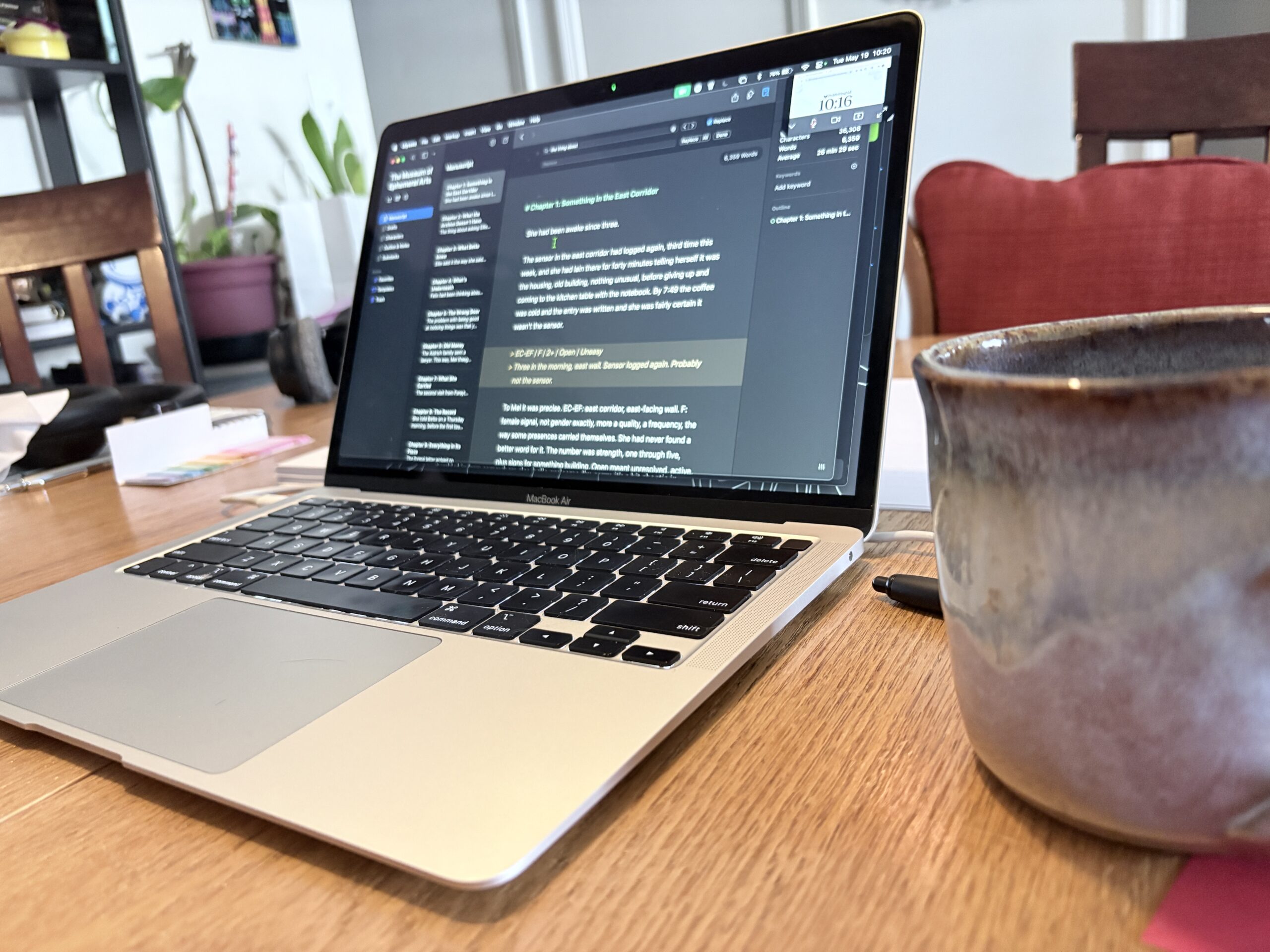
The book is called The Museum of Ephemeral Arts: A Mel Tate Mystery.
It is a paranormal cozy mystery set in a museum dedicated to preserving the last of things, vanishing trades, forgotten sounds, dying crafts, the objects nobody else thought worth keeping. The museum has been collecting things for over a century. It turns out it has also been collecting people.
Mel Tate is the museum’s new tour guide. She is tall, pale, freckled, and in possession of a grey streak at her left temple that appeared at thirty-five and which she decided, after approximately four days of consideration, suited her. She has brown hair that catches amber in the right light, eyes that shift between brown and almost green depending on the day, laugh lines she earned the hard way, and forty-four composition books filled with a notation system she invented when she was nine years old.
She has been aware of the dead since she was nine years old.
She doesn’t call herself a medium. She dislikes the word. If you pressed her, really pressed her, the way almost nobody does because she has spent thirty-two years being professionally warm and personally careful, she would tell you she is a witness. She finds the ones who need finding. She is present for things that happened without anyone present. She makes sure someone knows.
In the east corridor of the Museum of Ephemeral Arts, something has been waiting to be found for eighty-six years.
Mel is going to find it.
The Romance (Or The Possibility Of It)
I want to mention Harper Voss, because I would be doing you a disservice if I didn’t.
Harper is the museum’s IT department, which in a small museum means she is also the person everyone calls when something needs documenting, filming, or fixing, and since she is good with a camera she ends up doing all of those things regularly. She has raven black hair with small braids and wraps and two purple streaks that catch the light when she moves. She wears a raw stone pendant on a silver wire wrap around her neck, dark and shifting between near-black and deep bruised purple depending on the angle. She pairs knit sweaters with combat boots. She has opinions about symmetry that run counter to the general consensus. She paints on Sunday mornings in the corner of her apartment with the right light, three hours, no phone.
She is direct, warm, deliberate, and patient in a way that is clearly a choice rather than a default.
She has been paying a very specific quality of attention to Mel since October.
Mel has been filing this under do not examine since approximately the first conversation they had, which was about cable housing and which Harper made considerably more interesting than cable housing has any right to be.
I’ll leave it there. You’ll have to read the book.
The Part Where I Get Personal
Here is what I didn’t expect about writing Mel Tate.
I expected to write a character. I did not expect to write a character and then spend several months having an ongoing and somewhat unsettling conversation with myself about why she felt so familiar.
Mel has systems. Elaborate, carefully maintained systems for keeping the world around her at a manageable distance. A notation system for the dead. A filing system for her feelings. Boxes within boxes within boxes for the things she is not ready to examine. She has been building these systems since she was nine years old and they work, mostly, until they don’t, and then she has to figure out where she actually stands without the scaffolding.
I have systems too. Mine are less elegant. Mine involve lists that breed other lists, which breed further lists that I may or may not follow or pay attention to, and the deep personal conviction that if I can just organize this one more thing, the inside of my head will become a manageable place to live. It has not yet become a manageable place to live. I remain optimistic.
The thing about being neurodivergent in the specific way that I am is that your brain is simultaneously trying to control everything and unable to control anything. You build systems because the alternative is freefall. And then sometimes the systems become the problem because you’re so busy maintaining the scaffolding that you forget what you were building in the first place.
Writing Mel, watching her slowly run out of room to file things, watching her choose, eventually, to stop filing and just feel, was more personal than I planned for. It messed with my neuroses, to use the technical term. I saw myself in her in ways that were uncomfortable and clarifying and occasionally required me to go and lie in the sun with my cat until I felt like a person again.
Which is also something Mel does, for the record. She and the cat share a philosophical approach to sunlight.
I don’t know if that makes the book better. I think it probably does. I also think it made the writing harder, and I want to say that out loud because I don’t see enough writers talking about the specific difficulty of writing yourself without meaning to.
The Editing Situation (Or: I Killed A Tree)
Here is where we are right now.
The book is written. All twelve chapters and an epilogue. I have a complete manuscript and a character I love and a mystery that resolves properly and a romance that earns itself and a ghost who has been waiting eighty-six years and deserves every page she gets.
I have also printed the entire manuscript.
I killed a tree. I’m sorry about the tree. The tree died in service of something I hope is worth it.
The printed manuscript is sitting on my kitchen table and I am going to take it outside, away from the laptop, away from the screen, away from the seventeen other tabs I have open, and I am going to mark it up like a bad test. Red pen. Margin notes. The whole thing. And then I am going to bring those changes back to the digital document and make them.
My goal is to get through this editing pass this week.
I am saying that here because saying it here means you know, and you knowing means I have to do it.
I also want to be honest that I have two other books sitting in various stages of editing, Shadow Pine Lodge and Last Knight, and they are looking at me from the editing room with the patient, slightly wounded expressions of manuscripts that know they are not the priority right now. I chose the museum. I’m choosing Mel and Harper and Bette and the east corridor and the notation system and forty-four volumes of testimony.
I hope I can stay focused on it. I’m going to try very hard to stay focused on it.
The Publishing Plan (Or: The Part Where I Make A Decision And Hope For The Best)
When this is done, when the red pen has done its work and the digital document has been updated and the manuscript is as good as I can make it, I am going to publish it on Amazon.
Just Amazon, this time. Kindle Unlimited.
I’ve published on Draft2Digital before. The books looked nicer. The distribution was wider. I sold very few copies. I’ve done better on Kindle. Most paranormal cozy mystery readers, in my completely unscientific and anxiety-driven assessment, are probably Kindle readers. Kindle Unlimited is where a lot of cozy readers live. So that’s where I’m going.
Will I regret this? Possibly. I don’t know. I’m doing it anyway, because at some point you have to make a decision and live with it, and I have enough unresolved decisions in my head without adding this one to the permanent rotation.
If it goes badly I’ll tell you about it here. That feels like the honest approach.
The Thing I Want To Say Before I Go
I’m new to doing this publicly. Writing, yes, I’ve been writing forever, in the way that people with obsessive thinking tend to do things forever, completely and without stopping. But talking about writing publicly, building an audience, putting the process somewhere people can see it, that’s new and it makes me feel like I’m showing up to a very organized party wearing the wrong thing.
Other writers on Substack seem to have it together. They have content plans and posting schedules and a clear sense of what their newsletter is. I have thirty-two subscribers, a dead tree on my desk, and a cozy mystery about a woman who witnesses ghosts and is slowly, carefully falling in love.
I think that’s enough to be going on with.
If you’re here, whether you’ve been here since the beginning or you just arrived today, thank you. I’m going to try to show you something real. The writing and the mess and the figuring it out. All of it.
The museum is waiting.
