Winter Short Stories
Every January, we promise ourselves we’ll become someone new. We buy the gym membership, the journal, the expensive hobby kit. But what if all those abandoned attempts weren’t failures? What if they were breadcrumbs leading you to who you were always meant to be?
—

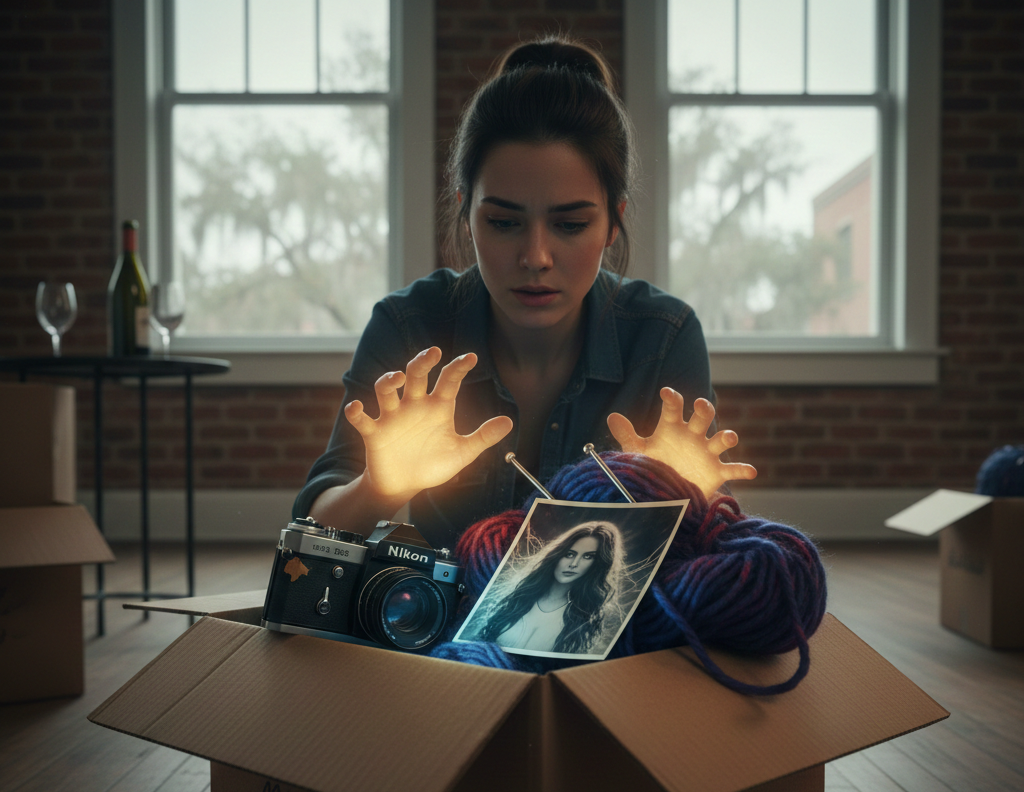
The box was labeled Misc. Storage in her careful handwriting, but that was a lie. It was a graveyard. Or maybe a cradle. Nina hadn’t decided yet.
She sat on the floor of her new Charleston apartment, humidity making the cardboard soft under her palms. She’d been here three weeks, and boxes still towered against the exposed brick walls like a cardboard skyline. This particular box had been sitting in the corner since the movers left, and she’d been avoiding it the way you avoid old letters from people you used to love.
Outside, the January sun was pale and weak. But something else crept through the salt-damp air—something Nina had been noticing more since she’d crossed the city limits. A hum beneath the cobblestones. A whisper in the Spanish moss. Charleston felt alive in a way that made her teeth ache.
Every year on January first, Nina tried to buy a new personality. She didn’t go to the gym like her sister or make resolutions about drinking less. No—Nina went to hobby shops. She went to craft stores with their fluorescent promise of transformation, looking for a version of herself that was more grounded, more artistic, more complete.
What she didn’t know was that she’d been looking for the wrong thing entirely.
She reached into the box. The moment her skin touched the first object, static electricity crackled up her arm. She pulled back, startled. Then reached in again.
The Glass Lens (2019)
The Nikon FM2 was cold and heavy, its shutter jammed, leather peeling. When she lifted it out, static came again—stronger, making the hairs on her arms stand up.
In 2019, Nina had decided to be a “Witness.” She’d spent three hundred dollars on vintage glass and black-and-white film, believing that if she just looked hard enough, she would finally see what everyone else seemed to see: meaning in the ordinary, beauty in the broken.
But what she’d actually been doing, she realized now, was trying to see through the veil.
She’d been drawn to liminal spaces—thresholds, doorways, the places where water met land. She’d photographed mirrors and windows compulsively, never understanding why. The shots that excited her most were double-exposed even though she’d been careful, with figures in the background she didn’t remember seeing.
One particular afternoon, she’d been standing at the Battery, staring at a heron through the viewfinder. The bird had been surrounded by a shimmer she’d convinced herself was heat distortion. Through the lens, she’d seen threads of light connecting the heron to the water, to the air, to her.
She’d been so frightened by what she was seeing that she’d nearly left the camera on a bench and walked away.
But before she’d fled, she’d taken one last photograph.
A woman had been standing at the other end of the Battery—dark hair moving in wind, pale skin that seemed to glow, an expression of such profound loneliness that Nina had felt it in her chest like a physical weight.
The woman had turned. Their eyes had met across the distance. And Nina had run.
She’d convinced herself later that she’d imagined the way the woman’s eyes had reflected light like a cat’s. The way she’d smiled, showing teeth that were just slightly too sharp.
Now, six years later, holding the Nikon in the fading January light of her new apartment, she saw it: a faint luminescence clinging to the metal and glass, like oil on water. She turned it over in her hands and the glow intensified.
“What are you?” she whispered.
There was still film in it, she realized. Roll number six, half-exposed. She wondered what ghosts were trapped inside—what truths she’d been too afraid to develop.
The Tangled Skein (2021)
Beneath the camera was a mass of scratchy wool—the color of a bruised sky. Circular needles were still stuck through it like silver skewers, holding together a shape that might have been a sleeve or might have been something else entirely.
This was the January of the Great Quiet. Nina had decided to knit her way out of anxiety. She would make an Icelandic sweater, become the kind of woman who sat by windows with tea and turned string into armor.
What she’d actually been doing was practicing binding spells without knowing it.
She’d joined a virtual knitting circle that met on Tuesday evenings. Lin in Toronto had said something once that Nina had dismissed as wine-talk: “Knitting is just tying knots with intention. You’re literally weaving reality every time you pick up the needles.”
Nina had laughed it off. But she’d felt it—the way her anxiety bled into the stitches, her tension manifesting in the fabric. She’d been trying to knit herself into calm, but what she’d actually created was a trap. Every row was too tight, binding her own energy into the wool until she couldn’t breathe.
By the time she reached the sleeves, she’d been having panic attacks in her sleep. The wool had felt like a noose because it was one—a noose she’d made herself, knot by careful knot.
She’d abandoned it before she finished, some survival instinct finally kicking in.
Now, touching it again, she felt the knots pulse with that same trapped energy. The wool was warm—too warm for something that had been in a box for years. She pulled her hand back and saw a faint burn mark on her palm, already fading.
“Okay,” she said to the empty apartment. “Okay, this is something.”
Her hands were shaking. She needed air. She needed to think. She needed—
A knock at the door made her jump hard enough to bite her tongue.
The Neighbor
Nina opened the door to find a woman standing in the hallway with a bottle of wine and a smile that made her stomach flip in a way that had nothing to do with fear.
She was maybe twenty-eight or thirty, with dark hair that fell past her shoulders and eyes so dark they looked black in the dim hallway light. She wore a leather jacket despite the humidity, black jeans, and boots that looked expensive. Everything about her was sharp—sharp cheekbones, sharp smile, sharp intelligence in those dark eyes.
She was the most beautiful woman Nina had ever seen.
“You’re making quite a bit of noise up here,” the woman said, her voice like smoke—low and smooth and somehow dangerous. “I’m Delilah. I live in 2C. Thought I’d come introduce myself.”
“I’m Nina,” Nina managed, very aware that she was wearing ancient sweatpants and a t-shirt with a hole in it. “I’m sorry about the noise. I was just unpacking some old stuff.”
“Don’t apologize. Old stuff is the best stuff.” Delilah held up the wine. “I was going to drink this alone while watching terrible reality TV, but I thought—new neighbor, being friendly, all that. Want some company?”
Nina should say no. She was in the middle of some kind of supernatural crisis, possibly losing her mind, definitely not prepared to entertain a gorgeous woman who made her feel like a teenager with a crush.
“Yes,” Nina heard herself say. “That would be great.”
Delilah’s smile widened, and again Nina noticed her teeth were very white, very straight, and the canines were just slightly more pronounced than seemed normal.
“Perfect. I’ll go grab some glasses—I assume you haven’t unpacked those yet?”
“How did you know?”
“Because you’ve been here three weeks and your place still looks like a storage unit.” Delilah leaned against the door frame. “I’ve been watching you carry boxes up and down the stairs. You move in circles—like you can’t decide if you’re staying or going.”
Nina felt exposed. “I’m staying.”
“Good.” Delilah pushed off the door frame. “I’ll be right back.”
—
Delilah returned with two wine glasses that looked expensive. She walked into the apartment like she’d been there a hundred times before, taking in the boxes, the exposed brick, the cheap furniture. Her gaze landed on the open box in the middle of the floor.
“Ah,” she said. “A retrospective.”
“Something like that.”
Delilah opened the wine with practiced ease—no corkscrew, just her hands and a smooth twist that shouldn’t have worked but did. She poured two generous glasses and handed one to Nina.
“To new beginnings,” Delilah said, raising her glass.
“To new beginnings,” Nina echoed, and they drank.
The wine was good—better than anything Nina usually bought. It tasted like dark fruit and something else, something almost spicy that lingered on her tongue.
“So,” Delilah said, settling onto Nina’s couch like she belonged there. “What’s the story with the box of abandoned dreams?”
Nina laughed despite herself. “Is it that obvious?”
“I recognize the signs — you collect a lot of almost-selves over the years.” Delilah’s eyes lingered on the camera. “Photography?”
“2019. I thought I wanted to be a Witness.”
“And now?”
“Now I think maybe I was trying to see something I wasn’t ready to see.”
Delilah’s expression shifted, became more intent. “What did you see?”
Nina shouldn’t tell her. They’d just met. But the wine was warm in her stomach, and Delilah was looking at her like she actually wanted to know, and Nina was so tired of pretending everything was normal.
“Things that shouldn’t have been there,” Nina said quietly. “Lights around people. Shadows that moved wrong. And one woman—” She stopped.
“One woman,” Delilah prompted, her voice soft.
“She was standing at the Battery. I took her picture. And when she looked at me, her eyes—” Nina shook her head. “I sound crazy.”
“You don’t.” Delilah set down her wine glass. “What did her eyes do, Nina?”
“They reflected the light. Like an animal’s. Like—” Nina met Delilah’s gaze and saw something flicker there, something old and patient. “Like yours are doing right now.”
The silence stretched between them, taut as a wire.
Then Delilah smiled, slow and dangerous and somehow sad.
“Well. I wasn’t planning on having this conversation tonight. But I suppose there’s no point in pretending.” She leaned back against the couch. “That was me, Nina. I’ve been in Charleston for a very long time.”
Nina’s hand tightened on her wine glass. She should run. She should scream. She should do something other than sit here feeling like the world had just tilted sideways.
“What are you?” she whispered.
“Old,” Delilah said simply. “Dangerous, sometimes. Lonely, always.” She met Nina’s eyes. “I’m what your grandmother would have called a vampire, though I dislike the word. It’s been corrupted by too many stories. The truth is both more mundane and more complicated.”
Nina should run. She didn’t run.
“Why are you telling me this?” Nina asked.
“Because you saw me. Six years ago, you saw through whatever glamour I wear, whatever story I tell myself about blending in. You looked at me through that camera lens and you saw me.”
She paused. “And because you’re waking up to what you are, and you’re going to need answers that the humans can’t give you.”
“What I am,” Nina repeated faintly.
“You’re not human, Nina. Not entirely. You never have been.” Delilah stood, moved to the box, looked down at its contents. “These aren’t failed hobbies. They’re attempts at finding your practice. The camera to see through the veil. The knitting to bind and shape energy.” She picked up the wool, ran her fingers along it. “You’ve been trying to teach yourself magic, and you didn’t even know it.”
“Magic isn’t real.”
Delilah laughed, and it sounded like wind chimes made of bones. “Says the woman who can see a vampire’s reflection in her camera lens. Says the woman whose hands are currently glowing with residual energy from touching objects she’s charged with her own power.” She gestured at Nina’s hands.
Nina looked down. Her palms were faintly luminescent, like she’d dipped them in glow-in-the-dark paint.
“Oh,” she said faintly.
“There’s a woman who lives downstairs,” Delilah said. “Iris. She’s a practitioner—a witch, if you want to be traditional about it. She’s probably already felt you flailing around up here, trying to figure out what’s happening. She’ll knock on your door soon, offer to teach you.” Delilah paused. “You should say yes. You need a teacher who understands the craft.”
“And what about you?”
“Me?” Delilah smiled, and this time it was genuine, almost gentle. “I can teach you other things. How to see in the dark. How to tell when someone is lying. How to move through the world when the world doesn’t want you to exist.” She moved closer. “How to stop running from what you are.”
Nina’s breath caught. Delilah was close enough now that Nina could smell her—rain and old books and something copper-sweet that made Nina’s hindbrain scream danger even as the rest of her leaned in.
“Why would you help me?” Nina asked.
“Because six years ago, you saw me, and instead of being afraid, you took my picture like I was beautiful. Like I was worth documenting.” Delilah’s voice was soft. “Because I’ve been in this state for two hundred years, and I’ve never met anyone who could see through my carefully constructed normalcy with nothing but a camera and raw, untrained power.” She paused. “And because I’m tired of being alone.”
Nina’s hands were shaking. “I don’t know what I’m doing.”
“Nobody does, at first.” Delilah stepped back, giving Nina space to breathe. “I should go. You need time to process all of this. And Iris will be here soon—she’s very punctual about collecting strays who’ve just awakened to their power.”
“Wait.” Nina stood up. “The photo. The one I took of you. It’s in the camera. On the film.”
Delilah’s expression became unreadable. “Yes.”
“What will it show?”
“The truth. Whatever you were able to see that day.” Delilah moved toward the door, then stopped. “Get it developed, Nina. You need to see what you saw. And then—if you want—come find me. I’m in 2C.”
“What if I’m not—what if I can’t—”
“You can.” Delilah’s smile was small and sad and knowing. “You’ve been running toward this your whole life, Nina. You just didn’t know what you were running toward.”
And then she was gone, moving down the hallway with that same inhuman grace, leaving Nina alone with a half-empty bottle of wine, glowing hands, and the certain knowledge that her life would never be the same.
—
The knock came exactly ten minutes later, just as Delilah had predicted.
Nina opened the door to find another woman standing in the hallway, this one with a bottle of wine—everyone in this building apparently traveled with wine—and an expression that suggested she knew exactly what Nina had been doing in there.
She was maybe fifty, with silver hair cut sharp at her jaw and eyes the color of strong tea. She wore layers of linen despite the humidity, and rings on every finger.
“You’re making quite a racket with all that unpacking,” the woman said, but she was smiling. “I’m Iris. I live downstairs. Thought I’d come introduce myself before you accidentally burned the building down.”
“I’m not—I wasn’t—” Nina stopped. “How did you know?”
“Honey, I can feel you flailing around up here from my kitchen. You’re putting out enough unfocused energy to power the entire block.” Iris held up the wine. “Can I come in? We should talk before you hurt yourself.”
Nina stood frozen in the doorway, still seeing the glow on her hands, still tasting wine that a vampire had poured.
“You’re not crazy,” Iris said gently. “You’re not having a breakdown. You’re just finally waking up to what you are. Now let me in before one of your neighbors sees me standing out here like a Jehovah’s Witness.”
Nina stepped aside.
Iris walked past her into the apartment, her gaze landing on the open box in the middle of the floor, then moving to the empty wine bottle on the counter, then to Nina’s still-faintly-glowing hands.
“Ah,” she said. “Delilah beat me here. That’s unusual—she normally lets me do the welcoming committee routine before she introduces herself.” Iris’s smile was knowing. “She must really like you.”
Nina’s face heated. “She told me what she is.”
“Did she tell you what you are?”
“She said I’m not entirely human.”
“That’s the politest way I’ve heard it phrased in a while.” Iris set the wine on the counter next to Delilah’s bottle. “You’re a practitioner, Nina. A hedge witch, some would call it. You have the ability to work with energy, to see and manipulate the threads of reality that most people ignore. And every single hobby you’ve ever abandoned was actually you trying to stumble your way into your practice.”
Nina sank down onto the couch. “Delilah said the same thing.”
“Delilah has been around long enough to recognize awakening power when she sees it.” Iris sat down in the chair across from Nina. “Charleston is a thin place. The veil between worlds is gossamer here. All that history, all that energy—it soaks into the ground, the buildings, the air. Practitioners are drawn here without knowing why.”
“Why are you telling me all this?”
“Because if I don’t, you’ll keep accidentally setting things on fire or binding yourself into knots. And because—” Iris paused, seemed to choose her words carefully. “Because you need a teacher who understands that you’re not broken. You’re just waking up.”
Nina looked at her hands. The glow had faded, but she could still feel the energy humming under her skin. “What if I don’t want this?”
“Then you’ll keep abandoning hobbies every January for the rest of your life, and that energy inside you will keep building until it finds a way out. Usually messily.” Iris’s expression was compassionate. “But I don’t think that’s what you want. I think you’re tired of running from yourself.”
Nina thought about the heron surrounded by threads of light. About the wool that had trapped her own energy. About all the ways she’d been reaching for something without knowing what it was. About Delilah’s dark eyes and the way she’d said I’m tired of being alone.
“Okay,” Nina said. “Okay. Teach me.”
Iris’s smile was brilliant. “Good. First thing tomorrow, we’ll start with grounding. But tonight—” She picked up the camera. “Tonight, we get this film developed. You need to see what you saw.”
The Development
The photo shop on King Street was the kind of place that shouldn’t still exist—analog in a digital world, dim and cluttered with vintage cameras and film canisters. The owner was ancient, his hands steady despite their tremor as he took Nina’s camera.
“FM2,” he said appreciatively. “Haven’t seen one of these in years. Film’s been in here a while, hasn’t it?”
“Six years.”
He whistled low. “Might not turn out. But I’ll do my best. Come back tomorrow evening.”
—
Nina spent the next day learning to ground herself with Iris, practicing pulling her scattered energy back into her body instead of letting it bleed into everything she touched. It was harder than it looked. Her power wanted to reach, to explore, to connect with the threads of energy that ran through Charleston like veins.
“You’re a natural sensor,” Iris said. “That’s rare. Most practitioners have to work for years to feel what you’re feeling instinctively.”
“Is that why I kept abandoning the hobbies? Because I could feel something but didn’t understand it?”
“Exactly. You were drowning in input with no framework to process it.” Iris handed her a cup of tea. “Delilah will have felt it too. Vampires are predators—they’re attuned to life force. You must have lit up like a beacon to her.”
Nina thought about Delilah turning on the Battery six years ago, their eyes meeting across the distance. “She said I saw her. What did she mean?”
“Vampires can’t be photographed normally. Something about the film, or the soul—depends who you ask. But a practitioner with the sight? Especially one working through a charged object like that camera? You would have seen her exactly as she is.” Iris paused. “No wonder she’s interested in you. You saw past two hundred years of carefully constructed humanity and captured the truth.”
—
That evening, Nina picked up the photographs. The envelope felt heavy with possibility.
She made it halfway home before she stopped on a bench overlooking the water—the same stretch of Battery where she’d taken the photo. The sun was setting, painting the sky in bruised purples and oranges.
Nina opened the envelope with shaking hands.
Most of the photos were what she expected—overexposed shots of the harbor, blurry images of birds, the kind of amateur work that made her cringe. But then she found it.
The photograph of Delilah.
Nina’s breath caught.
In the image, Delilah stood at the edge of the water, her dark hair moving in a wind that seemed to come from nowhere. But around her—through her—there were threads of light and shadow, moving like living things. Her eyes reflected the camera flash, but not like an animal’s. Like mirrors, like windows, like portals to somewhere ancient and vast.
She looked exactly like what she was: something old and powerful wearing a human face.
She looked beautiful.
Nina was still staring at the photograph when she felt someone sit down beside her on the bench.
“Did I turn out well?” Delilah asked softly.
Nina handed her the photograph without a word.
Delilah took it, and for a long moment she just looked. In the fading light, Nina could see her expression shift—surprise, then something softer, almost vulnerable.
“You saw me as I am,” Delilah said finally. “Not the monster I’m supposed to be. Not the human I pretend to be. Just… me.” She looked at Nina, and her dark eyes were bright with something that might have been tears if vampires could cry. “Do you know how long it’s been since anyone saw me like this?”
“Two hundred years?”
“Longer. I stopped seeing myself this way before I was even turned.” Delilah handed the photograph back. “I was twenty-three when it happened. Just a girl who wanted to see the world beyond Charleston’s drawing rooms. The vampire who turned me—he said he was giving me freedom. What he gave me was an eternity of hunger and hiding.”
“I’m sorry.”
“Don’t be. I’ve made my peace with what I am.” Delilah turned to face her fully. “But this—you—seeing me like this and not running? That’s new.”
“I’m terrified,” Nina admitted.
“Good. You should be. I’m older than this country, Nina. I’ve killed people. Not in a long time, not since I learned control, but my hands aren’t clean.” Delilah’s voice was steady, unflinching. “If we’re going to do this—whatever this is—you need to know the truth.”
“This?”
“You feel it too. I haven’t been this drawn to someone in decades. And you—your energy reaches for me every time I’m near. I can feel it, like fingers brushing against my skin.”
Nina’s face heated. “I don’t know how to control it yet.”
“I know. That’s part of why I’m telling you now, before you learn to hide what you feel. Before you learn to lie with your energy the way humans lie with their words.” Delilah stood. “I’m not asking you for anything, Nina. But I wanted you to know: I see you too. And if you want to know me—the real me, not the friendly neighbor act—I’m here.”
She started to walk away, moving with that liquid grace.
“Wait,” Nina called. “Thursday. Iris is having a circle—a gathering of practitioners. Will you come? If I invited you?”
Delilah turned back, surprised. “Vampires don’t usually attend practitioner circles.”
“But you could?”
“I could.” Delilah’s smile grew. “Are you inviting me?”
“I don’t know what I’m doing,” Nina said honestly. “I just found out I’m a witch yesterday. I have a box full of failed hobbies and a camera that sees things it shouldn’t. I’m probably going to be terrible at this.”
“At magic?”
“At all of it.” Nina stood, walked closer. “But I saw you six years ago and I took your picture because you were beautiful. That hasn’t changed. So yes, I’m inviting you.”
Delilah looked at her for a long moment, and Nina saw something shift in her expression—that careful control cracking just slightly.
“Then I’ll be there,” Delilah said quietly. “But Nina? Be careful with me. I’m not good at casual. When I care about something, I hold on. Sometimes too tight.”
“Iris warned me.”
“And you’re still inviting me?”
Nina thought about her box of abandoned hobbies, all those versions of herself she’d tried on and discarded. She thought about running from the camera, from the truth, from everything that scared her.
She was done running.
“Yes,” she said. “I’m still inviting you.”
Delilah’s smile was radiant and terrible and utterly genuine. “Then I’ll see you Thursday, little witch.”
She disappeared into the gathering darkness, moving like smoke, and Nina was left standing on the Battery with a photograph of impossible truth in her hands.
The Practice
Thursday came, and with it, Nina’s first real gathering as part of Charleston’s supernatural community.
Iris’s apartment was exactly what Nina expected—plants everywhere, crystals on every surface, bookshelves crammed with volumes that looked older than the building. Candles burned in the corners, filling the air with sage and lavender.
Four other practitioners were already there when Nina arrived with Delilah. They all stared when the vampire walked in, but Iris handled it smoothly.
“Everyone, this is Delilah. She’s here as Nina’s guest.”
They formed a circle on Iris’s floor, and for the next two hours Nina learned what it meant to be part of a community. They shared techniques, discussed difficult cases, and practiced energy work together. Marcus showed her how to set a basic ward on her apartment. Sienna explained the properties of different herbs. Keiko did a reading that made Nina’s head spin with possibility.
And Delilah watched it all with an expression Nina couldn’t quite read—hunger, maybe, or longing. Like she was witnessing something she’d been denied for a very long time.
When the circle ended and people started to leave, Nina walked back upstairs with Delilah, both of them quiet in the stairwell.
“Thank you,” Delilah said when they reached Nina’s door. “For inviting me. I haven’t felt that… included in a long time.”
“They liked you.”
“They tolerated me. There’s a difference.” Delilah leaned against the wall. “But it was still more than I expected.”
Nina unlocked her door, then turned back. “Do you want to come in? Just for tea. And talking.”
“I shouldn’t.”
“Why not?”
“Because I want to. Very much. And I’m trying to be good.” Delilah’s smile was pained. “I meant what I said, Nina. When I care about something, I hold on too tight. And you’re just learning who you are. The last thing you need is me complicating that.”
Nina thought about her box of abandoned selves. About all the times she’d run from things that scared her. About the photograph of Delilah surrounded by threads of light and shadow.
“What if I want complicated?” she asked softly.
Delilah’s expression shifted—that careful control cracking again. “Nina—”
“I’m not asking for forever. I’m just asking if you want to have tea and talk. That’s all.”
“That’s not all. We both know it’s not all.”
“Maybe not. But we can start there.” Nina held the door open. “Come in, Delilah. Please.”
For a long moment, Delilah just looked at her. Then she stepped across the threshold, and Nina felt the energy shift—a vampire, invited in, crossing into her space with all the weight and permanence that implied.
“Tea,” Delilah said firmly. “And talking. Nothing more tonight.”
“Nothing more tonight,” Nina agreed.
—
Later, after Delilah had left with a careful kiss on Nina’s cheek that had made her entire body sing with possibility, Nina sat on her floor with the blank journal open in her lap—the 2024 one that had judged her so harshly with its emptiness.
She found a cheap, chewed-up pen at the bottom of her purse and opened to the first page.
She wrote:
Day Five. I invited a vampire to witch circle today. Everyone thought I was crazy. They might be right.
But Delilah looked at me like I was handing her something precious. Like belonging was a gift she’d forgotten she could receive.
I’m starting to understand what Iris meant about being messy. About not fitting into anyone’s idea of what I should be.
I’m a witch who takes bad photographs and knits spells too tight. I’m a woman who’s failed at seventeen hobbies but kept all the tools anyway. I’m someone who saw a vampire and thought “beautiful” before I thought “dangerous.”
The box is in my closet now. I don’t need to look at it anymore to remember who I tried to be. Those women are still part of me—the witness, the weaver, the correspondent, the intentional liver. But they’re not separate selves. They’re just facets of one messy, complicated, still-becoming person.
And that person just invited a vampire in for tea.
I think I’m finally becoming someone I recognize.
She closed the journal and looked around her small apartment. Tomorrow she would practice wards with Marcus. Next week she would learn about herb craft from Sienna. In a month, maybe, she would understand how to control the power that hummed beneath her skin.
And Delilah would be there, teaching her how to see in the dark, how to move through the world as something other, how to hold on without being held down.
It wouldn’t be easy. It would probably be complicated and messy and sometimes terrifying.
But Nina was done looking for the perfect version of herself in hobby shops and January resolutions.
She was ready to be exactly who she was: a hedge witch with glowing hands and a box full of almost-selves, learning magic from a cartomancer and falling for a two-hundred-year-old vampire with lonely eyes.
It was enough.
It was more than enough.
It was everything.
—
Thank you for reading. If you’ve ever had a box of abandoned hobbies—a graveyard of almost-selves—I’d love to hear about it in the comments. What were you really searching for?
And if this story resonated with you, please share it with someone who might need to hear that their “failures” were actually lessons all along.
More magic and monsters coming soon. Hit subscribe to get the next story in your inbox.
❤️ Like this story? Tap the heart below
💬 What abandoned hobby taught you the most about yourself?
🔄 Share this with someone still searching
