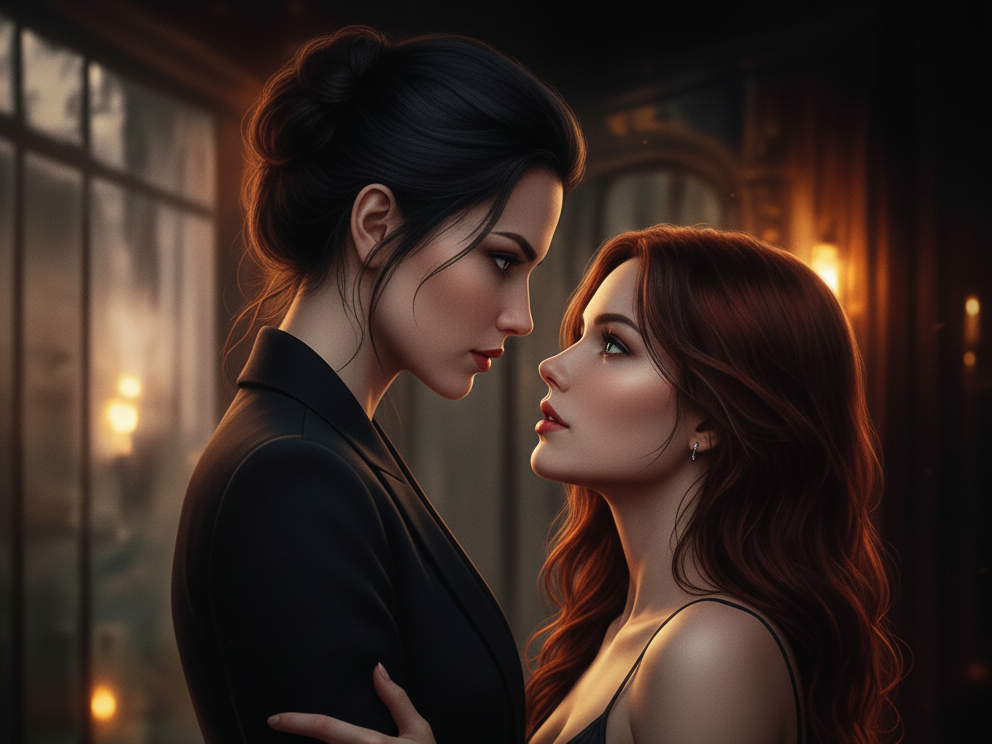
Episode One: The Gallery Opening
Welcome to the start of Falcon & Manon: A Charleston Tale, a series exploring the secret history, old magic, and eternal shadows of the Lowcountry. If you’re new here, buckle up, it gets humid, and the past is never truly dead.

Spring 2024
“They’re not for sale.”
Falcon turned from the photograph—a phosphate factory drowning in kudzu, windows like empty eye sockets—to find a woman watching her with sharp, silver-gray eyes.
The gallery reeked of cheap Chardonnay and cheaper conversation. Gas lamps flickered through the front windows, casting gold across exposed brick while Charleston’s French Quarter hummed outside: tourists stumbling between bars, carriage horses on cobblestones, jasmine blooming wild in hidden courtyards.
But this woman looked like she actually gave a damn about the art.
Auburn hair, mid-thirties, wearing a black dress that was elegant without trying. The kind of dress someone wore when they needed to move, to work, not to be admired.
The kind of woman Falcon should have walked away from immediately.
“A pity,” Falcon said, letting her old Charleston drawl slow the words like molasses.
“They deserve to be lived with. Studied. Not just glanced at between glasses of bad Chardonnay.”
The corner of the woman’s mouth twitched. “The wine is terrible, isn’t it?”
“Unforgivable.” Falcon extended her hand, cool skin against the humid spring air.
“Charlotte Falcon. Most call me Falcon.”
“Manon Laurent.” Her grip was firm, confident. She didn’t flinch at the temperature difference the way mortals usually did. “You pronounced your name the French way.”
“My family were Huguenot. Old Charleston.”
True enough, though that family was two centuries dead and dust.
Manon’s gaze drifted back to her photographs—abandoned rice mills consumed by marsh grass, plantation houses collapsing into themselves, grand columns buckling under humidity and neglect. “How long have you been photographing the Lowcountry?”
“Eight years. Moved here from Texas for grad school, MFA in photography. Planned to stay two years.” Manon’s expression softened. “The ocean wouldn’t let me leave.”
Something in those words resonated in Falcon’s chest like a struck bell. Charleston had claimed her too, long ago. Claimed her and never released its grip.
“Which piece is yours?” Manon asked, gesturing to the crowd. “You have the look of a collector.”
“What look is that?”
“Like you’re evaluating everything for acquisition. Or threat.” Manon met her eyes steadily. “Most people here are just networking. You’re actually looking.”
Clever. Observant. Dangerous.
“I collect many things,” Falcon said carefully. “But I’m not here for acquisition tonight. I saw your work through the window and couldn’t resist.”
“That’s stalking behavior.” But Manon’s tone was teasing.
“I prefer ‘irresistibly drawn.’”
“That’s definitely stalking.”
Falcon laughed—genuine, surprised. When was the last time someone had made her laugh without calculation or centuries of context? “Guilty. Should I leave before you call security?”
“Security is my friend Rafael, and he’s smoking in the alley.” Manon tilted her head, studying Falcon the way she probably studied her viewfinder. “Besides, you’re the first person tonight who actually looked at the work instead of the price tags. You can stay.”
“Generous.”
“Pragmatic. These people don’t care about abandoned phosphate factories. They want something to hang in their beach houses that says ‘I appreciate art’ without actually appreciating it.”
“Cynical for an artist.”
“Realistic for a photographer trying to pay rent.”
They drifted toward the quieter end of the gallery, away from the worst of the crowd.
Falcon was intensely aware of Manon beside her—the rhythm of her heartbeat, the warmth radiating from her skin, the faint scent of developer chemicals and jasmine perfume. The hunger stirred, that eternal hollow ache, but Falcon had two centuries of control.
What unsettled her was the other wanting. The one that had nothing to do with blood.
“Why abandoned places?” Falcon asked. “Why not tourist Charleston? Rainbow Row, the Battery, church steeples?”
Manon was quiet for a moment. “Because that’s the Charleston everyone sees. I’m interested in what gets forgotten. What we build and abandon. The places that remember even when we want to forget.” She paused. “Does that make sense?”
“Perfect sense.”
More than Manon could know. Falcon was herself a ruin that remembered, walking through a world that had moved on without her.
“What do you do?” Manon asked. “Besides collecting things and stalking artists?”
“I manage properties. Historic preservation, mostly. I’ve lived in Charleston most of my life.” Another truth carefully edited. “I have a particular affection for things that survive beyond their time.”
“That’s a romantic way of saying you flip houses.”
“I prefer ‘give them purpose again.’” Falcon smiled. “Not so different from what you do. You document what’s dying. I try to keep it alive a little longer.”
“Both losing battles.” Manon’s voice went soft. “Everything falls apart eventually.”
“Yes.” Falcon looked at her—really looked. There was grief in this woman, carefully buried but present. Something had broken in her past. “But there’s beauty in the falling, isn’t there? In the fact that it tries to stand at all.”
Manon held her gaze. For a moment the gallery disappeared—the awful wine, the pretentious chatter, the weight of time itself.
Just two women standing in lamplight, recognizing something in each other that neither could name.
“Ms. Falcon.”
The voice cut through the moment like a blade.
Falcon didn’t turn immediately, though every predatory instinct locked onto the presence behind her. She knew that voice.
Marcus. The Savannah Guardian, here instead of waiting at the Magnolia Club where he belonged.
“Marcus.” She turned, her expression pleasant and utterly cold. “You’re early.”
He was tall, dark-suited, ageless in that way that could be thirty or three hundred. His smile didn’t reach his eyes. “You were late. I thought I’d find you here instead of where we agreed to meet.”
The rebuke was clear. Guardians didn’t stand each other up. It was a breach of protocol, a sign of disrespect.
Marcus’s presence here was both message and threat: I know where you are. I know what you’re doing. I know you chose this over me.
“I was detained,” Falcon said smoothly. “Surely our business can wait—”
“Now would be better.” Marcus’s gaze slid to Manon, dismissive and coldly appraising. “Unless you’re otherwise engaged?”
The question hung heavy with implication.
Falcon felt her hands curl into fists—the only outward sign of rage coiling through her. He was testing her. Pushing to see if she’d choose mortal company over Guardian obligations.
She could end this. Make polite excuses to Manon, follow Marcus to the club, handle the territorial dispute like the Guardian she was. The smart choice. The safe choice. The choice she’d made a hundred times before with a hundred other mortals who’d caught her interest briefly before fading back into the anonymous stream of humanity.
Falcon looked at Manon, who watched the exchange with quiet intelligence, clearly sensing the tension.
“Actually,” Falcon said, turning back to Marcus with a smile that showed too many teeth, “I am otherwise engaged. Perhaps we could reschedule? Next week. I’ll have Arthur call your people.”
Marcus’s expression hardened. “This is unacceptable.”
“And yet I’m accepting it.” Falcon’s voice dropped to a register that vibrated with command and barely leashed violence. “Go back to Savannah, Marcus. Tell whoever sent you that I am perfectly capable of managing my own territory. We’ll talk when I decide we need to talk.”
For a long moment, Marcus stared at her. Then his gaze flicked once more to Manon, calculating, before he turned and walked out without another word.
The silence that followed felt fragile.
“Friend of yours?” Manon asked dryly.
“Business associate. Territorial dispute.” Falcon relaxed her hands. “I apologize for the interruption.”
“You just pissed him off pretty thoroughly for me.” Manon’s eyebrows rose. “Should I be flattered or concerned?”
“Both, probably.” Falcon surprised herself with honesty. “He’ll get over it. And if he doesn’t, that’s not your problem.”
“Is it yours?”
“Potentially.” Falcon met her eyes. “But worth it.”
The words landed between them, more confession than she’d intended.
Manon’s expression shifted… something warm and surprised flickering across her face.
“You don’t know me,” Manon said quietly. “You’ve known me for twenty minutes.”
“I know your work. I know you left Texas and found the ocean. I know you see beauty in things other people want to forget.” Falcon took a careful breath she didn’t need. “And I know I’d rather be here than anywhere else in Charleston tonight.”
Manon studied her for a long moment. Then she pulled a card from her clutch, handwritten in fountain pen. “I’m doing a shoot tomorrow evening. Old phosphate factory on the Ashley River. If you’re interested in seeing more abandoned places.”
Falcon took the card, their fingers brushing. “What time?”
“Sunset. I like the light then.” Manon’s smile was slight but genuine. “Fair warning—I don’t usually invite strangers to remote locations, but you did just alienate someone for me. Seems only fair.”
“I’ll be there.”
“Good.” Manon glanced around the gallery at the crowd growing louder and drunker. “I should circulate. Pretend to care about networking.”
“And I should go smooth ruffled feathers.” Though Falcon had no intention of apologizing. “Thank you for letting me stay.”
“Thank you for actually looking at the work.” Manon’s expression softened.
“Tomorrow, then.”
“Tomorrow.”
Falcon watched her disappear into the crowd, auburn hair catching lamplight like a beacon.
She should leave now. Should put distance between herself and this dangerous wanting. Should remember all the mortal women before—the ones she’d kept at arm’s length, the ones whose names she’d deliberately never learned because knowing made it hurt more when they aged and died and she remained.
But she was already thinking about tomorrow evening. About light falling through broken windows. About watching Manon work, seeing how she moved through the world with her camera.
“You’re making a mistake.”
Arthur stepped out of the shadows near the gallery entrance, his expression troubled. He’d been watching, of course. Always watching, always protecting, ever since that night in the 1840s when he’d seen her take a beating meant for someone else.
“Probably,” Falcon agreed.
“She’s mortal.”
“I know.”
“Marcus will report this to the Court. There will be questions.”
“Let them ask.”
Arthur sighed—the sound of someone who’d had this conversation before, in different decades, with different faces but the same outcome. “At least be careful.”
“I’m always careful.” Falcon turned to him, something almost pleading in her expression. “But Arthur… what if this time is different?”
“That’s what concerns me,” he said gently. “Because this time, you already believe it is.”
He was right. God help her, he was right.
She’d known Manon for less than an hour and already the pattern felt broken, the careful distance impossible to maintain. Already she was thinking not in terms of nights but weeks, months, the shape of something that couldn’t exist but insisted on existing anyway.
Outside, Charleston breathed its humid night air—jasmine and pluff mud and the salt promise of the ocean. Gas lamps flickered like earthbound stars. Somewhere in the French Quarter, Marcus was probably making calls, spreading word that Falcon was distracted, compromised, weak.
Let them think it.
Falcon had held this city for 170 years not through cruelty or fear but through something they couldn’t understand: she loved it. Every cobblestone, every ghost, every whispered prayer in the old churches. She loved it the way Arabella had never been able to love anything—without needing to own it.
And now, impossibly, she was falling for a mortal woman who photographed beautiful ruins with silver-gray eyes that saw too much.
Falcon tucked Manon’s card into her pocket and walked out into the warm spring night, already counting the hours until sunset tomorrow.
Behind her, the gallery continued its hollow celebration, none of them knowing that something had shifted in Charleston’s careful balance. That the Guardian had chosen, however briefly, a mortal woman over duty.
That some choices, once made, could never be unmade.
The city hummed around her, old magic stirring in the stones.
And Falcon smiled despite everything.
Tomorrow. She would see Manon tomorrow.
That was worth whatever came after.
What Happens Next?
Falcon has chosen Manon over her Guardian duties, but Marcus—and the mysterious “Court”—will not forget the slight.
Join the Discussion: What do you think Arthur meant when he said Falcon believes this time is different? Share your theories about Falcon’s past and Manon’s possible role in the comments below!
Continue the Story:
Episode 2: The Phosphate Factory at Sunset will be delivered to your inbox next Thursday at 7:00 AM EST.
Catch Up:The Charleston Guardian
Author’s Note: Thank you so much for reading the first installment of The Charleston Guardian! This series is a passion project, and I’m thrilled to share this world of humid nights, ancient magic, and dangerous romance with you. If you enjoyed this, please share it with a friend—word of mouth is everything for independent writers!

