The Knights of Maenara Collective (1 of 10)

Detective Nicola Knight had come home the way ghosts do: quiet, uninvited, and carrying unfinished business. Her plane touched down at Louis Armstrong International at 6:13 p.m., wheels screeching like wounded birds, engines reversing with enough force to jolt her forward against the fraying seatbelt. Nicola didn’t flinch. She’d flown rougher rides into smaller towns, dropped into places where the only welcome was a rust-eaten sign pocked with bullet holes and a missing persons report gone yellow at the edges. This was just New Orleans. It wasn’t the landing that shook her, it was the return, the way gravity felt different when you’d spent three years running from it.
Outside, the heat pressed against her like something alive, something with wet palms and shallow breath. Something that kissed your skin with tongue and teeth, promised sweetness, then suffocated you slow while humming a lullaby. The air tasted of jet fuel and overripe magnolias, thick enough to chew. Nicola bypassed baggage claim with the practiced efficiency of someone who’d learned to live out of a single bag, crossing toward the short-term parking garage where fluorescent lights buzzed and died in stuttering intervals, casting everything in sickly green.
In the dimness between dying bulbs, a shape stood out: a 1997 Ford F150 with sun-faded red paint the color of dried blood, rust blooming around the wheel wells like orange lichen claiming territory one molecule at a time. Leaning against the dented driver’s side door, arms crossed and one scuffed boot propped on the tire, was Delphine Guidry.
Del had been her best friend since childhood, back when childhood meant catching crawfish in coffee cans and learning which plants would make you sick if you weren’t careful. She was trouble with a smile, fire wrapped in denim and leather, lean and wiry as a whip, skin like polished mahogany that caught light and held it, and olive green eyes narrowed against the heat and everything else life threw at her. Where Nicola moved like she was perpetually bracing for impact, shoulders hunched and hands always near her weapon, Del moved like a lit match actively seeking gasoline.
“You pick a fight?” Nicola asked, reading the tension in Del’s crossed arms, the tightness around her mouth, the way her jaw worked like she was chewing on words too sharp to swallow.
“She’s got an attitude today.” Del gestured at the truck with a tilt of her chin, affection and exasperation braided together in her voice. “Been stalling out since Tuesday. Think she knows I was looking at newer models.”
Nicola sighed and rolled up her sleeves, revealing forearms corded with lean muscle and a few pale scars that never tanned. “Mind if I…?”
“Be my guest. She responds better to you anyway.”
They fell into rhythm without a word, moving around each other with the fluid grace of people who’d spent years in each other’s orbit. Muscle memory, or something older, something written in bone and marrow. Del held the flashlight at awkward angles, cursing softly in a mixture of French and English, words her grandmother had taught her that had no good translations. Nicola reached in, grease-stained fingers catching tools before they could hit gravel, anticipating Del’s movements like reading sheet music.
“You always bring city clothes to a street fight?” Del asked, the beam catching Nicola square in the eyes, turning her pupils to pinpricks.
Nicola winced, raising one oil-streaked hand to shield her face, “You still hold a flashlight like it owes you money and you’re coming to collect.”
Del grinned, wide and wolfish, showing the gap between her front teeth that she’d always refused to fix. “Well, it does. Oughta pay rent the way I carry it through every damn crisis you drag me into.”
“You remember when you tried to tape one to your forehead? Said it was ‘hands-free innovation,’ but it burned a bald spot into your hairline the size of a quarter.”
“Unnecessary attack.” Del’s voice carried mock offense, but her grin widened. “I was fifteen and a visionary ahead of my time. Besides, the burn only lasted six weeks.”
“You smelled like melted plastic and regret for the entire summer.”
“Regret’s the cologne of genius,” Del said, and gave the truck a hard thump with the flat of her hand, the metallic thud echoing through the parking structure.
In the pause that followed, cicadas filled the space between words with their electric screaming, a sound that meant summer, memory, and time passing whether you wanted it to or not. Nicola found the issue. It was a loose ground wire, exactly what she’d suspected. She tightened it with practiced efficiency, her hands remembering this engine the way you remember prayers learned young.
“Missed this,” she said quietly, barely audible over the insect chorus.
Del didn’t look up, her fingers still wrapped around the flashlight like a lifeline. “The truck?”
“Yeah. Especially the part where she breaks down every other Tuesday like clockwork, reliable in her unreliability.”
Del finally met her eyes, and Nicola saw three years compressed into that look, all the calls not made, the texts not sent, the space that had grown between them. “Still runs, don’t she?”
Nicola looked at the engine, its guts exposed and vulnerable, then at Del. “Like hell. But I guess so do we.”
Del laughed, big and honest, the sound ricocheting off concrete and rebar. “Speak for yourself. I’m thriving on caffeine, good herbs, and spite. That’s the holy trinity keeping me upright.”
She slid behind the wheel and turned the key. The truck grumbled to life with a sound like a bear waking from hibernation: reluctant, angry, but ultimately cooperative. Del whooped, triumphant, slapping the steering wheel. “I’d say I owe you, but I ain’t lying to your face this early.”
Nicola grabbed her duffel, the canvas worn soft and stained with dirt from a dozen towns whose names she’d already half-forgotten. The passenger door stuck when she opened it, the hinges groaning like arthritic joints. Still. After all these years, she smiled despite herself. “Some things never change.”
The drive was long and quiet at first, the silence between them comfortable and terrible in equal measure. Swamp-lined roads blurred past, Spanish moss dancing like ghosts in the trees, hanging and swaying in the thick evening air. The dashboard glowed soft orange in the gathering dark, instrument lights reflected in the windshield like distant stars.
“I’m sorry,” Nicola said finally, the words scraping their way out of her throat where they’d been lodged for months. “I didn’t mean to disappear like that. Like I’d never existed at all.”
Del glanced over, her profile sharp in the dashboard glow, but said nothing. The truck’s engine filled the silence with its steady growl.
“They called me in to consult on a missing persons case in Georgia. Small town, one girl gone. One turned into thirty-six.” Nicola’s voice was flat, factual, the tone she used for reports. “Pattern recognition. That’s what they called it. Like I was software instead of a woman who couldn’t sleep.”
Del’s voice was steel wrapped in velvet, soft but unbreakable. “That’s not consulting. That’s exile. That’s running until your legs give out.”
“No one else saw the patterns,” Nicola replied, watching the road unspool before them like ribbon. “And I needed the silence. Needed to not hear my own thoughts echoing in that warehouse. Needed to chase someone else’s ghosts instead of sitting with mine.”
Del nodded slowly, her hands flexing on the steering wheel, knuckles going white then relaxing. “Doesn’t mean it didn’t suck. Doesn’t mean I didn’t call your phone just to hear your voicemail. Doesn’t mean I didn’t drive by the warehouse some nights.”
Nicola didn’t argue. She watched fireflies lift from the brush, blinking gold against the gathering dark like tiny lanterns carried by invisible hands. She used to trap them in mason jars as a kid, holes punched in the lid with a screwdriver, swore they could lead her somewhere important if she watched them long enough.
“I didn’t run, Del,” she said, watching one firefly’s arc across the darkness. “I followed ghosts. It’s different.”
Del shifted in her seat, boot scraping against the gas pedal with a sound like sandpaper. “What kind of ghosts live in Georgia?”
Nicola gave a tired half-smile, the kind that didn’t reach her eyes. “The kind that don’t know they’re dead yet. The kind that keep walking around, keep going to work, keep kissing their kids goodnight, until one day they just… stop. And everyone acts surprised.”
A pause, filled with engine noise and the whisper of wind through the cracked window.
“Then, there was a girl in a well. Seventeen, blonde, missing three years. Everyone said it was a dead end, that she’d run away to Nashville or Atlanta, chasing some boy or some dream. But I climbed down anyway, boots sinking into mud that smelled like rot and copper, hands going raw from rope that hadn’t been replaced since the well was dug. I didn’t just find her, I found what they’d buried with her. The lie, sealed up neat like a secret with its mouth stitched shut and coins on its eyes.”
Del listened the way she always had, without rushing, without offering empty platitudes, just present and solid as earth.
“Then there was a woman who moved like mist through three counties. Changed names like seasons, shedding identities like snake skin: Dahlia, Rose, Camellia, always flowers, always something that could be pressed and preserved. I chased her handwriting across truck stop receipts and motel registers, knocked on doors with lukewarm coffee in one hand and her photograph in the other. Kept her trail in notebooks and napkins, like catching fireflies in a jar, trying to map something that refused to hold still.”
She exhaled slowly, the breath carrying weight. “There was a fire. Fields lit up like the end of the world, flames so bright you could read by them from two miles away. Nothing left but ash and the twisted skeletons of irrigation equipment. But she’d been sending money orders to a sister in Athens. I traced them, one smudged receipt at a time, following paper ghosts through Western Unions and check-cashing places that smelled like desperation and air freshener. Paper trails leading me home to something that looked like closure if you squinted.”
Her voice softened, went ragged at the edges. “Then a grave. Unmarked, half-swallowed by vines thick as your wrist. Found it mentioned in a county file no one had bothered to read since 1987, just a note in margin about ‘unidentified remains, female, approximate age 30-40.’ We ran the DNA. Her sister had been lighting candles every year on her birthday, still hoping for a miracle, still setting a place at Thanksgiving dinner.”
She met Del’s eyes. “She was a Jane Doe with just enough left to say her name one last time. Just enough teeth for dental records, just enough bone for DNA.”
“You’re still talking to the dead,” Del said quietly, not quite a question.
“Sometimes they answer.”
“And what do they say?”
A long pause, filled with the sound of tires on asphalt and something crying in the swamp. “They say I should’ve come home sooner. They say I’m a coward with a badge.”
The road narrowed, flanked by ancient trees that leaned together overhead like cathedral arches, their branches weaving a canopy that blocked what little moonlight remained. Del’s voice was barely audible over the engine, rough with something that might have been tears. “Lots more ghosts out this way. Always have been. This land remembers everything.”
Nicola didn’t ask if she meant the land or the years or the people who’d walked here and left their marks in blood and longing. “They don’t bother me anymore.”
“You always were better at making peace with the dead, Nix. It’s the living that confuse you.”
Nicola’s eyes flicked to a crooked road sign, weathered past legibility. Almost there. Almost home. Almost time to face whatever waited.
Salt Row had always been more ghost town than neighborhood, a stretch of old shrimping warehouses slouched along the bayou like drunks propping each other up, most picked clean for copper wiring and anything else that could be sold for scrap, left to rot in the salt air that ate everything eventually. Nicola and Ellie had been the only ones foolish or hopeful enough to stay, to see potential in rust and ruin.
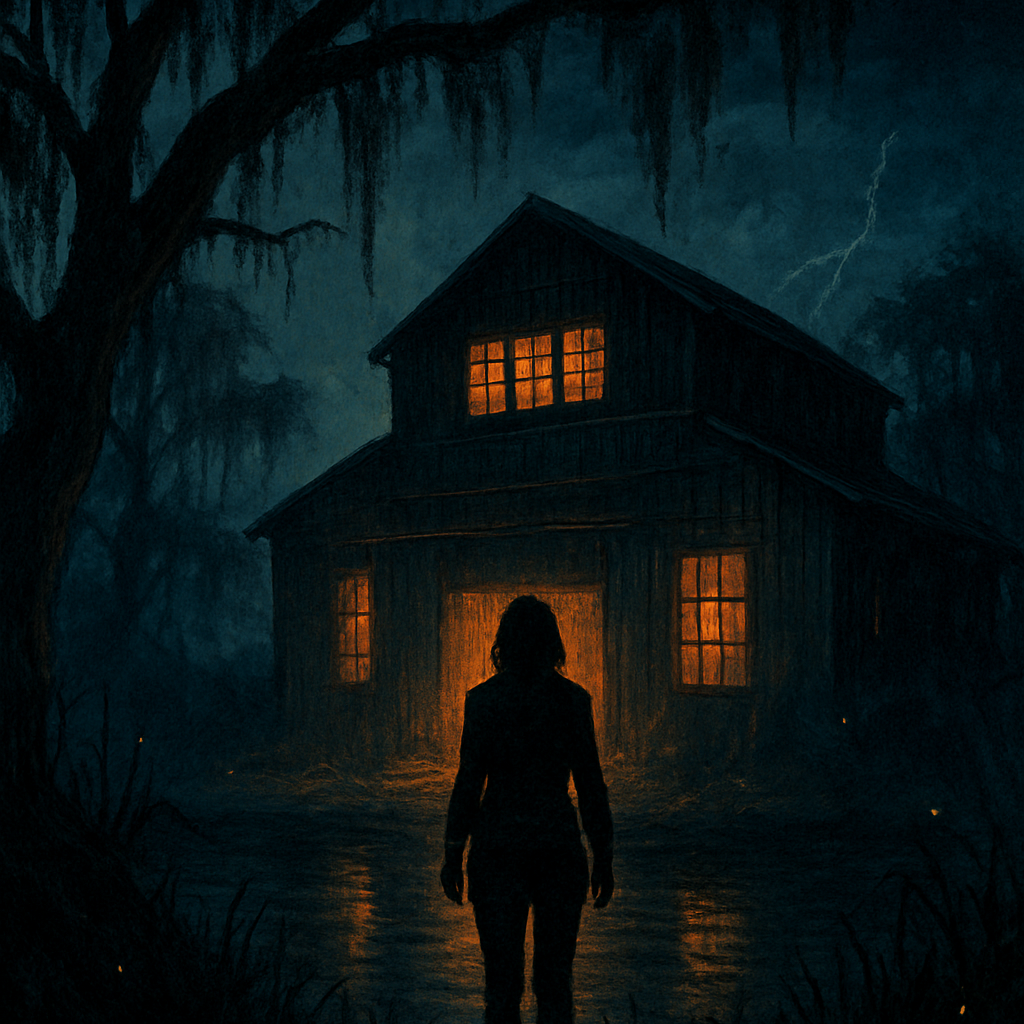
Their warehouse loomed ahead through the windshield, three stories of stubborn steel and weathered wood that had survived hurricanes, floods, and time itself through sheer obstinacy. It looked like something halfway between a mausoleum and a shipwreck, all sharp angles and dark windows that caught moonlight and held it like accusations. Nicola approached the front door with the wariness reserved for old friends and older gods, things that knew you too well to be trusted completely.
The key slid into the lock, brass worn smooth by years of hands, but the mechanism resisted with the peculiar stubbornness of metal that had tasted salt air too long. She pressed harder, shoulder against the door. Click. Then snap, sharp and final as breaking bone.
The broken edge of the key caught her palm in a mean slice, the kind that hurts worse five seconds after it happens. Blood welled up fast and hot, slipping down her lifeline in a dark ribbon that looked black in the porch light’s sickly yellow glow.
A single drop hit the threshold, soaking into wood that had drunk rain and a decades of footsteps.
The porch light flickered once, twice, then held steady but wrong, brighter than it should be, almost pulsing.
Then the wind shifted, hard and sudden, like breath sucked in before a scream. Trees groaned, their branches scraping together with sounds like fingernails on coffin lids. Thunder rolled somewhere in the marsh, low and threatening, though the sky held no clouds.
Nicola stood perfectly still, blood dripping steady as a metronome, each drop hitting wood with a sound that seemed too loud, too purposeful.
The front door creaked open by itself, hinges shrieking, swinging wide like an invitation or a warning.
A whispered memory surfaced, a voice thick with accent and absolute certainty: “Blood is how the house remembers its own. You feed it once, it knows your taste forever.”
Another drop sank into the boards, disappearing like water into desert sand, and the air tightened around her, pressure building in her ears, in her chest, in the space between her ribs where her heart hammered. She hadn’t meant to wake anything, but the house had been listening for that particular sound all along, waiting with the patience of wood and stone and things that don’t measure time in human years.
“She remembers you,” Del said under her breath, and there was something in her voice that wasn’t quite fear but was its close cousin.
Inside, the dark was thick and textured, the kind of darkness that has weight and temperature. Del moved to the fuse box mounted near the door, its metal cover streaked with rust like dried blood, and started flipping switches with sharp, decisive clicks. Overhead bulbs coughed to life, stuttering and blinking like old eyes waking after a long sleep, filaments glowing orange before settling into harsh white. Behind them, the wind slammed the front door shut with a bang that echoed through the cavernous space.
The first floor opened around them like a mouth, revealing its guts: old ropes coiled like sleeping snakes in the corners, stacks of crab traps rusting into lace, scattered tools dusted in sea grit and time. Dried herbs still hung from the net hooks by the far wall, rosemary gone gray, bundles of sage crumbling to dust, things Ellie had hung there and never taken down.
“You never cleared any of this?” Del asked, her voice echoing strangely in the space, bouncing off metal, wood, and memory.
Nicola shook her head, wrapping her bleeding hand in a bandana from her pocket, but the red was already soaking through the fabric. “Didn’t have the stomach for it. Felt like erasing her. Like admitting she was really gone.”
The lights held steady now. Just barely. But in their glow, shadows moved in ways shadows shouldn’t, stretching and contracting like something breathing.
“You staying?” Nicola asked, though she already knew the answer from the way Del stood with one hand on the door, weight shifted toward escape.
Del hesitated, her eyes searching the shadows that pooled in corners and gathered under tables like living things. “I don’t know if I can. This place… it’s too much Nix. Too full. Too empty. Both at once.” Her voice cracked. “Ellie was my friend too. I miss her. And I’m still figuring out what that means, for me and you. For us. For whatever we are now that she’s not here to be the bridge between us.”
Nicola’s throat tightened, muscles constricting around words she couldn’t quite form. Ellie, with her fierce smile and softer edges, with her laugh that sounded like bells and her hands that could coax life from the stubbornest soil, had been gone for three years, carved out of their lives by brain cancer that had eaten through her like rust through steel. They’d fought it with everything: surgeries and chemo and radiation and prayers and herbs and hope. But the cancer had won anyway, the way cancer always seemed to, slow and relentless as the tide.
“It’s like she’s still here,” Del continued, voice breaking on the last word. “I can smell her perfume. That lavender and something else, something green. And I keep expecting her to walk down those stairs, say something wise and weird, make everything make sense again.”
“Coffee?” Nicola offered quietly, knowing it wasn’t enough but offering anyway because that’s what you did, you offered small comforts when the big ones were impossible.
Del shook her head, already backing out the door like something was pushing her, gentle but insistent. “Storm’s coming. I can smell it. I need to get home before it hits, before the roads flood.”
Nicola didn’t argue. She watched Del disappear into the night, the taillights of the old Ford fading into darkness like dying embers, then turned back to face the warehouse alone. The elevator waited, its metal accordion gate half-open like a mouth.
She headed for the freight elevator, her footsteps echoing on concrete.
The second floor was warmer, sweeter, like stepping into a different house entirely, or maybe into a memory of what a house could be. Lavender still lingered in the wood, in the very grain of it, like the scent had soaked in and become part of the structure. The industrial bones of warehouse and ruin gave way to deep jewel tones painted over years: sapphire blues and garnet reds and forest greens, all layered like rebellion against the rust and salt outside. An old crab-sorting table, scarred and stained and solid as faith, served as a kitchen island with copper pans hanging from shrimp net hooks overhead, catching light and throwing it back in warm amber.
A pothos vine, thick as rope and covered in heart-shaped leaves, wound around the pulley system above the window where Ellie had trained it, talking to it while she worked, telling it stories and secrets and occasionally arguing with it when it grew in directions she didn’t approve of.
Every clever repurposing, every touch of whimsy and defiance, that had been Ellie. She said a home should feel like it was holding its breath in the best way, in anticipation instead of fear. She hadn’t left. Not really. Her presence saturated the space like water in wood, invisible but essential, holding everything together.
Nicola took the metal stairs up, her boots ringing on each tread, the sound both lonely and familiar. The third-floor loft opened into weathered beams and billowing tapestries, deep reds and golds and midnight blues that moved in drafts that came from nowhere. The bed sat on a platform constructed from old shipping crates, their stenciled labels still visible—Port of New Orleans, Fragile, This End Up—draped in mismatched quilts that Ellie had collected from estate sales and thrift stores, each one with its own history stitched into faded patches.
Books lined every surface in precarious towers: botanical encyclopedias with color plates, horror novels with cracked spines, critical theory Ellie had marked up in purple pen, cookbooks stained with oil and wine and years of use. A nightstand constructed from weathered crab baskets held a reading lamp with a green glass shade and a cracked photo frame.
Ellie’s smile stared out from behind the fractured glass, forever backlit by golden hour sun, her hair wild around her face, eyes bright with something that might have been mischief or love or both.
Nicola dropped her bag with a thud that seemed too loud, too final. She lit a candle, beeswax and honey scent filling the air. Then poured two fingers of rye into a pale green glass etched with faded leaves and vines. Ellie’s glass. Botanical, like everything she touched. Organic. Growing.
The phone rang, loud and insistent and rude in the candlelit quiet, shattering the moment like a rock through stained glass.
“Knight,” she answered, voice like gravel scraped over concrete, her cop voice automatic as breathing.
“Hey, Detective. It’s Officer Maddie Broussard, NOPD.” Young voice, nervous energy crackling through the line. “Chief Oakley saw you were scheduled to return today. I know you’re technically off-duty until Monday, but—”
“What’s going on?”
“Warren’s already on scene. Said it’s ‘delicate’ and you’d want to see it before the news does, before it becomes a circus.” A pause, heavy with meaning. “It’s at your grandparents’ old place.”
Nicola went completely still, the glass frozen halfway to her lips, rye catching candlelight and holding it.
“First response is already there, media’s sniffing around like bloodhounds. Chief said you’d understand why.”
“I’m not officially back until…
“I know, I know. But when he said your name, it wasn’t a suggestion. You know how he gets.”
Silence stretched between them, filled with static and things unsaid.
“You okay?” Maddie asked, genuine concern bleeding through the professional courtesy.
“Guess I’m about to find out.”
“Texting you the pin now. And Nic? It’s good you’re back. Really. We missed you.”
Nicola ended the call with a thumb that felt numb, disconnected. She opened her duffel with mechanical precision, gathering badge, cuffs, and service pistol. All standard issue, all cold metal and bureaucratic weight. But the knife, her grandfather’s knife, she took with both hands, reverently, though the worn leather of the sheath caught on her cut palm.
“Dammit.” She wrapped it quickly with a fresh rag from her bag, but the blood was already soaking through by the time she strapped the sheath to her belt, the red blooming like flowers in fast-forward.
The sheath was worn soft as skin from decades of handling, the wild olive wood handle warm even in the cool air, its grain swirling in patterns that seemed to shift in candlelight. A sigil was burned in. Curves and angles that might have been letters in a language long dead were similar to the one burnt into her skin but not quite the same. Not quite.
Her grandfather’s mark had been a ward, meant to keep things out, to build walls between worlds. Hers was burned into the flesh over her collarbone when she was thirteen by a woman whose name she’d never learned. She said it burned to let things in, to open doors that should stay shut.
The scar pulsed, harder now than it had in months, a throb that matched her heartbeat and went deeper. The ghost in her blood was stirring, waking like something that had been sleeping light and dreaming dark. She’d been marked and nobody left alive had explained what it meant, what it was for, what it would cost.
Then the air shifted behind her. Not the warehouse settling, not wind through cracks or the building breathing the way old buildings do. Something gentler than that. Familiar. Intimate as a hand on your shoulder in the dark.
A book fell.
No wind to push it. No movement she could see. Just the soft, deliberate thump of weight hitting wood, purposeful as a knock at the door.
Nicola crossed the room in three strides and crouched, knees cracking. A moss-colored hardcover lay face-up on the floor: Botanical Necromancy: The Folklore of Root and Rot. The cover was cloth-bound, water-stained, edges soft with handling.
Ellie had called it “witchy trash for academic minds who should know better.” But she’d kept it anyway, annotated it in purple and green pen, dog-eared pages stained with dirt and tea and—yes, that was definitely blood—tiny brown spots that could have been anything but probably weren’t.
Nicola opened to a marked page, the spine cracking softly. Purple ink underlined a passage, with Ellie’s handwriting in the margin: Is this us? Is this why?
The text read: “Certain plants will continue to grow in the presence of strong emotional resonance, especially in spaces touched by grief. The dead do not always leave. In some homes, particularly those built on liminal land, near water, crossroads, or places where boundaries blur, they choose to root. To become part of the structure. To grow into the walls and wait.”
The scar on her skin burned hotter, pulsing with heat that had nothing to do with fever and everything to do with recognition. With something seeing her and being seen in return.
For the first time in months, maybe the first time since the funeral, she spoke her wife’s name aloud into the empty loft.
“Ellie.”
No answer. But the air felt listened to, the way a room feels when someone’s holding their breath. Downstairs, the floodlight outside flickered once, twice, three times like Morse code. The bayou whispered secrets in a language she couldn’t quite hear but almost understood, almost remembered from childhood when she’d been closer to whatever lived in the water. By the time the warehouse door slammed behind her minutes later, her blood was humming, vibrating with recognition and warning and something that might have been anticipation.
End of part one…
To everyone reading,
Thank you for being here at the start of something new. This story is the first piece of a larger collection that’s been waiting patiently and somewhat menacingly to be told. I’d love to hear what you think. All the questions, theories, favorite lines, and anything that stayed with you.
And if you’re thinking about joining the community, now’s the perfect time. The strange and the beautiful are just getting started.
Cheers,
Harlo

