9 of 13 Before Halloween

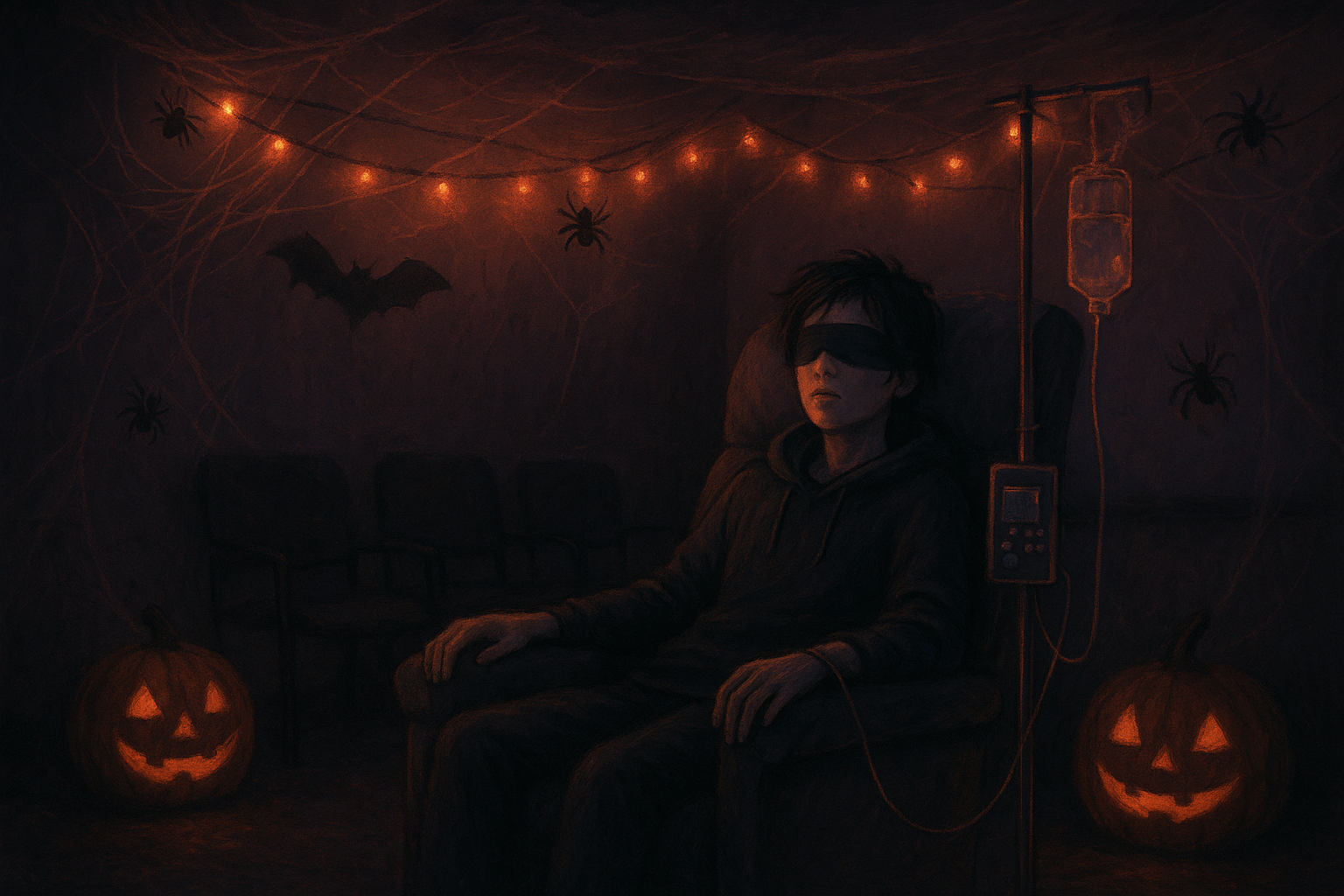
The clinic waiting room was decorated with plastic spiders and orange twinkle lights. Alex almost laughed at the juxtaposition, seeking relief from treatment-resistant depression surrounded by fake cobwebs and grinning jack-o’-lanterns.
They’d tried everything else first. Seven different antidepressants over four years. Therapy: CBT, DBT, EMDR, all the acronyms. Exercise. Meditation. Supplements. Light boxes. That one desperate month where they’d tried to manifest their way out of it, as if depression was just a vision board problem.
Nothing worked. Or rather, things worked a little bit, for a little while, and then the darkness would come creeping back like fog under a door.
Their psychiatrist, Dr. Conway , had suggested ketamine infusion therapy six months ago. “It’s for treatment-resistant depression,” she’d explained. “When the traditional routes haven’t worked. The research is promising. It affects different neurotransmitter systems than SSRIs. Works on glutamate instead of serotonin.”
Alex had been skeptical. Ketamine. Horse tranquilizer. Party drug. But they were also tired of waking up every morning with a weight on their chest that made breathing feel optional.
“Alex?” The nurse wore cat ears with her scrubs, a small name tag reading “Vanessa” pinned beneath them.
They followed her back to the treatment room, where a recliner sat beneath more warm lighting. This would be their third infusion. The first two had been… strange. Helpful, but strange. The darkness had lifted a bit after the first one, not gone, but less suffocating. Like someone had opened a window in a stuffy room. The second had built on that, made them feel like maybe their brain could remember what hope felt like.
“Any plans tonight?” Vanessa asked, checking their vitals, blood pressure, heart rate, making sure Alex was stable enough for the treatment.
“Just this,” Alex said. “My friends are at a party dressed as characters from The Wizard of Oz. I was supposed to be Dorothy.”
They’d bailed last week when everyone was planning it. The thought of being around people, having to perform happiness, had felt impossible. Maya had been understanding, she always was, but Alex knew their friends were worried. They’d been canceling a lot lately. Actually, they’d been canceling for about two years now.
“Well, you’re about to go somewhere over the rainbow anyway.” Vanessa winked as she prepped the shot, swabbing Alex’s arm with alcohol.
Dr. Conway came in to check on them, a tiny plastic bat clipped to her stethoscope. “How have you been feeling since the last session?”
“Better,” Alex said honestly. “Not like… cured or anything. But I made dinner twice this week. Actual cooking, not just cereal.”
Dr. Conway smiled. “That’s significant. The effects can be cumulative. Some patients notice more improvement after the full initial series of six treatments.” She checked Alex’s chart. “Any dissociative symptoms between sessions? Mood changes?”
“Just the normal amount of existential dread,” Alex said. “But like, manageable existential dread.”
“Good. Ready?”
Alex nodded, settling into the recliner. The eyeshades went on. Headphones with ambient something without lyrics, just gentle instrumental waves. Then the bite of the medicine as the needle went in, then the slow spread beginning its work.
At first, nothing. They focused on their breathing like Vanessa had taught them. In for four, hold for four, out for four. Let the medicine do its work. Don’t fight it.
Then…
It started at the edges. A softening. Like someone had taken an eraser to the hard lines that separated Alex from the chair, Alex from the air, Alex from the sound.
The music, what had been simple ambient tones, began to expand. Each note didn’t just sound, it became. A cello drone stretched into a cathedral made of purple velvet. A synthesizer shimmer crystallized into geometric flowers that bloomed and folded and bloomed again in dimensions they could suddenly perceive.
Their body felt strange. Not numb exactly, but… distant? Like they were wearing it loosely, the way you’d wear an oversized coat. They could feel their hands, but they seemed very far away, and also possibly not hands at all but just the concept of hands, the idea of grasping.
Oh, they thought. Oh, this is different from last time.
The darkness behind the eyeshades began to breathe, actually breathe, expanding and contracting with a gentle rhythm that was either their heartbeat or the heartbeat of the universe or possibly there was no difference. The black became deep purple, then indigo, then a darkness so rich it had texture, like crushed velvet you could sink into forever.
This was the glutamate working, Dr. Conway had explained. Forming new neural pathways, creating connections their depressed brain had forgotten how to make. Neuroplasticity in action. But knowing the neuroscience didn’t prepare you for what it actually felt like.
They felt themself lifting, but not up. More like… out? Sideways through reality? Their consciousness peeled away from their body like a Post-it note, still attached but now free to wave around in the breeze of whatever this dimension was.
The plastic skeleton from the waiting room materialized in their mind, but now it was enormous, cosmic, doing a slow-motion jig across a stage made of stars. Its bones clicked with the music, each joint a percussion instrument playing a rhythm that made them want to laugh and cry at the same time.
We’re all just skeletons, the thought arrived fully formed, not in words but in knowing. Every single person walking around is just bones in a people costume. Every day IS Halloween.
The profundity of this hit them like a wave, and then the wave was literal. They were underwater, but the water was warm and safe and made of time instead of liquid. They could breathe it. They could taste it. It tasted like October.
Their sense of self began to dissolve at the edges. This was the dissociation Dr. Conway had warned them about. Not scary, she’d said, just different. Your sense of self might feel fluid. That’s part of how it works, it interrupts the rigid thought patterns depression creates.
Not scary, more like ice cream melting on a summer day, sweet and inevitable. Alex was becoming un-Alex’d. They were just… awareness. Witnessing. A pair of eyes that existed without a face.
Wait, am I dead? A flicker of concern.
No, you’re more alive than you’ve ever been, something answered. Not a voice. Just certainty arriving from nowhere.
They moved through layers of themself or maybe layers moved through them. Each one was a different color, a different density. The orange layer was every anxiety they’d ever had about being judged, but from here it looked so small, so absurdly tiny, like a child’s drawing of a monster that couldn’t possibly hurt anyone.
The black layer was grief, old grief, new grief, grief they didn’t know they were still carrying. Their grandmother’s death three years ago. The relationship that ended when they’d gotten too depressed to be a good partner. The career they’d loved before their brain stopped cooperating. But here, it wasn’t heavy. It was just… information. Data. A color in the painting.
The purple layer was exhaustion, yes, but underneath it was something else. Something that had been there the whole time, waiting. Was it hope? Was it just… energy? The thing that makes cells divide and flowers grow and people get out of bed even when bed is the only place that makes sense?
This is what normal brains feel like, they realized with sudden clarity. This access to… possibility. To wanting things. To believing effort might matter.
Their depressed brain had forgotten this existed. Had told them for so long that the flatness, the gray, the weight was reality. That everyone else was just pretending or lying or somehow superhuman.
Time stopped making sense. They existed for three seconds and three thousand years simultaneously. They were seven years old and seventy and not yet born. They were their mother and their grandmother and some version of themself from a future they couldn’t imagine.
The tunnel of jack-o’-lanterns appeared thousands of them, millions, stretching into infinity. But they weren’t carved pumpkins anymore. They were portals. Windows. Each one showed them a different version of their life.
One pumpkin showed them at seven, in that sparkly purple witch costume, believing in magic because why wouldn’t you believe in magic when the evidence was everywhere? Before the depression came. Before their brain chemistry betrayed them.
Another showed them at fifteen, crying in a bathroom stall, the first time the darkness came and they didn’t have a name for it yet. Just thought they were broken. Wrong. Fundamentally unlovable.
Another showed them at twenty-three, sitting in their first therapist’s office, finally saying the words out loud: “I think I’m depressed. Like, really depressed. Like, I’ve been thinking about dying kind of depressed.”
Another showed them last Tuesday, lying in bed at 2 PM, unable to move, the weight of simply existing pressing them into the mattress like a flower being pressed into a book. Their phone full of unopened texts. Their boss’s concerned email about their “work performance.” Their own voice in their head: Just get up. Just get up. Why can’t you just get up?
And then, a pumpkin they didn’t recognize. Themself, but lighter. Not happy, necessarily, but… present. Actually there. Taking up space without apologizing for it. Making plans and keeping them. Laughing at something genuinely funny instead of performing laughter because that’s what you’re supposed to do.
Is that possible? they asked the pumpkins. Can I actually get there?
You’re looking at it, they all said in unison, except they didn’t say it, they just were it.
Their depression materialized as an actual entity, not the scary monster they’d expected, but something sadder. A creature made of fog and old disappointments, wearing a costume that was trying so hard to be terrifying but was really just exhausted. They could see the zipper now. The seams. The places where it was held together with duct tape and lies they’d told themself.
You’re not a moral failing, they told it. You’re a medical condition. You’re neurons not firing right. You’re serotonin and dopamine and glutamate doing the wrong dance.
“You’re not even real,” they told it, and their voice echoed across dimensions. “I mean, you’re real. But you’re not truth.”
The depression monster looked at them. For a moment, it seemed offended. Then, impossibly, it shrugged. Started doing the “Thriller” dance, jerky and slow, like it was making fun of itself.
Alex laughed, or tried to. Laughing required a body and they weren’t entirely sure where they’d left theirs. The laughter became light instead, golden light that spilled out of their chest-that-wasn’t-a-chest and filled the space-that-wasn’t-a-space.
They were dissolving completely now. Becoming music. Becoming color. Becoming the space between thoughts. Their edges were gone. They were the room and the building and the city and the planet and the darkness between stars.
It should have been terrifying.
It was the most peaceful thing they’d ever experienced.
They existed in this vast, warm darkness The feeling of Halloween night when you’re eight years old and you’ve just finished trick-or-treating and you’re dumping your pillowcase of candy onto the living room floor. That specific feeling of abundance and safety and possibility. The whole night ahead of you. Your parents in the next room. The world small and manageable and full of sweetness.
They’d forgotten that feeling existed. Depression had told them it had never existed, that they’d made it up, that everyone else was just better at pretending.
I want to come back here, they thought.
You never left, the darkness whispered. You just forgot how to look.
Somewhere very far away, in another dimension entirely, a voice asked, “How are we doing in here? Heart rate looks good.”
“The pumpkins,” Alex said, or tried to say, their words moving through molasses-time. “They’re… teaching me about… structural integrity…”
“That’s nice, honey,” Vanessa’s voice, warm and amused and very, very far away.
Time folded. Unfolded. Folded again. They were a piece of origami in the hands of something vast and careful. Each fold revealed a new pattern, a new way of being Alex who had depression but was not made of depression.
The music swelled or maybe they swelled into the music. The distinction didn’t exist anymore. They were the cello. They were the silence between notes. They were the intention behind the composition.
A memory surfaced: their grandmother’s kitchen. The smell of ginger and star anise. Their grandmother telling them, “Life is long, sweetheart. The sad parts don’t last forever. Neither do the happy parts. But you, you last. You keep going.”
They’d been seventeen. Already depressed, though they hadn’t known the word yet. Their grandmother had known something was wrong. Had tried, in her way, to give Alex something to hold onto.
The memory was so vivid, so real, that Alex could feel the warmth of the coffee cup in their hands, could see the way afternoon light came through the kitchen window and made everything golden.
I can keep going, they realized. Not as a thought but as a truth that lived in their cells. I’ve been keeping going this whole time. Even when getting out of bed felt like climbing Everest. Even when brushing my teeth was a victory. I kept going.
The darkness began to lighten. Not harshly, gently, like dawn, like waking up slowly on a weekend. They could feel their body again, distant at first, then closer. Their fingers. Their breath. The weight of their head against the recliner.
The neural pathways were forming. The connections rebuilding. They could almost feel it, their brain remembering there were other ways to be.
They were coming back.
—-
When Vanessa lifted the eyeshades away, the fluorescent lights seemed impossibly bright, each photon a tiny miracle doing its job.
“Welcome back,” Vanessa said, her cat ears slightly askew. “You’ve been smiling for the last fifteen minutes. That’s a good sign.”
“The skeleton,” Alex said slowly, their tongue feeling thick and clumsy, “was teaching me about… the impermanence of… flesh?”
“They do that,” Vanessa said, checking their blood pressure with the casual wisdom of someone who’d heard much stranger things. “How’s your mood? Any nausea?”
“Mood is… good?” Alex said it like a question because it felt strange to say. “Surprisingly good. No nausea.”
Vanessa made notes on their chart. “Dr. Conway will want to check in before you go. The dissociative effects should wear off in the next thirty minutes or so.”
Alex’s body felt like it was made of warm honey. Heavy and light at the same time. Each breath was interesting. Each blink was an event. Their hands looked like hands again, but better somehow. Like they were seeing them for the first time.
The depression was still there, they could feel it in the corner of their awareness, lurking like it always did. But it looked different now. Smaller. More negotiable. Less like a fundamental truth about the universe and more like… weather. Bad weather that would eventually change. A medical condition that could be treated, was being treated, would continue to be treated until they found what worked.
“How do you feel?” Vanessa asked, putting a small bandage over the injection site.
Alex considered the question carefully. Words were coming back slowly, like birds returning after winter.
“Like maybe I can go to next year’s Halloween party,” they finally said.
Vanessa smiled, the kind of smile that said she’d seen this before, seen people come back from the place Alex had just been. “That’s the best costume of all, yourself, but the version that wants to be there.”
—-
Alex sat in the recovery area for the required thirty minutes, drinking water that tasted like the best water that had ever existed. Everything had an edge of significance. The fake bats dangling from the ceiling weren’t just decorations, they were tiny sculptures, each one representing someone’s attempt to make people smile. The orange twinkle lights were small suns, working so hard to be cheerful.
Another patient was in a different recliner, younger than Alex, maybe early twenties, just starting their own infusion. Their parent sat beside them, holding their hand. Alex remembered their first infusion, how scared they’d been. How desperate. How this had felt like a last resort.
Maybe it was. But maybe last resorts were just new beginnings with worse marketing.
Their phone screen was the most phone-like phone screen they’d ever seen. Each app icon was a small miracle of design. They stared at it for a full minute before remembering how to use their thumbs.
They texted their friend Maya: Sorry I missed the party. Was fighting monsters. Won.
The act of typing was fascinating. Their thoughts, translated into finger movements, translated into electrical signals, translated into letters on a screen. Magic. Actual magic.
Maya texted back immediately: YOU WENT TO THE INFUSION ON HALLOWEEN?? How very poetic of you
The skeleton did the Thriller dance
…are you still high
Probably
Love you. Save me some candy corn
Candy corn is disgusting and you know it
SAVE ME SOME
Alex laughed, an actual, real laugh that started in their chest and bubbled up like champagne. The sound surprised them. When was the last time they’d done that? Really laughed? Not performed laughter but felt it?
Dr. Conway came to check on them before discharge. “How are you feeling?”
“Weird,” Alex said honestly. “Good weird. Like my brain remembered something important.”
“That’s a lovely way to put it,” Dr. Conway said, checking their vitals one more time. “The research suggests that ketamine can help create new neural pathways, give your brain a chance to route around the depression. But remember, this is a tool, not a cure. You’ll still need to do the work. Therapy, medication management, sleep hygiene, all of it.”
“I know,” Alex said. And they did. They weren’t magically cured. They’d wake up tomorrow and the depression would still be there, waiting. But maybe they’d have new tools to fight it. New pathways to walk. New evidence that their brain could feel something other than gray.
“Three more sessions in the initial series,” Dr. Conway said. “Then we’ll assess and see if you need maintenance treatments. Some patients do well with monthly boosters. We’ll figure out what works for you.”
Angie at the front desk, a young woman with an orange bow tie for the occasion, checked them out, scheduled their next appointment. “You good to get home safe?”
“My roommate’s picking me up,” Alex said, the words coming easier now, their mouth remembering how to be a mouth.
“Happy Halloween,” he said, handing them a small bag of candy corn from the bowl on the desk.
They stared at it. The universe had a sense of humor.
—-
Outside, the sun was setting in purples and oranges that would have made the infusion proud. The colors seemed somehow more themselves than colors usually were. Purple-er. Orange-er. The sky was really committing to the bit.
Kids were starting to appear on the sidewalk in their costumes. A tiny Spiderman holding his dad’s hand, the dad looking tired but happy. A group of teenagers dressed as characters from some anime they didn’t recognize, all of them laughing at something on someone’s phone. A toddler in a pumpkin outfit who had abandoned all pretense of trick-or-treating and was simply sitting on a lawn, examining a candy wrapper like it contained the secrets of the universe.
Same, kid, Alex thought.
They’d just come back from facing their own ghosts, the ones that lived in their neurotransmitters and wore their thoughts like masks. And for the first time in years, they felt like maybe, possibly, they were braver than them. Or at least, they had weapons now. Treatment. Knowledge. Hope that wasn’t just wishful thinking but was backed by science and careful dosing that took them apart and put them back together slightly different.
Maybe every day didn’t have to be Halloween. Maybe some days could just be… days. Regular days. Days where they got up and brushed their teeth and made coffee and that was enough. That was victory.
Their roommate’s car pulled up. It was Jen dressed as a very tired witch because she’d come straight from work.
“How was space?” Jen asked as Alex climbed in, still moving carefully, still remembering how legs worked.
“Spacious,” Alex said, and then giggled because that was genuinely the best their brain could do right now.
“You’re definitely still high.”
“The pumpkins had opinions about my life choices.”
“Were they good opinions?”
Alex thought about it. The pumpkins had shown them versions of themself: past, present, possible future. Had shown them that depression was real but not destiny. That treatment-resistant just meant you had to try different treatments, not that you were untreatable.
“Yeah,” they said. “Actually, yeah. They were.”
As they drove home through streets full of tiny ghosts and miniature superheroes, Alex looked out the window at the ordinary magic of Halloween, kids being brave enough to knock on strangers’ doors, parents patient enough to walk slow, teenagers cool enough to still want candy.
A kid walked by dressed as Dorothy, complete with ruby slippers and a small stuffed Toto, clicking her heels together.
Alex grinned. Close enough. They’d found their way home too. Or at least, they were finding it. One infusion at a time. One day at a time. One moment of actually feeling something other than gray.
“Hey Jen?” they said as they turned onto their street.
“Yeah?”
“I think I might come to the next party. If you guys do Friendsgiving or whatever.”
Jen glanced at them, smiling. “Yeah?”
“Yeah. I mean, maybe. Probably. We’ll see how I feel. But… maybe.”
“Maybe is good,” Jen said. “Maybe is great, actually.”
And it was. Maybe was a door that wasn’t locked. Maybe was a possibility they’d forgotten existed. Maybe was enough for right now.
The candy corn from Angie sat in their lap, terrible and orange and somehow perfect.
Alex smiled and watched the Halloween lights blur past, their brain quietly, carefully, building new roads.
