8 of 13 Before Halloween

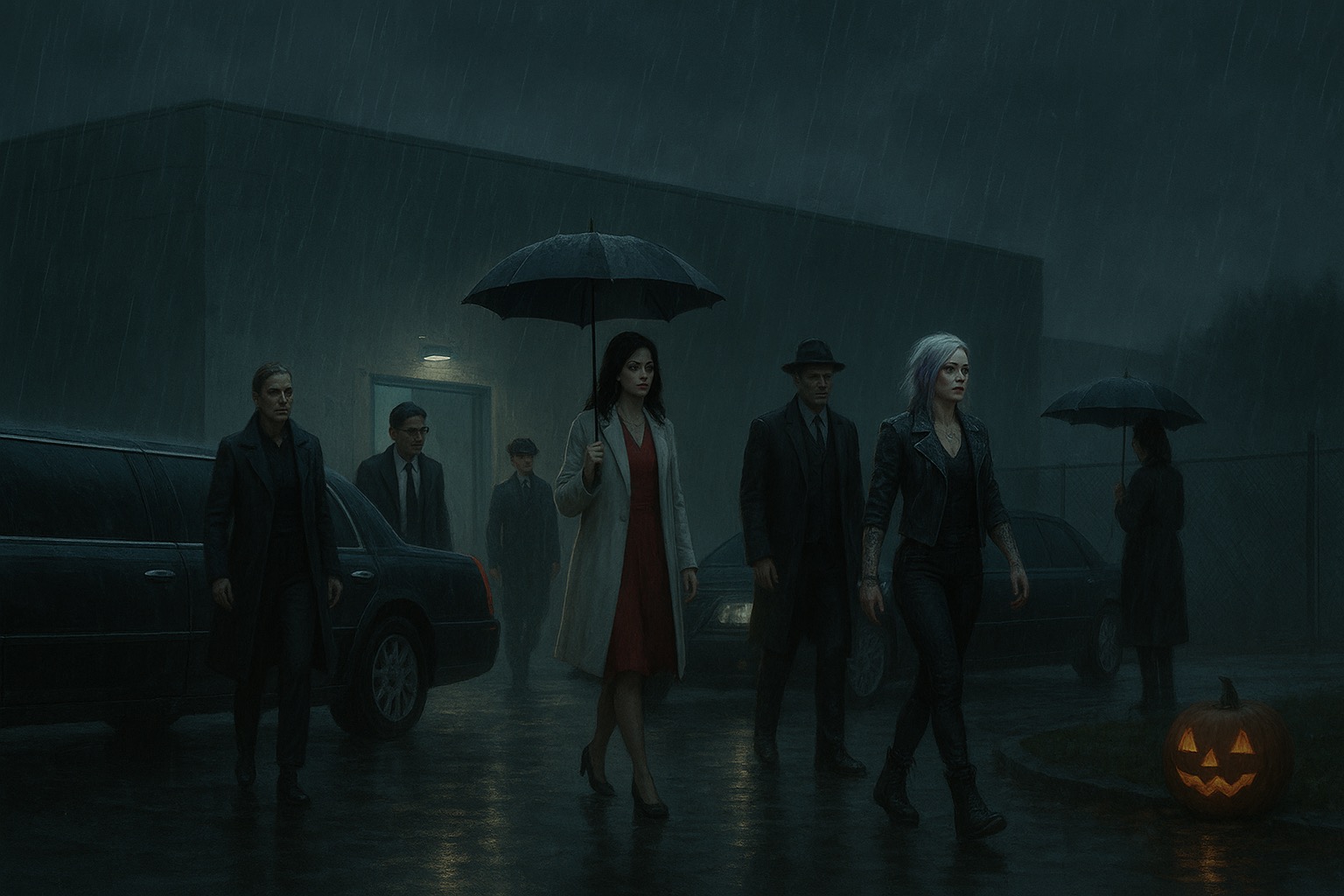
The rain came down in sheets as six figures emerged from their limousines outside the unmarked facility. Halloween night, and here they were, summoned by the mysterious Dr. Seraphina Oleander to tour what she’d promised would be “the future of regenerative medicine.”
Colonel Margaret Ashford arrived first, her military bearing unmistakable despite her civilian clothes. She immediately recognized the second arrival, tech mogul David Matsumoto, whose sneakers squelched in the puddles as he approached.
“Colonel Ashford,” he said with a slight bow. “I didn’t expect to see military investment in biotech ventures.”
“Retired military,” she corrected. “And I could say the same about Silicon Valley billionaires. Aren’t you usually disrupting the taxi industry or something?”
Before David could respond, a third figure emerged from a pearl-white limousine, unfurling a designer umbrella with a flourish. Antoine Dubois, the flamboyant theater producer, looked like he’d stepped off a Broadway stage even in the pouring rain.
“Margaret Ashford! Ma chérie!” He air-kissed both her cheeks before she could protest. “I haven’t seen you since that dreadful charity gala in Monaco. The one where the ambassador got drunk and, “
“Let’s not revisit that evening,” Margaret said quickly.
“And you must be David Matsumoto,” Antoine continued, turning his attention to the tech mogul. “I’ve been trying to get funding for my holographic theater project. Perhaps after this we could, “
“I don’t fund vanity projects,” David said flatly.
“Vanity? Art is never, “
“Gentlemen, lady,” a stern voice interrupted. Senator Patricia Reeves had arrived, her expression as warm as the October rain. “Perhaps we could continue this networking inside?”
“Oh God, not Pat Reeves,” Antoine muttered, but not quite quietly enough.
The Senator’s eyes narrowed. “Mr. Dubois. I see your tax evasion hearing didn’t humble you.”
“It was tax _optimization_, darling, and I was acquitted.”
A roar of a motorcycle engine cut through the tension. Zara Volt dismounted her custom bike, pulling off her helmet to reveal platinum hair with purple streaks. Tattoos covered her arms, and her leather jacket was studded with spikes.
“Holy shit,” David breathed. “You’re actually Zara Volt. I thought you’d retired after the Tokyo incident.”
Zara grinned wickedly. “Can’t keep a bad girl down, Matsumoto. Nice to see someone who made their billions without selling out to the man.”
“Says the woman who licensed her music to a car commercial,” Senator Reeves noted icily.
“For an _electric_ car, Senator. We can’t all make our money from oil company donations.”
“I resent that, “
“Ladies, gentlemen, please.” The final member of their party approached with measured steps. Dr. Imran Kapoor, his white hair gleaming in the security lights, looked at each of them with eyes that had seen decades of human nature at its worst. “We’re all here for the same reason. Let’s try to maintain some civility.”
“Dr. Kapoor,” Margaret said with genuine respect. “I didn’t know you were involved in this venture.”
“I’m not certain I am,” he replied carefully. “I’m here to assess whether this is medicine or madness.”
Antoine clapped his hands together. “Well! What a delightful group. It’s like an Agatha Christie novel. All we need is a mysterious death and, “
The door swung open, cutting him off.
Geoffrey stood in the doorway, his razor-sharp smile and impeccable British accent immediately putting everyone on edge. He wore a three-piece suit that cost more than most cars and moved with the fluid grace of a ballet dancer, or a panther.
“Welcome, welcome! Do come in from this dreadful weather,” Geoffrey purred, his eyes twinkling with something that might have been mischief or might have been malice. “Dr. Oleander is so looking forward to showing you her… achievements. Though I must say, Mr. Dubois, tempting fate with murder mystery references? On Halloween? How deliciously theatrical.”
As they filed inside, Geoffrey continued his patter. “Colonel Ashford, we’ve prepared a wheelchair-accessible route, despite your obvious athleticism. Senator Reeves, please note that no recording devices are permitted, I trust this won’t interfere with your famous tendency to document everything? Mr. Matsumoto, the facility’s network is entirely closed-circuit, so I’m afraid you’ll have to survive without checking your portfolio. Dr. Kapoor, I’ve been told you once wrote a scathing paper on the ethics of accelerated tissue generation. This should be quite the evening for you.”
“You’ve done your homework,” Dr. Kapoor observed.
“Oh, I always do my homework. Ms. Volt, there’s a smoking area in the back, though I suspect what you smoke isn’t quite tobacco. And Mr. Dubois, I’m afraid the lighting in here is rather more clinical than theatrical. You’ll simply have to endure.”
The facility’s lobby was sterile white, but as Geoffrey led them deeper inside, the decor became increasingly bizarre. Paintings of anatomical diagrams lined the walls, but with an artistic flair that made them unsettling rather than clinical.
“I recognize these,” Antoine said, pausing before one. “These are Vesalius reproductions. 16th century anatomical studies. Quite valuable.”
“A man of culture,” Geoffrey approved. “Though I prefer to think of them as… inspirational, rather than historical.”
They entered a lounge area where champagne and hors d’oeuvres had been arranged. Geoffrey insisted they relax for a moment, get comfortable. The conversation flowed more easily now, lubricated by expensive alcohol.
“So how do we all know Dr. Oleander?” Zara asked, sprawling in a leather chair.
“I don’t, actually,” Margaret admitted. “I received a prospectus six months ago. The technology seemed promising.”
“Same,” David said. “Though I usually avoid biotech. Too much regulatory risk.”
“She approached me after my wife’s accident,” Senator Reeves said quietly. “Promised technologies that could have saved her arm. I wanted to ensure others wouldn’t face the same limited options we did.”
The room fell silent for a moment.
“I knew her in medical school,” Dr. Kapoor said finally. “Brilliant, but… obsessive. When she contacted me about this venture, I almost declined. But if she’s truly achieved what she claims, it would be revolutionary.”
“Revolutionary,” Geoffrey murmured. “Yes, that’s certainly one word for it.”
“And you, Geoffrey?” Antoine asked. “What’s your role in all this?”
“Oh, I’m just the help, Mr. Dubois. I make sure everything runs smoothly. I ensure our guests are comfortable. I keep secrets.” His smile never wavered, but something cold flickered in his eyes. “So many secrets.”
“I must say,” Antoine whispered loudly, “this is the strangest Halloween party I’ve ever attended.”
“This isn’t a party, Mr. Dubois,” came a voice like honey and smoke.
Dr. Seraphina Oleander descended the glass staircase like a vision. Impossibly tall, with raven-black hair and cheekbones that could cut glass, she wore a white coat over a crimson dress. Her beauty was the kind that made people forget to breathe, dangerous, hypnotic, utterly commanding.
“This,” she continued, her red lips curving into a smile, “is the future.”
She moved through the room, making eye contact with each investor, her presence magnetic. “I’m so pleased you could all join me. I know you each have your doubts, your questions, your ethical concerns.” Her eyes lingered on Dr. Kapoor. “But I promise you, by the end of this evening, you will understand that what we’ve accomplished here transcends conventional morality.”
“That’s an interesting choice of words,” Dr. Kapoor said carefully.
“Come,” Seraphina said, gesturing toward a set of double doors. “Let me show you what your investments have created.”
The laboratory beyond was like something from a fever dream. Rows upon rows of transparent containers lined the walls, each filled with fluid that ranged from pale amber to deep crimson. Inside each container, perfectly preserved, were human limbs and organs at various stages of what appeared to be development.
The containers themselves were works of art, cylindrical chambers made of impossibly clear crystal or glass, each mounted on a chrome base embedded with blinking lights and digital displays. The fluids inside weren’t simply liquid; they moved with purpose, swirling with currents generated by invisible mechanisms. Some containers held a pale, opalescent fluid that caught the light like pearl essence. Others contained darker, more viscous substances that seemed to pulse with their own rhythm.
Arms floated in vertical chambers, fingers slightly curled as if frozen mid-gesture. Legs hung suspended in larger vessels, the fluid around them shimmering with what looked like microscopic particles of gold. Hands were displayed in smaller, almost jewelry-box-like containers, the preservation fluid a clear rose color that gave the skin an unsettling, lifelike flush.
Each container had tubing that connected to the base, creating a circulation system. Tiny bubbles rose through the fluids in some chambers, while others remained perfectly still. The lighting in the room was carefully designed, cool white light from above, but each container also had its own internal illumination that made the specimens seem to glow from within.
Digital readouts on each base displayed incomprehensible data: temperature, pH levels, nutrient composition, cellular activity markers. Some screens showed rotating 3D models of the specimens inside, mapping blood vessels and nerve pathways in impossible detail.
“My God,” Margaret breathed.
David moved closer to one container holding an arm suspended in amber fluid. “The preservation medium, what is it?”
“Proprietary,” Seraphina said smoothly. “A combination of nutrient-rich plasma, oxygenated proteins, and cellular regeneration factors. Each specimen remains viable indefinitely, continuing to develop and strengthen even in suspension.”
Senator Reeves stood before a container holding a leg, watching the fluid slowly circulate. “This is incredible. But how did you achieve this level of development so quickly? Your proposal was only approved eight months ago.”
“Accelerated growth protocols,” Seraphina explained, moving to stand beside her. “We’ve cracked the code on cellular division rates. What would normally take years now takes weeks.”
Antoine had wandered to a smaller display of hands. He leaned close to one container, its fluid a pale lavender color. “Wait,” he said, squinting. “Is that…?”
The hand inside had a small tattoo on the wrist, a delicate rose with thorns winding around the stem.
“Ah yes,” Seraphina said, gliding over. Her heels clicked on the polished floor. “One of our most exciting innovations. Pre-customization. We can add tattoos, adjust pigmentation, even modify fingerprints before attachment. Imagine, a client can receive not just a replacement limb, but one decorated exactly to their specifications. No need to visit a tattoo artist afterward. It’s already perfect.”
“That’s…” Dr. Kapoor moved closer, his expression troubled. “That’s a very specific tattoo. The detail, the aging of the ink. That’s not something you could create artificially. That’s real. That’s from a real person.”
“Well, obviously we practice on real tissue to perfect the technique,” Seraphina said, but something sharp had entered her voice. “Dr. Kapoor, surely you’re not suggesting, “
“I’m suggesting that tattoo looks lived-in,” he interrupted. “It looks like someone wore it for years.”
Geoffrey, who had been silent until now, spoke up. “Would anyone care for more champagne? No? Pity. I could use a drink.”
Zara had moved to a different section, where a series of smaller containers held various organs. The fluid here was darker, almost black, with tiny lights that looked like stars suspended in the depths. “This is heavy shit,” she muttered. “Like, seriously heavy.”
David was examining the technology. “The computing power required for this level of monitoring… you’d need quantum processing, custom AI algorithms. Where did you source the technology?”
“We developed it in-house,” Seraphina said. “Everything you see here is proprietary.”
“Everything?” Dr. Kapoor’s voice was quiet but carried weight. “Including the specimens themselves?”
The room temperature seemed to drop.
Geoffrey cleared his throat. “Perhaps we should move on to the surgical suites? I’m told they’re quite impressive.”
“Answer the question, Seraphina,” Dr. Kapoor said, not taking his eyes off the container with the tattooed hand. “Where did these come from?”
And in that moment, as Dr. Seraphina Oleander’s beautiful face began to shift into something harder, something colder, they all realized that they’d walked into something far worse than a business venture gone wrong.
They’d walked into a nightmare.
“Oh, Imran,” Seraphina said, her voice losing all pretense of warmth. “You always were too clever for your own good.”
She pressed a button on a remote, and screens flickered to life throughout the room. Security footage. Alleyways. Homeless encampments. Vulnerable people being lured, taken, dragged into unmarked vans. Operating tables. Saws. Screaming that was quickly silenced.
Senator Reeves gasped, her hand flying to her mouth. “Dear God.”
“Not God,” Seraphina said, her voice now stripped of all pretense. “Just good old-fashioned supply and demand. You people wanted revolutionary treatment options without the pesky wait time or ethical complications of real research and development. You wanted miracles, and you wanted them now. I provided. No one misses them, the homeless, the addicts, the undocumented, the ones society already threw away.”
“You’re insane,” Colonel Ashford said, her hand instinctively reaching for a weapon that wasn’t there.
“I’m a businesswoman,” Seraphina corrected, circling the group like a predator. “And let’s be honest, you’re all complicit now. You’ve toured the facility, seen the results, asked your questions, and your money has been in my accounts for months funding this operation. Each of you transferred millions. You’re accessories.”
“We thought we were funding research!” David Matsumoto shouted, his face pale.
“Did you, though?” Seraphina’s laugh was like breaking glass. “Did you really never wonder how we achieved such rapid results? Did you never question why I chose Halloween for this reveal? Because I wanted you to understand, this is horror. Beautiful, profitable horror. And you’re all monsters right alongside me.”
“Speak for yourself,” Zara said, but her voice shook.
Geoffrey had moved to the door, and now they saw he was holding a weapon, a small pistol that trembled in his grip. “She’s right about one thing,” he said quietly, and there were tears streaming down his face. “We’re all monsters here. Except I’ve decided I’m done being one.”
“Geoffrey,” Seraphina’s voice turned sharp. “What are you doing?”
“I called the police before anyone arrived,” he said. “Twenty minutes ago. They should be here any moment. I couldn’t let this continue. I tried to tell myself I was just the tour guide, just the front man, but every time I walked past these chambers, I saw their faces. The ones we took. I couldn’t sleep. I couldn’t breathe. I couldn’t keep pretending.”
“You fool!” Seraphina lunged toward him, but Antoine and Margaret grabbed her arms.
“Let me go!” She thrashed with surprising strength. “Do you know what you’ve done, Geoffrey? What you’ve destroyed? This was going to change medicine! This was going to save lives!”
“By taking others!” Dr. Kapoor’s voice cracked. “Seraphina, what happened to you? You were going to help people. You were brilliant. You could have done this the right way.”
“The right way takes too long,” she snarled. “The right way lets people die while waiting for bureaucracy and ethics committees and clinical trials. I found a better way. A faster way.”
“A monstrous way,” Senator Reeves said.
Sirens began to wail in the distance.
Seraphina’s eyes went wild. She twisted free from Margaret and Antoine with a sudden, vicious movement, and ran, not toward the exits, but deeper into the facility, back through a set of doors none of them had seen opened.
“Don’t let her, “ Geoffrey started, but they were already running after her.
The door led to the main processing laboratory, a massive space dominated by enormous tanks and industrial equipment. This was where the real work happened, where bodies were rendered down to usable parts. The largest tank in the center was three stories tall, filled with a bubbling, viscous fluid that gave off faint wisps of vapor. Warning signs covered every surface: CORROSIVE. EXTREME HAZARD. AUTHORIZED PERSONNEL ONLY.
Seraphina stood on a catwalk above the tank, her hair wild, her crimson dress billowing. She looked like a beautiful demon backlit by the tank’s eerie glow.
“If I can’t have my empire,” she shrieked, her voice echoing through the chamber, “no one will have anything!”
She began smashing controls on a nearby panel with something she’d grabbed, a heavy wrench. Sparks flew. Alarms began blaring, a deafening wail that mixed with the growing sound of police sirens outside.
“Get back!” Dr. Kapoor yelled, pulling the group toward the door. “Those tanks, if they rupture… “
The tank began to shudder. Pressure gauges spun wildly. The fluid inside was highly acidic, designed to break down organic tissue rapidly for processing and preservation. Cracks began to spider-web across the reinforced glass.
“Seraphina, stop!” Geoffrey screamed. “You’ll kill yourself!”
“Better that than prison!” She raised the wrench to strike the control panel again, but the force of the first blows had already done its damage.
The tank exploded.
It didn’t burst all at once, first a crack, then a spray of acid that hit the catwalk. Seraphina tried to run, but the metal beneath her feet was already dissolving, groaning, giving way. She screamed as she fell, her arms pinwheeling, her beautiful face frozen in terror.
The acid caught her before she hit the ground level. Her screams were brief, mercifully, impossibly brief, before the corrosive fluid consumed her. Within seconds, there was nothing left but the crimson fabric of her dress floating on the surface of the spreading pool, dissolving into pink wisps.
The group stood frozen, horror-struck, as Geoffrey collapsed to his knees, sobbing.
The police found them like that minutes later: six traumatized investors, one guilt-ridden accomplice, and a facility full of evidence that would expose the darkest corners of medical black markets. Geoffrey’s testimony, combined with the facility’s meticulous documentation, Seraphina had kept records of everything, would eventually bring down an international network of organ trafficking and worse.
They discovered forty-three victims. Forty-three people who had been reduced to parts, catalogued, preserved, prepared for sale. Each name was eventually returned to families who’d been searching, or to graves marked “Unknown” that could finally be given proper headstones.
The investors were investigated but ultimately cleared, their money was seized, returned to the victims’ families when possible, used for restitution when not. None of them would ever recover from what they’d seen. Senator Reeves retired from public life. David Matsumoto sold his company and now funds homeless shelters. Margaret Ashford started a foundation for missing persons. Antoine’s next production was a dark, experimental piece about complicity that critics called “unsettlingly personal.” Zara wrote an album that she never released, too raw, too real. Dr. Kapoor spent his remaining years advocating for stringent oversight in biotech research.
Geoffrey served two years for his role, then disappeared from public view entirely. Some say he entered a monastery. Others claim they’ve seen him working at homeless shelters, trying to make amends for the faces that still haunt his dreams.
The facility was demolished within the year. A memorial garden was built on the site, with a plaque reading: “For Those Who Were Forgotten, We Remember Now.”
And on every anniversary, six diverse investors would meet there, joined sometimes by a former tour guide with a British accent and eyes that had learned to carry their ghosts, to ensure that what had happened in that facility on Halloween night would never, ever be forgotten again.
Some horrors, they learned, don’t end when the monster dies.
They linger.
They teach.
And if we’re lucky, they change us into something better than what we were.
